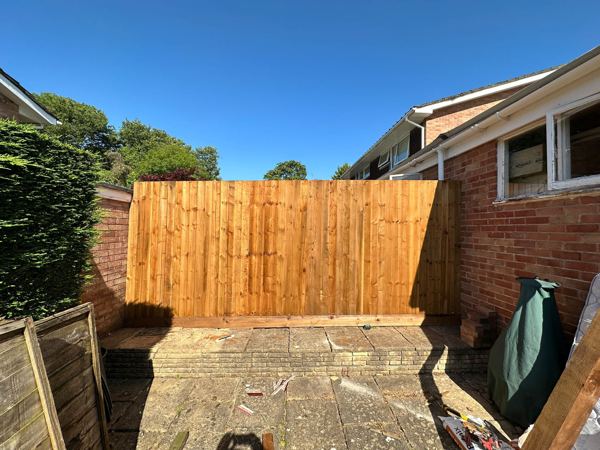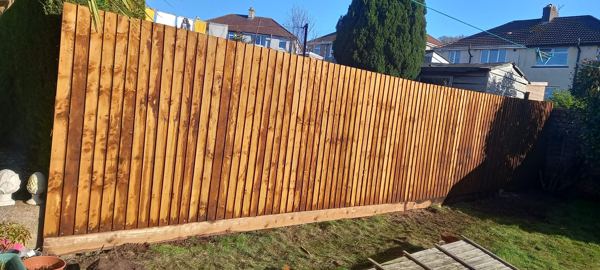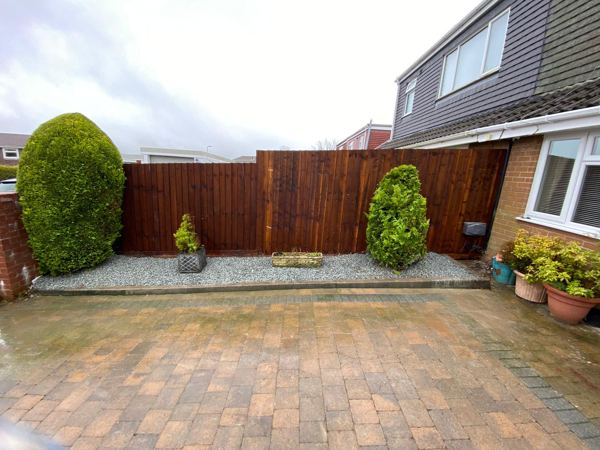
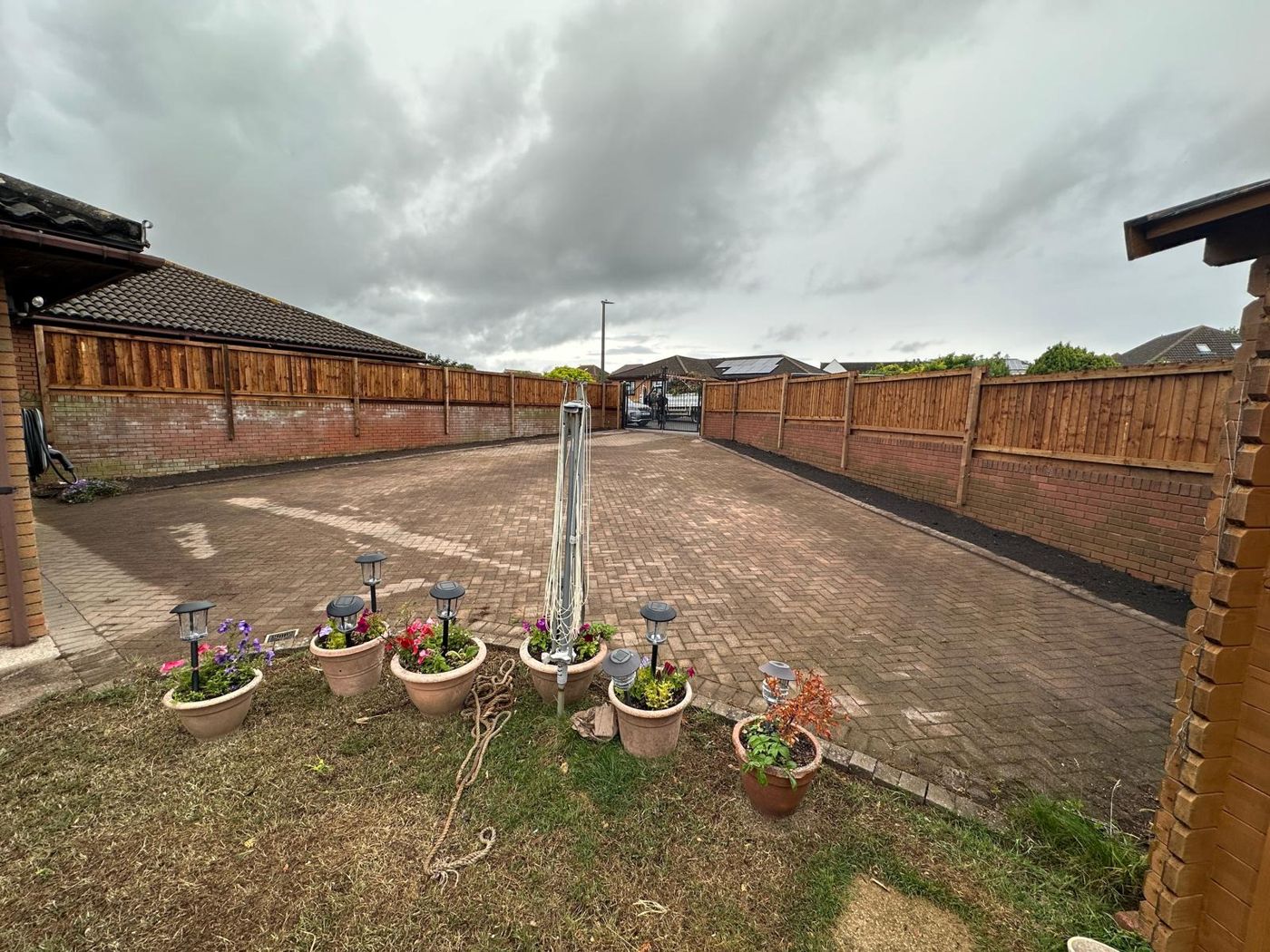
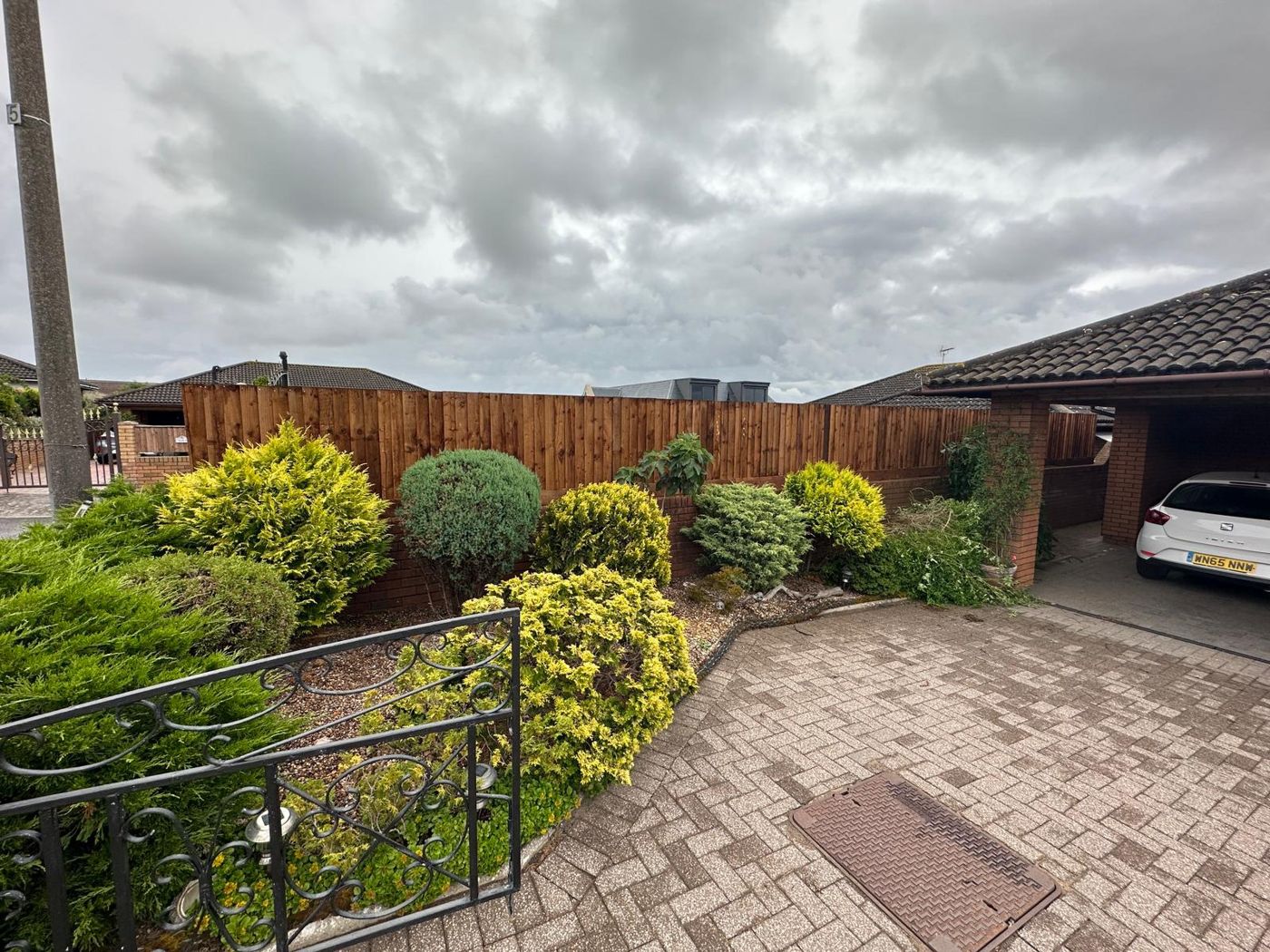
This Pontypool property already had its boundary marked by low red-brick walls around a large herringbone block-paved yard. What it lacked was height. The photos show the answer: close-board fence panels raised above the brickwork on timber posts, running the full length of both sides of the yard and along the back of a front shrub border.
It is a neat way to add privacy without losing a sound wall, and the brick and timber sit well together beside the bungalow. For other fence styles, gates and repairs, see our fencing services page, or read about landscaping in Pontypool.
Wall below, timber above
In the widest photo you can follow the fence all the way round the yard. Each bay is a close-board panel of vertical boards, held between square timber posts and topped with a capping rail that sheds rain off the end grain. Below the panels the original brick wall carries on unchanged, so the boundary reads as one piece.
Along the right-hand side the base of the wall has a fresh dark strip where it meets the paving, and the line of posts is straight and evenly spaced from the house end to the far corner. On the front of the property, a second run of the same panels stands behind a bed of rounded evergreen shrubs and gravel, next to the carport.
- Close-board panels with vertical boards and a timber capping rail
- Square timber posts, evenly spaced along each wall
- Existing low brick walls kept as the base of the boundary
- Runs on both sides of a herringbone block-paved yard and behind a front shrub bed
Things to weigh up before topping a wall with fencing
Raising a fence above an existing wall is only worth doing if the wall is sound. A leaning or cracked wall needs attention first, and our brickwork team can rebuild or repoint it before any timber goes up. The posts also need a proper footing of their own rather than relying on the brickwork to hold them against the wind.
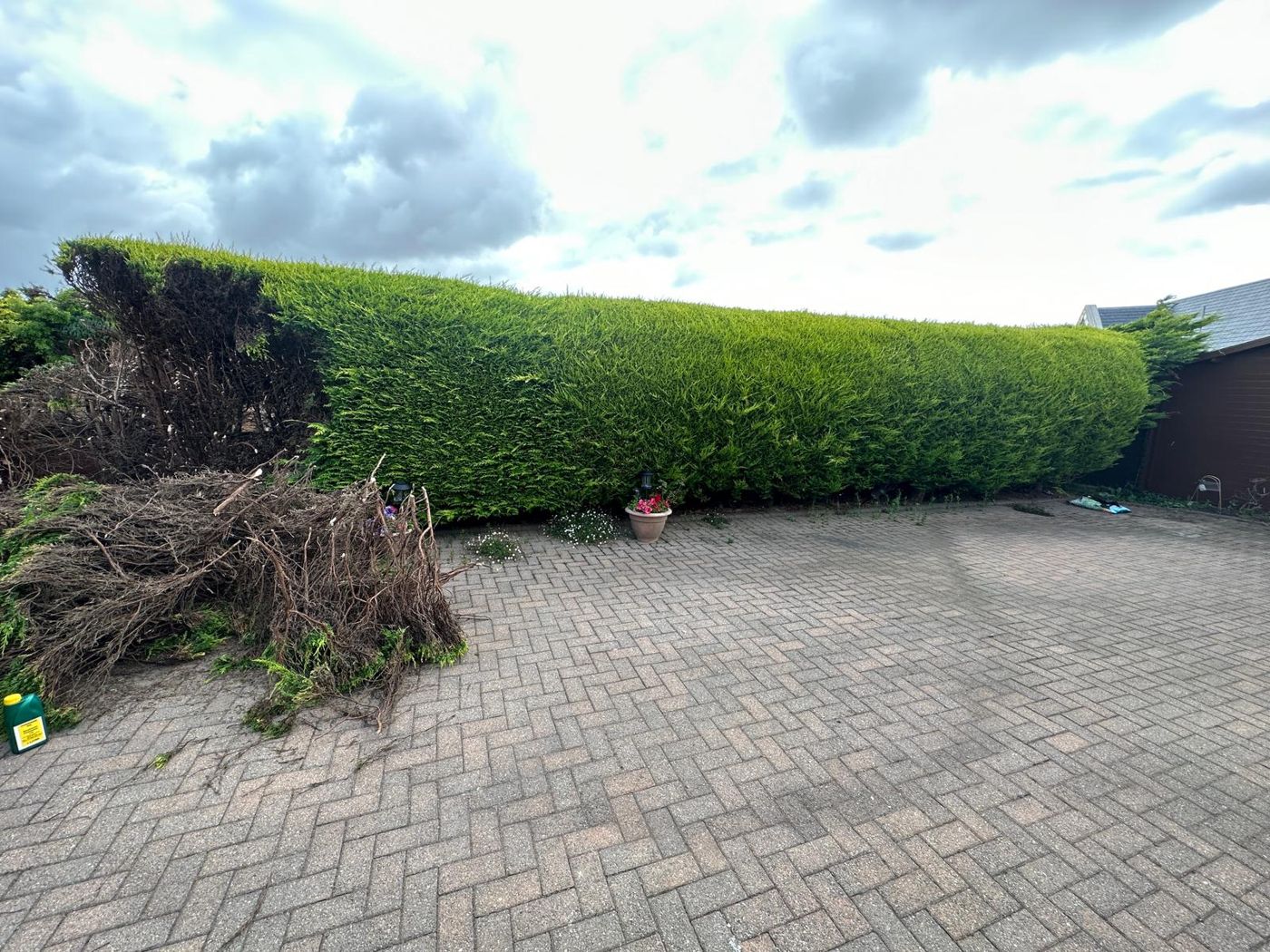
Height matters too. Adding panels to a wall increases the overall height of the boundary, and there are general limits on how high a garden boundary can go without permission, especially next to a road. Check with your local council if you are unsure. The third photo shows a tall conifer hedge along another edge of the paved area, with cut branches piled at one end; hedges like that need regular trimming, which a fence does not. For the pros and cons of each panel style, read close board, panel or slatted fencing, and get in touch for a free quote.
Questions About This Job
Can you put a fence on top of an existing garden wall?
Often, yes, as long as the wall is solid and straight. The posts are usually set in their own footings so the wall is not asked to carry the fence. We check the wall first and tell you if it needs work.
Do fence panels need a capping rail?
It is not essential, but a capping rail along the top protects the end grain of the boards from rain and gives a tidier finish. Most close-board panels are sold with one.
How high can a garden fence be?
There are general height limits for boundaries, lower next to a road or footpath. Rules vary, so check with your local council before going higher than usual, especially when the fence sits on a wall.
Would a fence need less upkeep than a conifer hedge?
Generally, yes. A fence needs an occasional treatment, while a fast conifer hedge needs trimming at least once or twice a year. Our tree surgery and hedge care page covers hedge work.