Garden Decking in South Wales - T J Landscapes

Garden Decking in South Wales

A good deck turns an awkward bit of garden into somewhere you actually want to sit. It can bridge a slope, cover a tired patch of concrete, or give you a level spot for a table right outside the back door without weeks of digging and retaining walls.

T J Landscapes builds timber and composite decks for homes across South Wales, working from our base in Pontypool. Tony and the team plan the frame around your ground, your drainage and the weather your garden gets, because in this part of the world a deck has to cope with a lot of rain. Every quote is free, and so is the advice that comes with it.

★ 4.8/5 Google · 69 reviews 10/10 on Checkatrade Free quotes & advice
Google★★★★★4.8/5 · 69 reviews Checkatrade10/105 reviews Our Website★★★★★70 reviews
What we do

The Decks We Build

Most decking jobs fall into one of these. Many gardens mix two, such as a raised deck with steps down to a lower lawn.

Garden Decking

Ground-level decking

A low deck sitting just above the ground on a timber frame, ideal for a flat or gently sloping garden. We clear and level the area, lay a weed membrane and make sure water can drain away underneath. It is the simplest way to create a clean, even seating area.

Composite deck lit at night outside bi-fold doorsRaised timber deck with balustrade and steps
Ask about ground-level decking →
Garden Decking

Raised decking

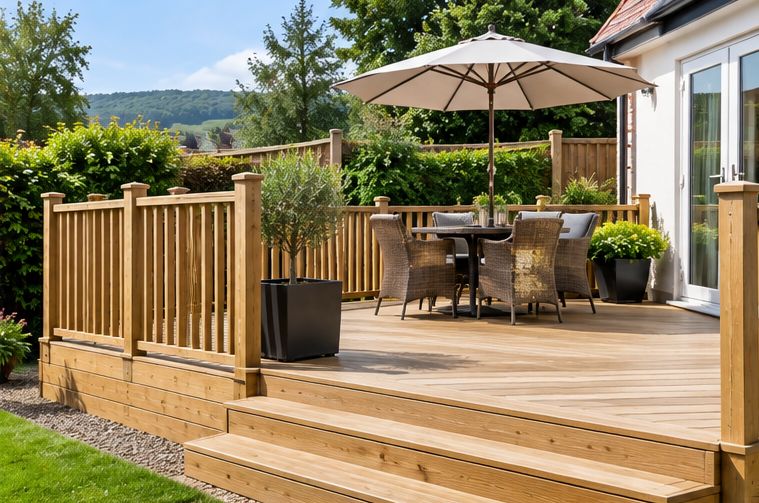
Built on taller posts to create a level platform where the ground drops away, often straight off a back door or patio doors. The frame, bracing and footings do the real work here, and higher decks need balustrades and steps. Our guide to raised decking frames, steps and balustrades explains what goes into one.

Raised timber deck with balustrade and stepsClose-up of new timber deck boards
Ask about raised decking →
Garden Decking

Composite decking

Boards made from a mix of wood fibre and plastic, which do not need staining and resist rot. They cost more to buy than softwood but ask for little more than a wash. We fit them on a frame built to the board maker’s spacing and fixing instructions.

Close-up of new timber deck boardsWide deck with outdoor seating and lawn beyond
Ask about composite decking →
Garden Decking

Timber decking

Pressure-treated softwood remains a popular choice, with a natural look and a lower starting cost. Grooved or smooth boards are available, and hardwood is an option for those who want a denser board. Treated timber needs regular cleaning and a fresh coat of oil or stain to stay at its best.

Wide deck with outdoor seating and lawn beyondComposite deck lit at night outside bi-fold doors
Ask about timber decking →
Garden Decking

Steps, balustrades and edging

Steps to a lawn, handrails and balustrades for raised sections, fascia boards to hide the frame, and built-in planters or benches. These are the details that make a deck look finished rather than just placed on the garden.

Composite deck lit at night outside bi-fold doorsRaised timber deck with balustrade and steps
Ask about steps, balustrades and edging →
Garden Decking

Deck repairs and refurbishment

Tired decks can sometimes be saved. We check the joists and posts first: if the frame is sound, replacing worn or split boards and adding new fascias can give it years more use. If the frame has rotted, rebuilding is usually the better choice.

Raised timber deck with balustrade and stepsClose-up of new timber deck boards
Ask about deck repairs and refurbishment →
Timber or composite

Choosing Your Decking Boards

Close-up of new timber deck boards

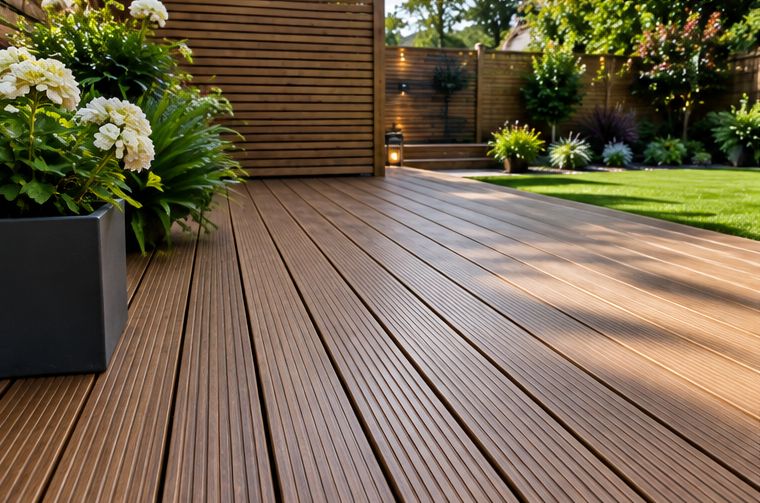
The board you walk on is the part everyone notices, so it is usually the first decision. Both main materials work well in South Wales when they are fitted properly, but they suit different people.

  • Treated softwood is warm underfoot, easy to cut to shape and cheaper to start with. It needs an annual clean and a coat of oil or stain every year or two, especially on a deck that gets little sun.
  • Hardwood is heavier and denser, so it tends to wear more slowly. It still weathers to a silver grey unless you oil it.
  • Composite keeps its colour well and will not splinter or rot. It can get warm in full summer sun, and cheaper boards vary a lot in quality, so we steer you towards ones with a proven track record.

If you are torn between the two, our article on composite or timber decking for a South Wales garden sets the pros and cons side by side, and how long garden decking should last looks at the lifespan you can expect from each.

Under the boards

What Happens Beneath a Deck We Build

Raised timber deck with balustrade and steps

Most decks that fail early do so because of what is underneath. Posts sunk straight into wet clay, joists spaced too widely, or no gap for air to move under the boards will shorten the life of any deck, however good the surface looks on day one.

On our builds the ground is cleared and levelled, weeds are suppressed with a membrane, and the frame is set on proper footings. Joists are spaced to suit the boards, and cut ends of treated timber are sealed. We leave a small gap between boards so rain runs straight through, and keep the frame clear of the soil so it can dry out between showers.

Where a deck meets the house we keep it below the damp-proof course and leave a gap at the wall, so water never gets trapped against the brickwork. On a wet site we look at drainage as part of the wider landscaping, because a deck is only as dry as the ground under it.

Slopes and old patios

Decks for Sloping and Awkward Gardens

Composite deck lit at night outside bi-fold doors

A lot of gardens in the valleys rise or fall steeply from the back of the house. Building level ground with walls and fill is often a big job, while a deck can create a flat area on posts with far less digging and far less waste to take away. It is one of the reasons decking is so common on hillside plots around Pontypool, Abertillery and Tonypandy.

Decks also work over hard surfaces. A cracked concrete yard or an old patio that has sunk in places can often be covered rather than broken out, as long as water can still drain away beneath. Our guide on building decking over an old patio or concrete covers when this works and when it does not.

Where a slope is too steep for one level, we can split the deck into two tiers joined by steps, or combine a deck with retaining walls and brick steps lower down the garden.

Why choose us

Why People Choose T J Landscapes for Decking

We are a landscaping business rather than just a decking fitter, which changes how a deck gets planned.

Built for the weather

Frames, fixings and board spacing chosen for damp winters and heavy rain, with air flow and drainage planned in from the start.

Part of the whole garden

We can handle the paving, fencing, turf and walls around the deck too, so everything fits together and one team is responsible for it.

Honest advice on materials

We will tell you whether timber or composite suits your garden and budget, and whether an old deck is worth repairing.

Highly rated locally

Customers rate us 4.8 out of 5 on Google and 10 out of 10 on Checkatrade. You can read their comments on our reviews page.

Safety and grip

Keeping a Deck Safe Underfoot

Wide deck with outdoor seating and lawn beyond

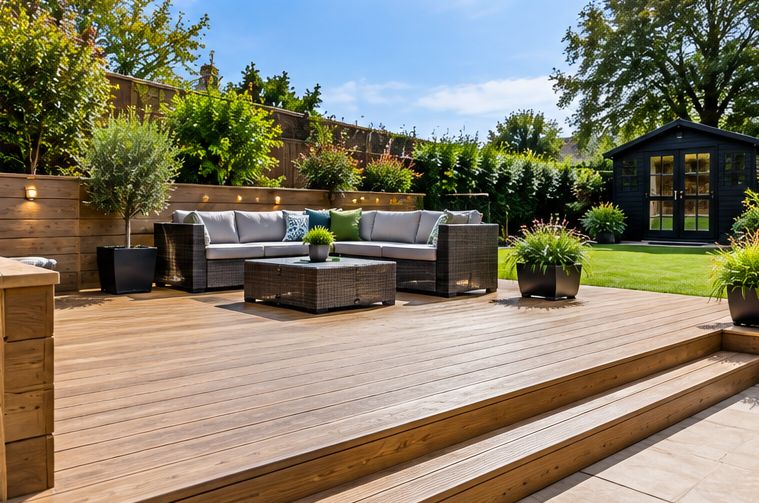
Wet weather and shade are the two things that make decking slippery. Algae builds up on boards that stay damp, and a north-facing deck under trees can turn slick within a season if it is left alone.

We reduce the risk at the design stage by choosing grooved or textured boards where they suit, keeping the deck out of permanent shade where the layout allows, and making sure water can drain off quickly. Anti-slip inserts can be added to steps. After that, regular brushing and a wash with a suitable deck cleaner make a real difference, and our article on how to stop decking going slippery gives you a simple routine to follow.

Raised decks need a sturdy balustrade and steps with an even rise. Raised decks and platforms above a certain height, or close to a boundary, can need planning permission, so we suggest checking with your local council before work starts on anything tall.

Finishing touches

Lighting, Planters and Linking the Deck to the Garden

Close-up of new timber deck boards

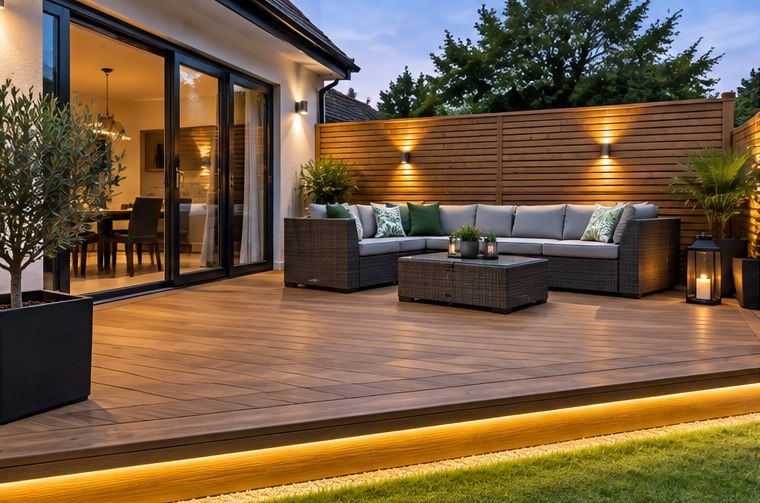
A deck feels far more inviting once it has a few extras. Low-voltage lights set into the boards or the step risers let you use it on summer evenings and show the edges clearly in the dark. Built-in planters soften the timber and screen the view, and a bench along one side saves on garden furniture.

  • Deck and step lights for safety and atmosphere.
  • Timber or composite planters built to match the boards.
  • Screening with trellis or slatted fencing for privacy.
  • A path or paved area linking the deck to the rest of the garden.
  • Fresh turf around the deck so the whole space looks new.

For more ideas, read decking lighting, planters and finishing touches. If the garden needs clearing before any of this starts, our garden clearance service takes the green waste away.

Reviews

What Our Customers Say

Real reviews from homeowners across South Wales — rated 4.8 out of 5 on Google from 69 reviews and 10/10 on Checkatrade.

★★★★★

Spectacular work

“Had my patio done by the company and could not be happier. Top quality work done and quickly too.”

Nicola
Patio
★★★★★

Great work, really pleased

“I was pleased to find Tony and his lads were absolutely great! Tony responded quickly & was very polite.”

Jenny
Garden work
★★★★★

Great work

“We were delighted with the work and materials, which were of very high quality. Tony and team helped us.”

Sian Davies
Landscaping
Advice centre

Decking Advice

Short guides to help you plan, build and look after a garden deck.

More from T J Landscapes

Our Other Garden Services

Most gardens need more than one trade. The same team does all of it, so one visit and one quote covers the whole job.

Areas we cover

Where We Build Decks

From our base in Pontypool we build decking across South Wales, including these towns. Each link takes you to our decking page for that town.

Based in Pontypool

Find T J Landscapes

T J Landscapes South Wales
24 Conway Road, Pontypool
Torfaen, NP4 6HL

07423 796115

We cover homes right across South Wales, from Cardiff and the coast up to the valleys and the Brecon Beacons.

FAQs

Common Questions

How much does garden decking cost?

It depends on the size of the deck, how high it sits, the boards you choose, how easy it is to get materials into the garden, and what the ground is like underneath. Steps, balustrades, lighting and removal of an old deck all add to the job. We visit, measure up and give you a free, no-obligation quote that breaks this down.

Is timber or composite decking better?

Neither is better for everyone. Timber costs less to start with and looks natural but needs regular treatment, while composite costs more but needs very little upkeep. We talk through how you use the garden and how much maintenance you are happy with, then recommend what fits.

How long does it take to build a deck?

A small ground-level deck can be done in a couple of days, while a large raised deck with steps and balustrades takes longer. Poor access, clearance work and bad weather can add time. We give you a realistic timescale with your quote.

Do I need planning permission for decking?

Most low decks in a back garden do not, but raised decks above a certain height, decks close to a boundary, and work at listed buildings or in conservation areas may. Rules can change, so please check with your local council before building anything tall. We are happy to talk through the height of your deck with you.

Can you build decking on a slope?

Yes. Sloping gardens are one of the most practical uses for decking, because a raised frame on posts creates level space without major earthworks. We can build on one level or in tiers joined by steps.

How do I look after my new deck?

Brush it regularly to clear leaves and dirt, and wash it down in spring with a suitable cleaner. Timber decks need oiling or staining every year or two. Composite needs a wash but no treatment. We leave you with care advice once the job is done.

Do you repair old decking?

Often, yes. If the joists and posts are sound we can replace worn boards and add new fascias. If the frame has rotted we will explain why a rebuild is the better option before you commit to anything.


Get in touch

Ask for a Free Decking Quote

Tell us a little about your garden and the deck you have in mind, and Tony will get back to you to arrange a visit. Photos of the space are always helpful.

Prefer to talk? Call 07423 796115 or WhatsApp us.

Call WhatsAppFree Quote