
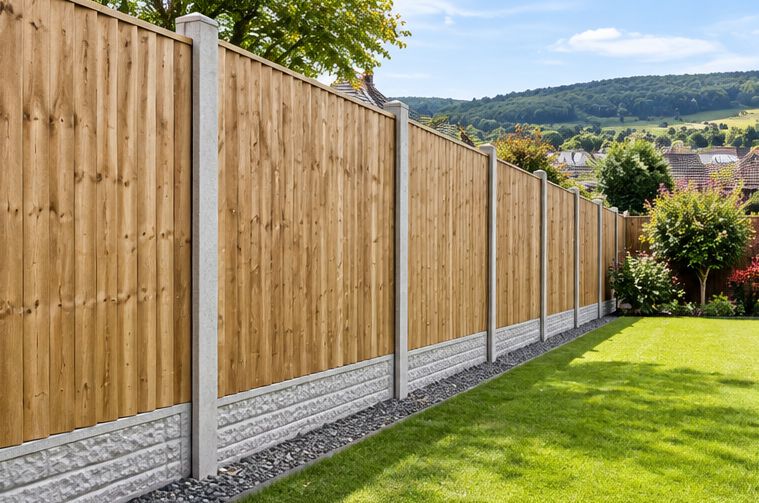
When people ring us about a new fence they usually have a picture in mind before we arrive: the ready-made panels they saw at a builders’ merchant, the tall board fence along a neighbour’s garden, or the horizontal slats they spotted on a garden programme. All three can be good fences. All three can also be the wrong choice for a particular garden.
This guide sets out how each style is built, what it is good at and where it falls short, so you can go into a quote knowing what to ask for. If exposure to the weather is your main worry, our separate article on which garden fence stands up best to Welsh wind goes into that in more depth.
Start with what the fence is for
Before comparing styles, it helps to be clear about the job. A boundary between two back gardens on a terrace has different priorities from a front boundary on a corner plot, or a screen around a hot tub. Ask yourself a few simple questions:
- Do you need full privacy, or is a partial screen enough?
- Is the fence mainly there to keep a dog or children in?
- How exposed is the spot to wind and rain?
- Will it be seen from the house every day, so looks matter as much as function?
- How much time are you willing to spend treating and maintaining it?
Panel fencing: quick and tidy
Panel fencing is made up of pre-built sections, usually around 1.8 metres wide, that slot or fix between posts. The common types are overlap (lapped boards running horizontally), feather edge panels that look like a small section of close board, and more decorative panels with trellis tops or woven slats.
Its big advantages are speed and simplicity. A run of panels in slotted concrete posts goes up quickly, looks neat straight away and is easy to repair, because a damaged panel can often be lifted out and a new one dropped in. That makes panels a sensible choice for many ordinary back gardens across South Wales.
The weakness is quality. Panels vary enormously, and the lightest overlap types have thin boards and flimsy frames that twist, split and rattle loose within a few seasons. If you choose panels, pay attention to the thickness of the boards and the weight of the frame, not just the price label. We will always tell you honestly if a panel is too light for where it is going.
Close board fencing: strong and built to fit
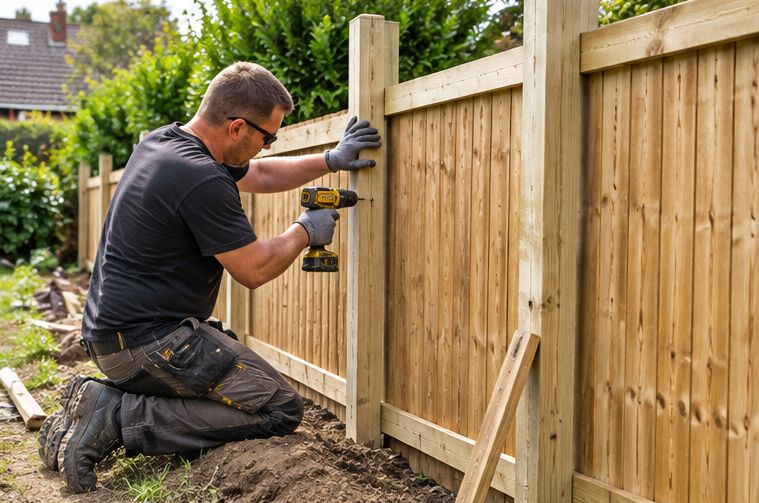
Close board, sometimes called featheredge or feather board, is built on site rather than bought as a panel. Posts go in first, then two or three horizontal rails (often triangular arris rails or square cant rails) run between them, and vertical tapered boards are nailed to the rails with each one overlapping the next.
Because it is built in place, close board follows the ground well. On a sloping or uneven boundary the boards can stay vertical and the top can step or follow the gradient, which is useful in hillside valley gardens such as those in Abertillery or Pontypridd, where panels would leave awkward gaps or triangles. It is also sturdier than most panels and can be repaired a board at a time.
The trade-off is time. Close board takes longer to build than a panel fence of the same length, and it needs a gravel board along the bottom to keep the boards clear of damp soil. Many people like to finish the top with a capping rail and counter batten, which throws rain off the end grain and helps the boards last.
Slatted fencing: modern and airy
Slatted fencing uses horizontal (or occasionally vertical) boards with small gaps between them. It is the look most people mean when they ask for a contemporary fence, and it works well alongside a new patio, decking or clean-lined planting.
The gaps are the point. They let light through, stop a small garden feeling boxed in, and allow some wind to pass, which takes pressure off the posts. The downside is privacy: from an angle a slatted fence screens well, but face on you can see through it. A closer spacing, or a hit-and-miss design with boards on alternate sides, gives more cover.
Slatted fences show every wobble, so they need straight posts, level lines and good-quality timber that will not bow. Smooth planed softwood, thermally modified timber and some composite systems are all used. They cost more to build than basic panels, mainly because of the extra material and the care needed in fitting.
How the three compare side by side
In very broad terms, this is how we would sum them up for a typical South Wales garden:
- Privacy: close board and solid panels give full screening; slatted gives partial screening depending on the gap.
- Strength: close board on sound posts is usually the toughest; heavy panels in concrete posts come close; light panels are the weakest.
- Sloping ground: close board copes best; panels step down in stages; slatted can be stepped or raked but needs careful setting out.
- Looks: slatted is the most modern; close board looks traditional and solid; panels range from plain to decorative.
- Repairs: panels and close board are both easy to mend in sections; slatted runs are harder to patch invisibly.
- Upkeep: all timber fences benefit from regular treatment, and none of them like soil piled against the bottom.
Mixing styles and adding extras
You do not have to pick one style for the whole garden. A common approach is close board or panels on the boundaries where privacy matters, with a lower slatted screen inside the garden to separate a seating area, hide bins or frame a patio. Trellis on top of a lower fence gives height and a frame for climbers without the full wind load of a solid board.
Gates are worth thinking about at the same time, so the gate matches the fence rather than looking like an afterthought. Our guide to choosing and fitting a garden gate covers that side of things.
Do not forget the posts
Whichever style you choose, the posts decide how long it stays upright. Panels usually go into slotted concrete or timber posts, close board is traditionally built on timber posts or concrete mortice posts, and slatted fences are most often fixed to timber posts so the boards can be screwed on neatly. We explain the choice in more detail in concrete posts or timber posts for a garden fence.
If you are still unsure, that is exactly what a site visit is for. Tony and the team can look at your boundary, the ground and the exposure, and give you free advice on the style that suits it. See our fencing and gates page for the work we do, or ask for a free quote.
Talk to T J Landscapes about your garden
Free quotes and honest advice across South Wales.
Questions People Ask
Which fence style gives the most privacy?
Close board and solid panels both give full screening at the height they are built to. A slatted fence can come close if the gaps are narrow, but you will still see some movement and light through it.
Is close board fencing better than panels?
It is usually stronger and copes better with slopes, and it can be mended a board at a time. Heavy-duty panels in concrete posts are quicker to fit and easy to swap out. Which is better depends on your ground, exposure and how you want it to look.
Are slatted fences suitable for windy gardens?
The small gaps actually help, because they let some wind through and reduce the load on the posts. They do still need well-set posts and straight, stable timber.
Can you match a new fence to my neighbour’s?
Often, yes, as long as we can find a similar board or panel. It is worth agreeing the style and who is paying with your neighbour before work starts on a shared boundary.
Which style needs the least maintenance?
None of them is maintenance-free if it is timber. A well-built close board fence with a gravel board and a capping rail, or panels in concrete posts, will generally need the least attention. See our article on making a fence last longer.