Brickwork & Garden Walls in South Wales - T J Landscapes

Brickwork and Garden Walls in South Wales

Walls do a lot of quiet work in a garden. They mark the boundary, hold back sloping ground, frame a patio, lift planting to a comfortable height and carry you from one level to the next. When they are built well you hardly notice them. When they are not, they lean, crack and let water through within a few winters.

Tony and the team build and repair garden brickwork right across South Wales: boundary and garden walls, retaining walls, steps, patio brickwork, raised planters, piers and pillars, and feature work in brick, block or stone. Every job starts with a free visit, so get in touch and we will look at the ground and talk through what would suit it.

★ 4.8/5 Google · 69 reviews 10/10 on Checkatrade Free quotes & advice
Google★★★★★4.8/5 · 69 reviews Checkatrade10/105 reviews Our Website★★★★★70 reviews
What we do

Garden Brickwork We Build

Most of what we build falls into one of these groups, and many gardens need a mix of them.

Brickwork & Garden Walls

Garden and Boundary Walls

Low walls along the front of a property, taller walls for privacy at the back, and dividing walls within a garden. We build in facing brick, rendered block or natural stone, finished with a coping that sheds the rain and suits the house.

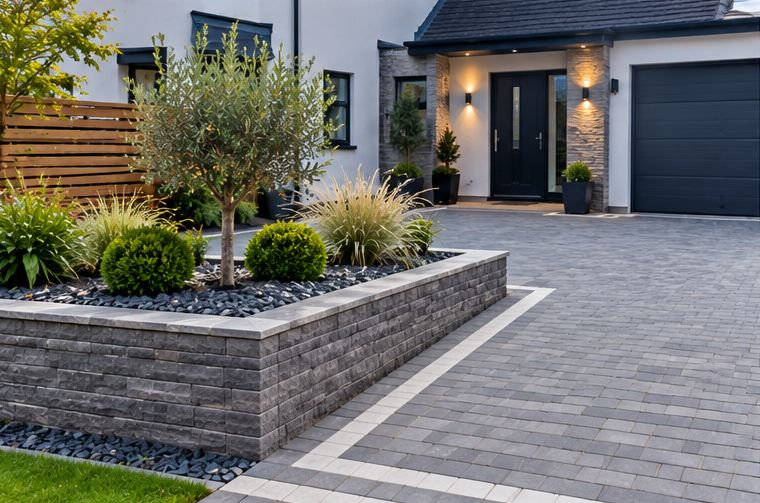
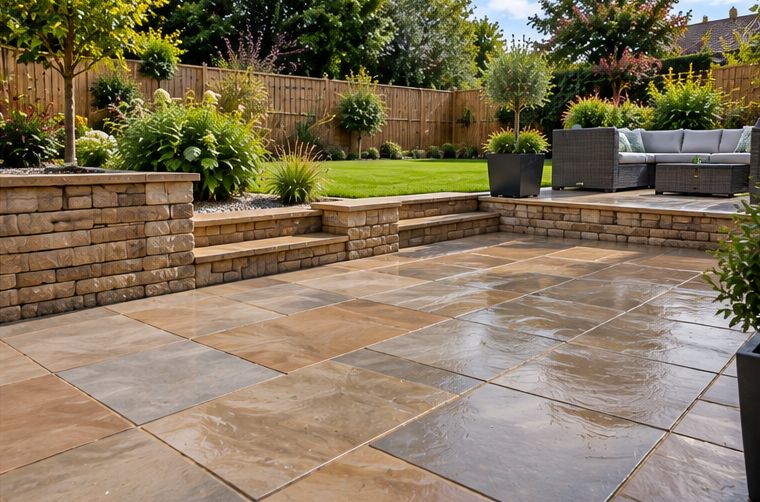
Block-paved driveway with a raised planter wallSandstone patio with a brick planter
Ask about garden and boundary walls →
Brickwork & Garden Walls

Retaining Walls

Where ground has to be cut back or built up, a retaining wall holds the soil in place. These need deeper foundations, drainage behind them and weep holes to let water out, and taller ones may need an engineer's design. We will tell you honestly when that applies.

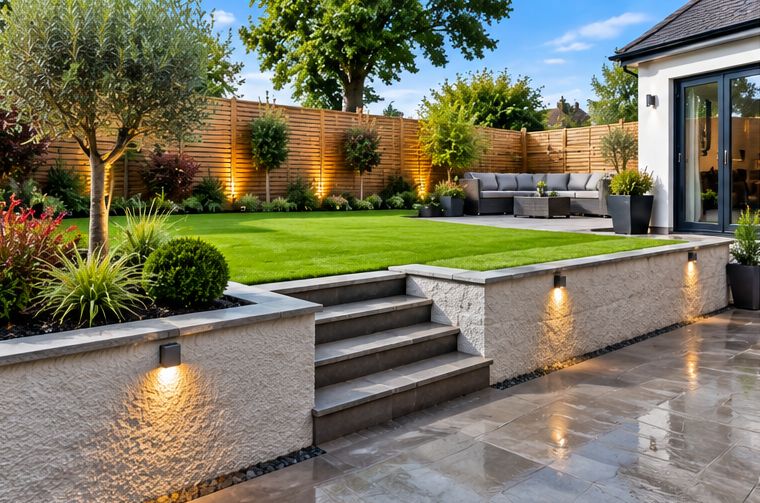
Sandstone patio with a brick planterGarden terrace with rendered walls and lighting
Ask about retaining walls →
Brickwork & Garden Walls

Steps and Staircases

Brick, block and stone steps to link terraces, reach a back door or climb a sloping garden. We set the rise and going of each step so they are even and comfortable to walk, and build them on a solid base so they do not settle or rock.

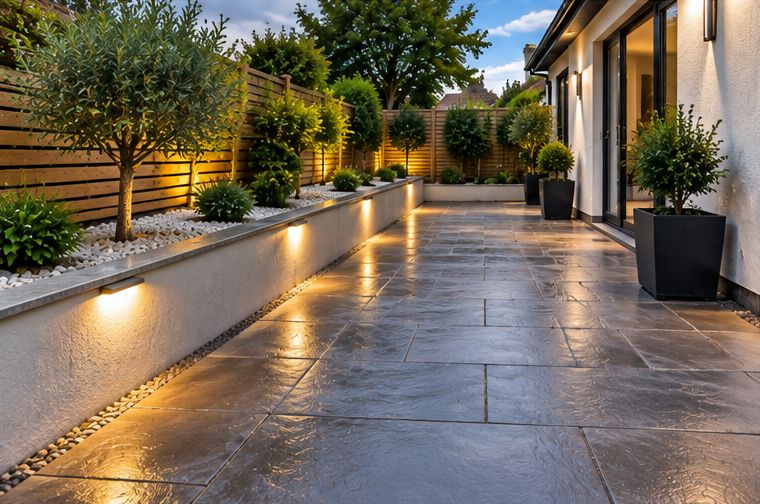
Garden terrace with rendered walls and lightingPaving path beside a low wall
Ask about steps and staircases →
Brickwork & Garden Walls

Patio Brickwork and Raised Planters

Dwarf walls around a patio, built-in seating walls, brick edging and raised beds that bring planting up to a height you can reach. Planters are built with drainage so they do not hold water against the brickwork.

Paving path beside a low wallBlock-paved driveway with a raised planter wall
Ask about patio brickwork and raised planters →
Brickwork & Garden Walls

Piers, Pillars and Feature Brickwork

Gate piers, pillars at the end of a wall or drive, curved walls, contrasting brick bands and decorative coping. These are the details that make a garden or frontage look finished.

Block-paved driveway with a raised planter wallSandstone patio with a brick planter
Ask about piers, pillars and feature brickwork →
Brickwork & Garden Walls

Repairs and Rebuilding

Repointing crumbling mortar, replacing blown or frost-damaged bricks, resetting loose coping and taking down and rebuilding leaning sections. We match brick, stone and mortar as closely as we can so the repair blends in.

Sandstone patio with a brick planterGarden terrace with rendered walls and lighting
Ask about repairs and rebuilding →
Below ground

Foundations Come First

Sandstone patio with a brick planter

The part of a wall that matters most is the part you never see. A garden wall needs a concrete footing dug down to firm ground, wide enough to spread its weight, and set deep enough that the soil beneath it will not shift as it wets, dries and freezes. Skipping or skimping on this is the most common reason garden walls crack and lean.

The right depth depends on the height and type of wall and on the ground itself. Heavy clay moves more than stony ground, tree roots nearby change things, and made-up ground or old rubble has to be dug through until we reach something solid. We work that out on site rather than using one size for every job.

Above the footing, we use a damp proof course where it is needed, frost-resistant bricks at ground level and a coping on top that overhangs enough to throw water clear of the face. Our guide to garden wall foundations explains why each of these matters.

Slopes and levels

Retaining Walls for Hillside Gardens

Block-paved driveway with a raised planter wall

Large parts of South Wales are built on hillsides, and many back gardens climb or fall steeply from the house. In valley towns such as Pontypool, Abertillery and Pontypridd, turning a slope into usable, level terraces almost always means building retaining walls.

A retaining wall carries far more load than a freestanding one, especially when the soil behind it is wet. Water is the main enemy, so we build in drainage: free-draining stone behind the wall, weep holes through it and, where needed, a pipe at the base to carry water away.

  • Low retaining walls holding back a bed or a small change in level are usually straightforward.
  • Taller walls, or walls supporting a drive, a path, a building or a neighbour's ground, may need a structural engineer's design and possibly building regulations approval.
  • Walls on or near a boundary may affect your neighbour, so it is worth talking to them early.

We are landscapers, not engineers, and we will say so plainly when a wall needs that level of design. Read more in when a retaining wall needs engineering advice, and see how to landscape a sloping valleys garden for the bigger picture.

Materials

Choosing Brick, Block, Stone and Coping

Paving path beside a low wall

The best-looking walls usually take their cue from the house. Red or buff facing brick suits most brick-built homes; natural stone suits the stone terraces and cottages found across the valleys and in towns like Abergavenny and Chepstow; and rendered blockwork gives a clean, modern finish that can be painted to match.

Whatever the face, the bricks have to cope with our weather. Garden walls are exposed on both sides and on top, so they get far wetter than the walls of a house. We use bricks rated for that exposure, a mortar mix to suit them, and coping stones or a brick-on-edge finish that keeps rain out of the top of the wall.

Our guide to choosing bricks and coping for a garden wall goes through the options, and we are happy to talk through the choices with you on site.

Why choose us

Why Choose T J Landscapes for Garden Brickwork

Good brickwork is mostly patience: proper footings, careful levels and walls built to deal with the rain.

Built From the Ground Up

Footings, drainage and coping are planned into every wall, because they are what stop it cracking, leaning or staining later.

Walls That Fit the Garden

We also lay patios, lawns and fencing, so walls, steps and surfaces are planned together and meet neatly.

Straight Talking

If a retaining wall needs an engineer or a wall may need permission, we will tell you before you commit, not after.

Free Quotes

We visit, look at the ground and the access, and give you a clear quote with no charge for the visit.

Getting around

Steps, Planters and Patio Walls

Garden terrace with rendered walls and lighting

Garden steps are used every day, so they need to be safe as well as good-looking. The height of each step and the depth of each tread should be consistent all the way up, because an odd step is exactly the one people trip on. On long flights we can add a landing part way up, and a handrail where it helps.

Raised planters are one of the most useful things you can build in a small or sloping garden. They bring the soil up to a comfortable working height, give plants a better depth of topsoil than thin valley ground often allows, and can double as seating around a patio or a deck.

See garden steps in brick and stone and building brick raised beds and planters for more ideas, or look at our landscaping page if the walls are part of a wider redesign.

Old walls

Repairing and Rebuilding Garden Walls

Sandstone patio with a brick planter

Plenty of older properties in South Wales have garden walls that have stood for a century or more and are now showing it. Soft mortar washes out, frost pops the faces off bricks, ivy and tree roots push stones apart, and sections start to lean.

Some walls just need repointing and a few replacement bricks. Others have moved too far and are safer taken down and rebuilt on a new footing, reusing the original brick or stone where it is sound. Older stone and brick walls were often built with lime mortar, and repairing them in a hard cement mortar can do more harm than good, so we match the mortar to the wall.

If a wall is on a shared boundary, the Party Wall Act may apply to some work, and walls in a conservation area or next to a listed building can need consent before they are altered or taken down. Check with your local council before work starts; we are happy to help you work out what to ask.

Reviews

What Our Customers Say

Real reviews from homeowners across South Wales — rated 4.8 out of 5 on Google from 69 reviews and 10/10 on Checkatrade.

★★★★★

Spectacular work

“Had my patio done by the company and could not be happier. Top quality work done and quickly too.”

Nicola
Patio
★★★★★

Great work, really pleased

“I was pleased to find Tony and his lads were absolutely great! Tony responded quickly & was very polite.”

Jenny
Garden work
★★★★★

Great work

“We were delighted with the work and materials, which were of very high quality. Tony and team helped us.”

Sian Davies
Landscaping
Advice centre

Brickwork and Garden Wall Advice

Guides to foundations, materials, retaining walls, steps and planters, written for South Wales gardens.

More from T J Landscapes

Our Other Garden Services

Most gardens need more than one trade. The same team does all of it, so one visit and one quote covers the whole job.

Areas we cover

Where We Build Garden Walls

From our base in Pontypool we build and repair garden brickwork across South Wales. Choose your town to see our brickwork page for it.

Based in Pontypool

Find T J Landscapes

T J Landscapes South Wales
24 Conway Road, Pontypool
Torfaen, NP4 6HL

07423 796115

We cover homes right across South Wales, from Cardiff and the coast up to the valleys and the Brecon Beacons.

FAQs

Common Questions

How much does a garden wall cost?

It depends on the length and height of the wall, how deep the foundations need to go, the materials you choose, whether it is retaining soil, how easy access is and how much spoil has to be taken away. Taking down an old wall first adds to the work. We give free, itemised quotes, so get in touch to arrange a visit.

Do I need planning permission for a garden wall?

Many low garden walls do not, but height limits apply, particularly next to a road or footpath, and the rules are different for listed buildings and conservation areas. We are not planners, so check with your local council before you commit; we can help you understand what to ask them.

Can you build a wall on a slope?

Yes. The footing is stepped down the slope in level sections so each part of the wall sits on flat, solid ground. On steep ground the wall may also need to act as a retaining wall, which changes how it is built.

My old garden wall is leaning. Can it be saved?

Sometimes. If the lean is slight and the cause, such as a root or blocked drainage, can be dealt with, repairs and repointing may be enough. If it has moved a lot, rebuilding on a proper footing is usually the safer choice, reusing sound materials where possible.

Do you build with natural stone as well as brick?

Yes. We build in brick, block and natural stone, and we can face a block wall with stone or render. Matching an existing stone wall is often the best choice on older properties.

Can walls and steps be built as part of a bigger garden project?

Yes, and that is often the best way. Walls and steps set the levels for everything else, so we build them before the paving, turf and planting. See our landscaping and garden design page for how we plan a whole garden.

Will you clear the old wall and rubble away?

Yes. Demolition waste, surplus soil and offcuts are cleared and removed as part of the job, and if the garden needs a wider tidy first our garden clearance service can help.


Get in touch

Ask for a Free Brickwork Quote

Tell us what you would like built or repaired, roughly how long and high it is, and your town, and we will arrange a free visit.

Prefer to talk? Call 07423 796115 or WhatsApp us.

Call WhatsAppFree Quote