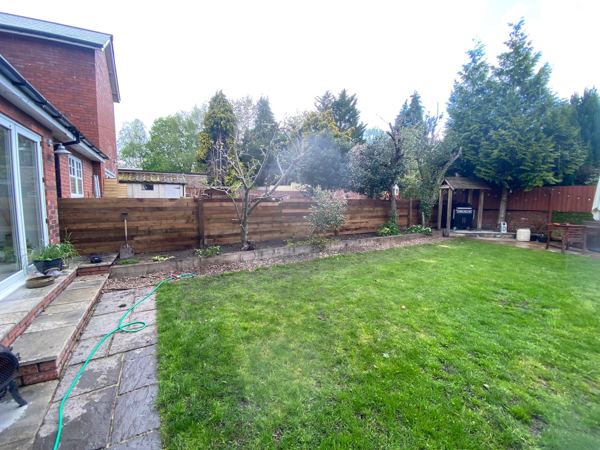
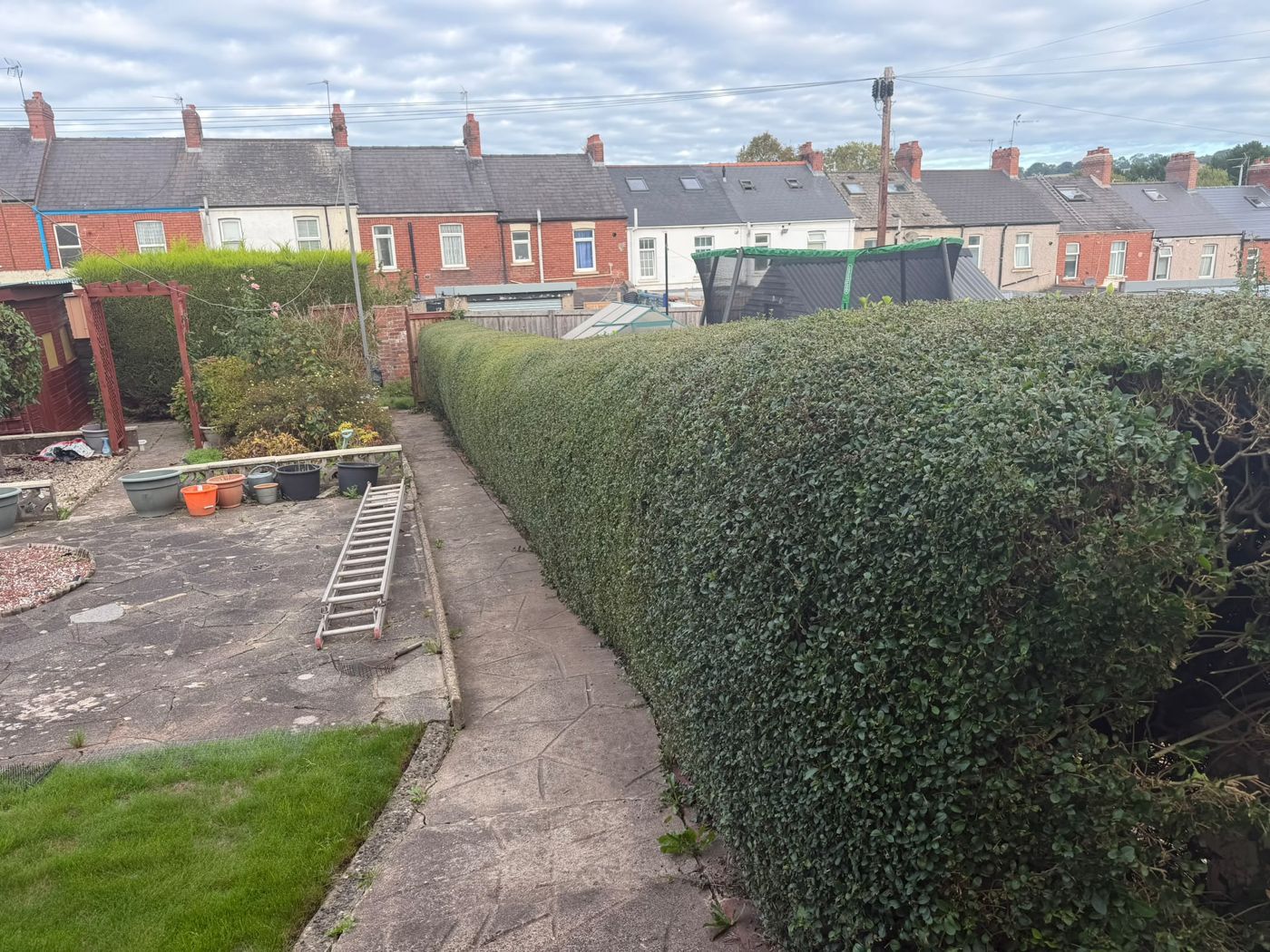
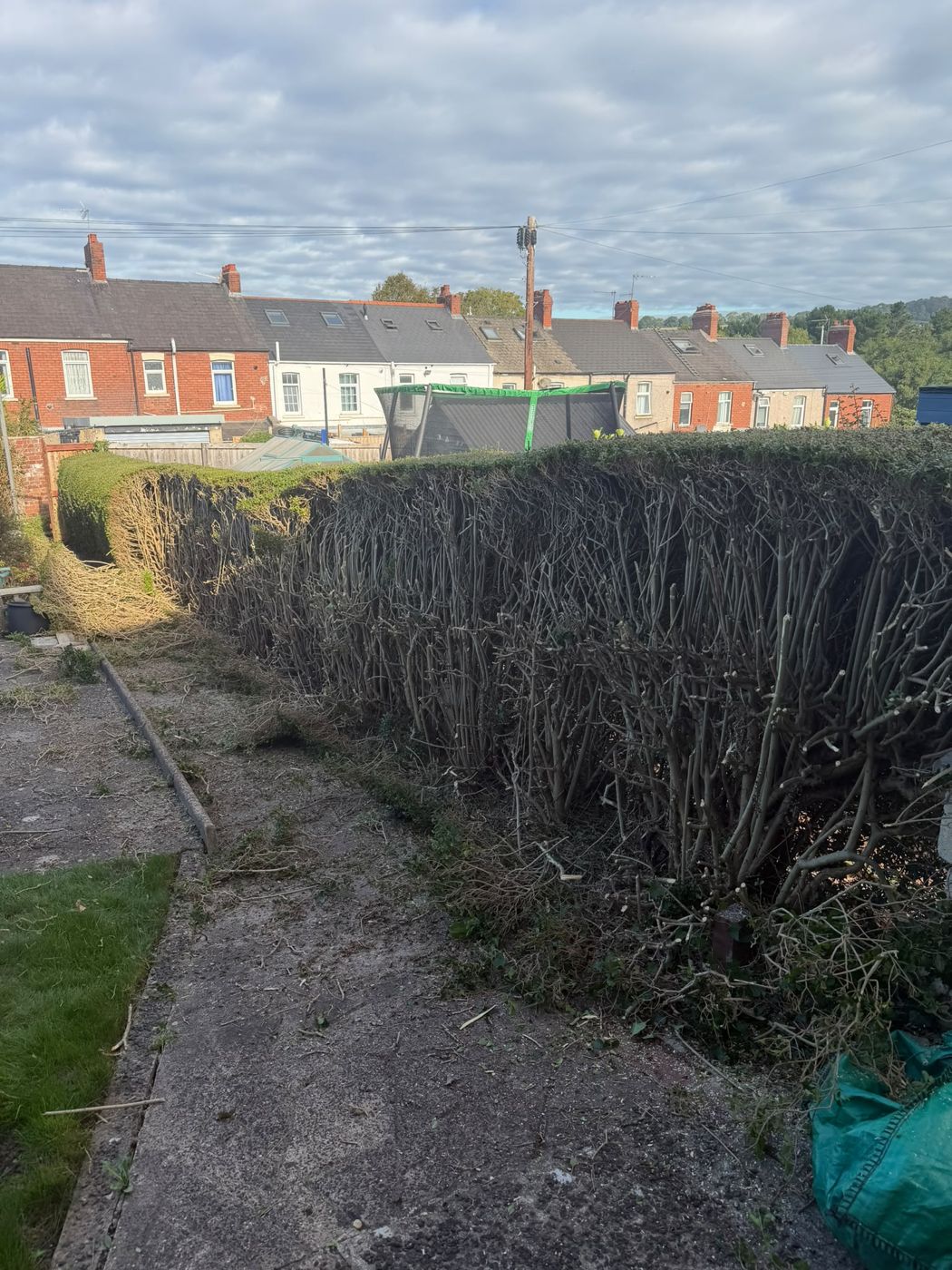
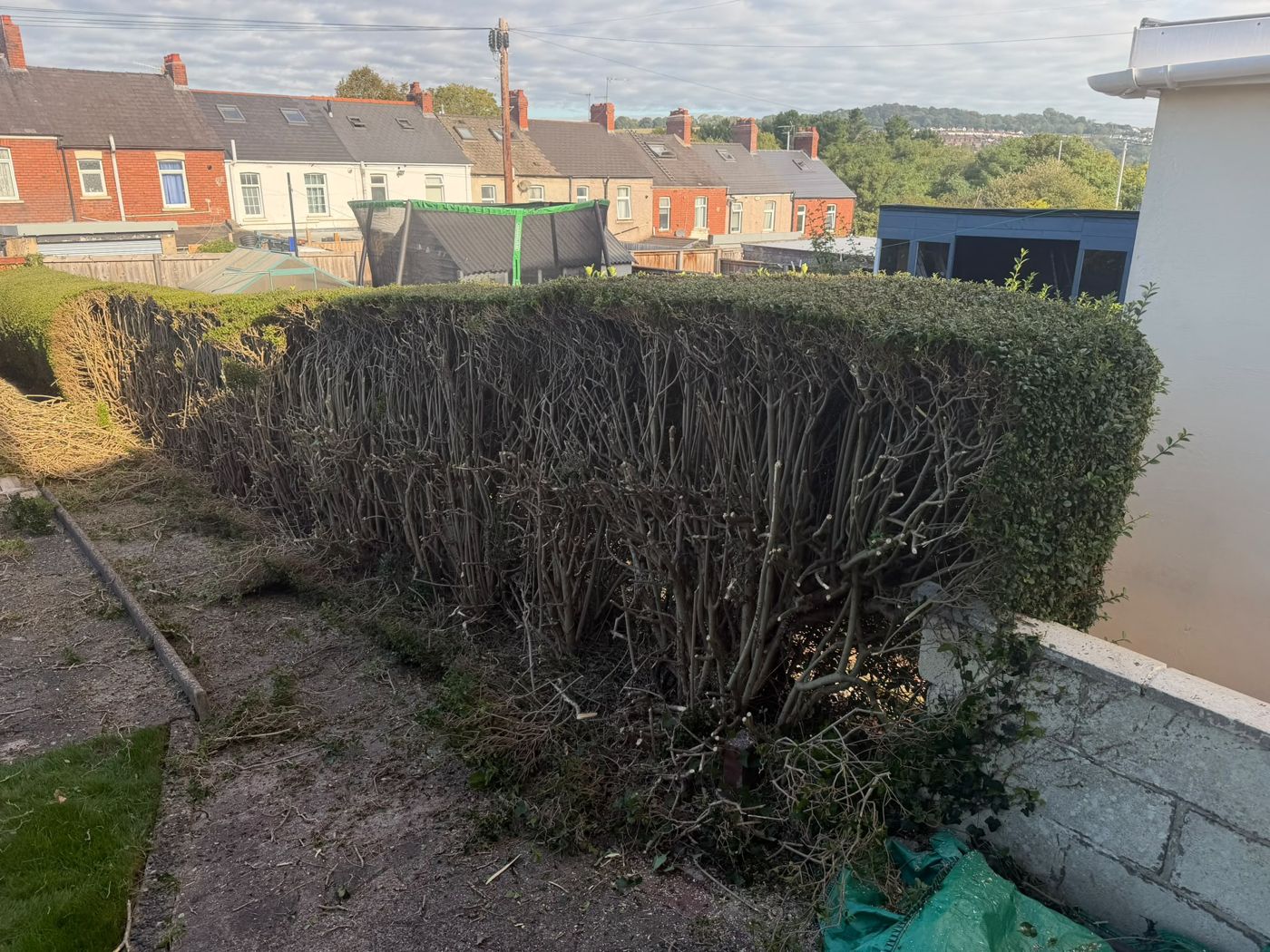
This Newport garden had a thick boundary hedge running the whole length of one side, on the high side of a long terrace garden looking out over the rooftops. It had grown wide as well as tall, taking a good metre of garden with it and needing cutting two or three times a year.
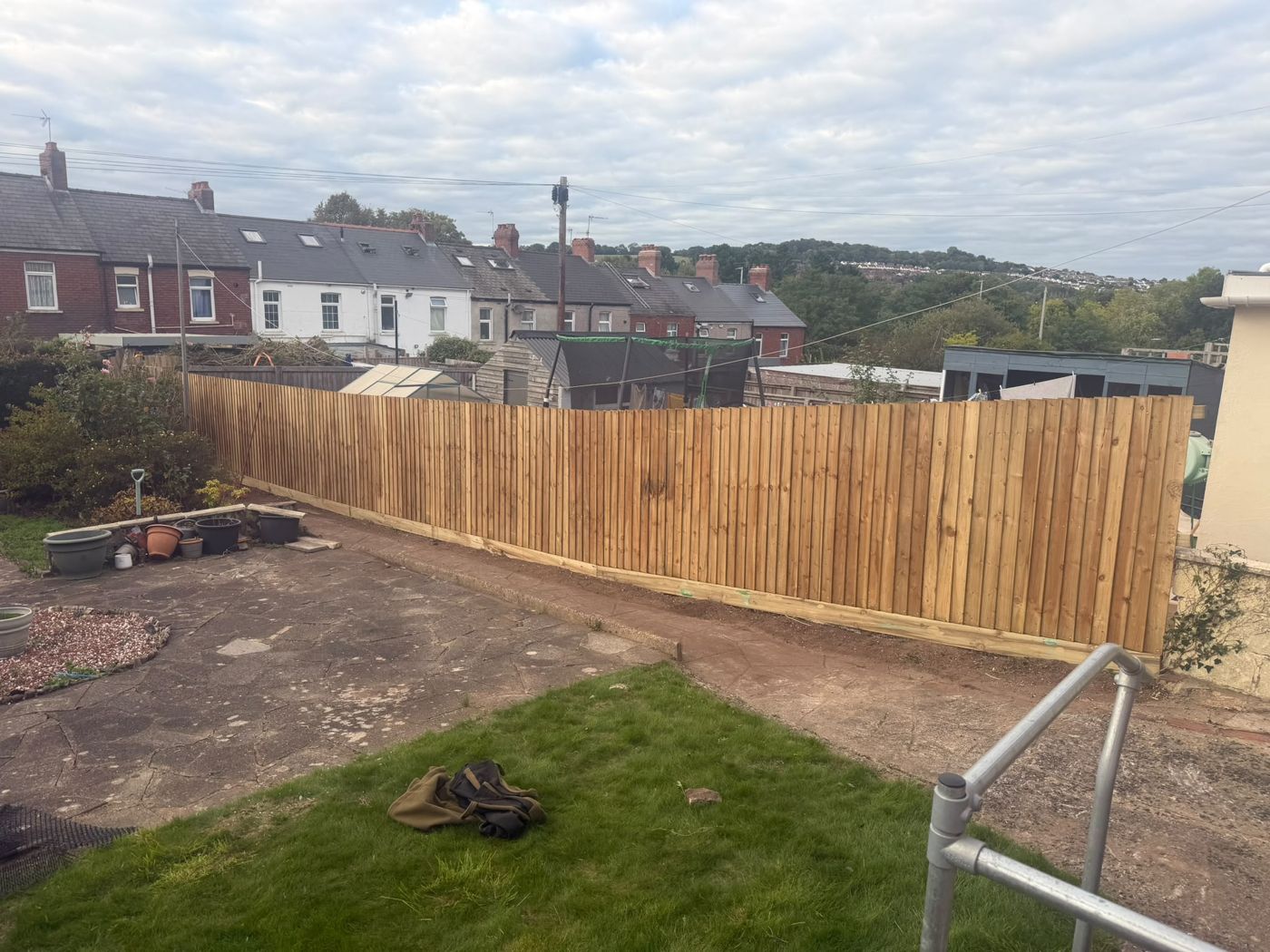
The owners wanted the space back and a clean line along the boundary, so we took the hedge out and put up a new close-board fence in its place. If you are weighing up the same swap in your own garden, we are happy to come and look and talk it through — ask for a free quote.
Taking the hedge out
The first job was to cut the hedge down in sections, starting at the top and working along, so nothing dropped onto the path or the greenhouse roof below. Once the green growth was off, what was left was a wall of old bare stems and a wide root plate running along the boundary.
Those stems came out with the roots, and the ground along the line was levelled back so the new fence could follow it. Everything we cut went with us, which is the part most people would rather not deal with themselves: a hedge that size fills a lot of bags. We can do the same as part of a garden clearance when there is more than just a hedge to shift.
- Hedge cut down in sections, top down
- Old stems and roots dug out along the line
- Ground levelled ready for the posts
- All the green waste taken away
The new fence
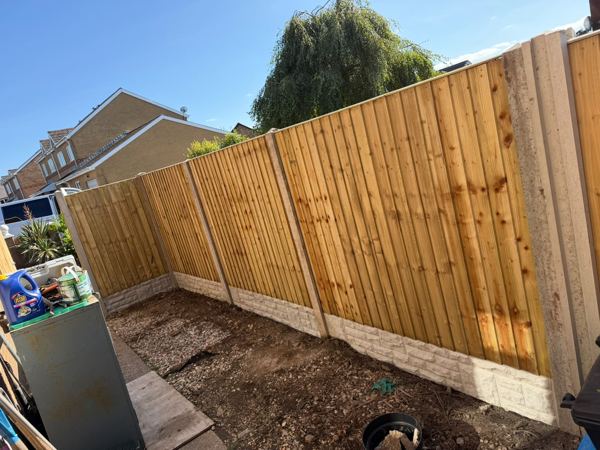
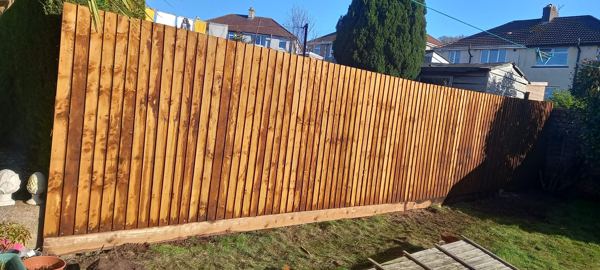
The replacement is a close-board fence: vertical featherboard nailed onto rails between posts, built in place rather than dropped in as ready-made panels. On a long run like this that matters, because the ground falls away towards the end of the garden and boards built in place can follow the slope without leaving gaps under the fence.
It gives a solid line with no gaps to see through, and the neighbouring rooftops now sit behind a clean top edge rather than a ragged hedge. A long, solid run like this catches the wind, so the posts are the part that earns its keep: set deep and firm, with the rails and boards fixed onto them.
For more on the choice between hedges, panels and close-board in gardens around the city, see our landscaping in Newport page.
Hedge or fence?
A hedge is good for wildlife and looks soft and green, but it takes up width, needs cutting every year and cannot be relied on for a clean boundary line. A fence gives you the line and the privacy straight away and hands back the strip of garden the hedge was using.
If you like the greenery, there is a middle way: take the hedge out, put the fence in, then plant a narrow border in front of it. You keep the planting and lose the annual battle with the hedge cutter.
Questions About This Job
Can you take a hedge out and put a fence up in one visit?
Often yes, on a boundary this size. The hedge comes out, the line is cleared and levelled, and the fence goes in behind it. We will tell you at the quote whether it is one visit or two.
What happens to all the hedge waste?
We take it away with us. A long hedge makes a surprising amount, and it is usually the reason people would rather not tackle it themselves.
Will the roots cause a problem later?
We dig the stumps and main roots out along the fence line rather than cutting them off at ground level, so there is nothing left to push at the posts or send up new growth.
Can a close-board fence follow a sloping garden?
Yes. Because the boards are fixed on site rather than coming as fixed panels, the fence can step or rake with the ground, which keeps the gap underneath even. Send us a photo of your boundary and we will tell you what suits it.