
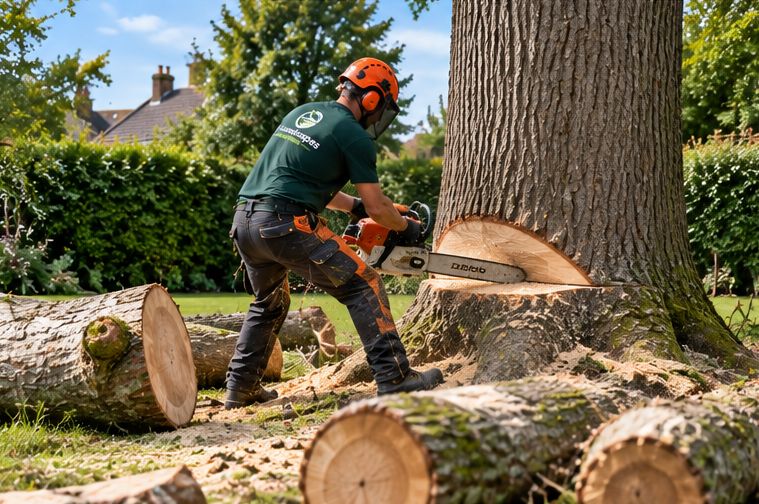
It is one of the first questions people ask when we come out to look at a tree: “Am I allowed to take it down?” The honest answer is that it depends, and the rules that apply are not always obvious from looking at the tree.
This guide sets out the main things to check before any pruning or felling in a South Wales garden. Please read it as general guidance only. We are landscapers and tree workers, not solicitors or planning officers, and the final word always rests with your local council or, for larger felling, Natural Resources Wales. If something here does not match what your council tells you, go with the council.
Start with the council: Tree Preservation Orders
A Tree Preservation Order (TPO) is made by the local planning authority to protect a particular tree, a group of trees or a whole woodland because of its value to the area. Where a TPO applies, you normally need the council’s written consent before cutting down, topping, lopping or uprooting the tree, and that covers pruning as well as felling. Damaging a protected tree without consent can lead to prosecution and a requirement to plant a replacement.
You cannot tell whether a tree has a TPO by looking at it. Protected trees are often mature oaks, beeches, limes or sycamores in older gardens, but an order can cover almost any tree. The only reliable way to know is to ask the council’s planning or tree team. Many councils have a map or an online search, and they will confirm by phone or email.
In South Wales that means Cardiff, Newport, Torfaen, Monmouthshire, Caerphilly, Blaenau Gwent, Merthyr Tydfil, Rhondda Cynon Taf, the Vale of Glamorgan or Neath Port Talbot council, depending on where you live. If your home is inside Bannau Brycheiniog (the Brecon Beacons National Park), for example around Talgarth, the National Park Authority is the planning authority instead.
Conservation areas
Trees in a conservation area have protection even without a TPO. In general you must give the council written notice, usually six weeks, before carrying out work on a tree in a conservation area, which gives them time to decide whether it should be protected with an order. Very small trees are exempt, but the size threshold is technical, so ask rather than guess.
Many of the older parts of our towns sit in conservation areas: town centres, Victorian suburbs and historic streets. If you live in a period property in places like Penarth, Monmouth or Abergavenny, it is worth checking before you plan any tree work. The council can tell you whether your address is inside a boundary.
Other things that can protect a tree
Even with no TPO and no conservation area, a few other things can restrict work:
- Planning conditions on newer estates. When a housing estate is built, the planning permission sometimes requires certain trees or hedges to be kept. Your deeds or the council’s planning records may show this.
- Restrictive covenants in the title deeds, which occasionally cover trees or boundaries.
- Tenancies and leases. If you rent, the tree probably belongs to the landlord.
- Bats. Older trees with cracks, hollows or loose bark can hold bat roosts, and bats and their roosts are protected by law. If there is any sign of bats, stop and get advice from the council or Natural Resources Wales before work goes ahead.
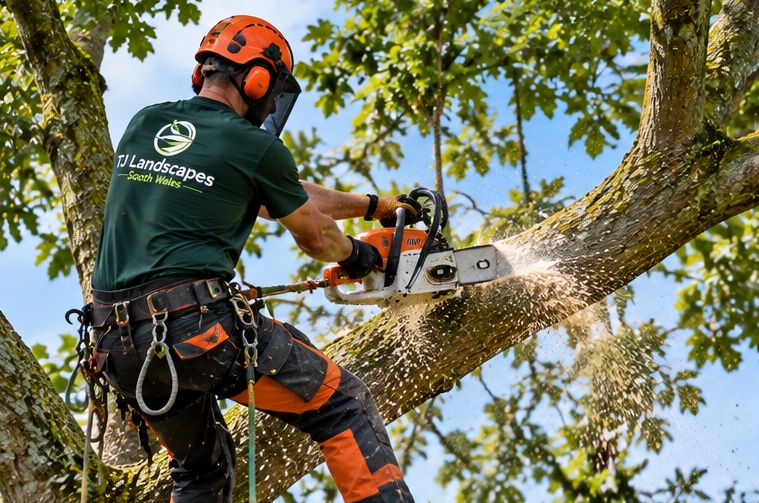
Felling licences from Natural Resources Wales
Separate from planning, the felling of larger volumes of timber can need a felling licence from Natural Resources Wales. This mainly matters for woodland, field trees and bigger rural properties rather than ordinary back gardens, and there are exemptions, including for trees in gardens. The detail of the exemptions and volume limits is set out by Natural Resources Wales.
If you have a large plot, a paddock with mature trees, or a strip of woodland on the edge of your land, which is common around the rural foothills and farm cottages of South Wales, check with Natural Resources Wales before any significant felling. Felling without a licence where one is needed is an offence, and a TPO or conservation area can apply on top of it.
Nesting birds: timing matters
All wild birds, their eggs and their nests in use or being built are protected by law. That applies to every garden tree and hedge, protected or not. In practice it means checking carefully for nests before any cutting, and avoiding heavy work on trees and hedges during the main nesting season, which generally runs from early spring through the summer.
It does not mean nothing can be done in spring. Light pruning can often go ahead after a careful check, but if we find an active nest we leave that part alone until the young have fledged. For big reductions, felling and hedge cutting, autumn and winter are usually the better time anyway, as the tree is dormant and the birds have finished.
Neighbours’ trees and overhanging branches
People often ask about a neighbour’s tree hanging over the fence. In general you can cut back branches that overhang your boundary, as long as you do not go beyond the boundary line or harm the health of the tree. But a TPO or conservation area still applies to your neighbour’s tree, so the same checks come first. It is also good manners, and avoids arguments, to talk to your neighbour before any work and offer them the cuttings back.
Dead or dangerous trees are a grey area. There are limited exceptions in the rules, but they are narrower than many people assume, so contact the council before relying on them and keep photographs of the condition of the tree.
How we handle it when you book tree work
When we price a job through our tree surgery and hedge care service, we will ask whether the tree is protected and whether you are in a conservation area, and we will look for nests and signs of bats on the day. If there is any doubt, we would rather wait for the council’s answer than start cutting. The applications and notices are free to submit in most cases, and we can describe the work we plan so you can include it.
Often, a full felling is not needed at all. Crown lifting, thinning or a careful reduction can let more light into a garden while keeping a healthy tree, and councils are more likely to agree to sensible pruning than to removal. If you want to talk through what is possible, ask for a free quote and free advice, or see how tree work fits into a wider plan on our home page.
Talk to T J Landscapes about your garden
Free quotes and honest advice across South Wales.
Questions People Ask
How do I find out if my tree has a Tree Preservation Order?
Contact your local council’s planning or tree team. Many councils have an online map, and they will confirm by phone or email. There is no reliable way to tell by looking at the tree.
Do I need permission to prune a tree, or only to fell it?
If a tree has a TPO, consent is normally needed for pruning as well as felling. In a conservation area, notice is normally required for both. Outside those, ordinary pruning of your own tree does not usually need permission, but nesting birds and bats are still protected.
Do I need a felling licence for a tree in my back garden?
Usually not, as garden trees are generally exempt. Felling licences mainly apply to larger volumes of timber, such as woodland and field trees. If you have a big rural plot, check with Natural Resources Wales first.
When is the nesting season for birds?
It generally runs from early spring through the summer. Nests in use are protected at any time of year, so a careful check is needed before cutting whatever the month.
Can T J Landscapes apply for TPO consent for me?
The application is usually made by the owner, but we can describe the work we propose clearly so you can include it. The council makes the decision, and we will not start protected work until you have their answer.