
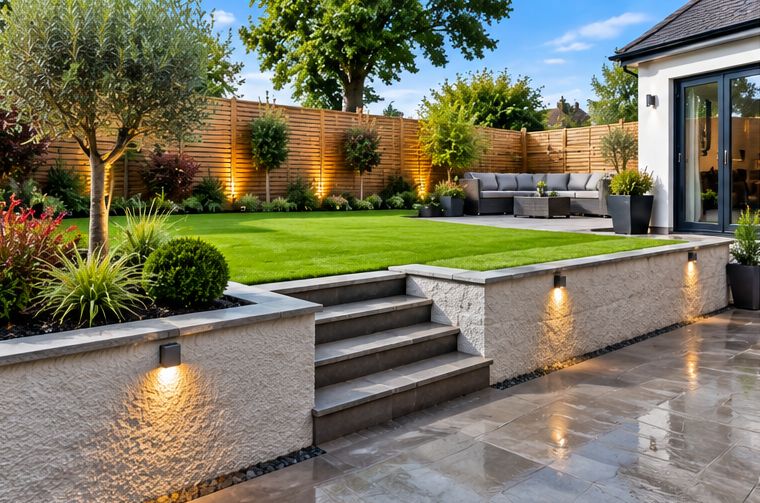
“Something that doesn’t need much looking after” is probably the request we hear most when people talk to us about a new garden. It usually comes from busy families, people who have just moved in, or people who have looked after a big garden for decades and want to enjoy it rather than work in it.
In South Wales there is an extra challenge. Our mild, wet climate means grass, weeds and moss grow for much of the year, and algae turns shady paving green. A garden that would look after itself in a drier part of Britain can need regular attention here. These are the choices that make the biggest difference, based on the gardens we design and build through our landscaping and garden design work.
Start by listing the jobs you want to avoid
Before choosing materials, think about what actually takes up your time now. For most people it is some mix of mowing and edging, weeding borders, cutting hedges, jet-washing the patio and treating the fence or deck. Once you know which jobs you dislike, you can design them out one by one instead of simply paving everything.
It is also worth being honest about what you enjoy. If you like pottering with a few pots of flowers, keep space for that. Low maintenance works best when it removes the chores and leaves the bits you like.
Hard surfaces that stay clean in a wet climate
A well-laid patio is the backbone of most low-maintenance gardens, but the material matters in our weather. Porcelain paving is dense and barely absorbs water, so it resists algae and moss and cleans easily. Natural sandstone and cheaper concrete slabs are more porous and tend to go green in shade, although sealing can help.
Joints matter as much as the slabs. Weeds grow in joints that have crumbled or washed out, so a good jointing compound, laid properly on a solid base with a sensible fall for water, keeps the patio looking tidy for much longer. Our guide to patio paving that copes with Welsh rain compares the options, and our patio slabbing and paving page shows what we lay.
Gravel is easy and cheap to lay, but on its own it is not as low maintenance as it looks: leaves and weeds settle in it, and on sloping valley gardens it washes downhill in heavy rain. A good weed membrane underneath, firm edging and a gravel stabilising grid on slopes make it far more practical.
Lawns: keep, shrink or replace?
A lawn is not automatically high maintenance. A simple, open shape with no fiddly corners, a mowing strip of paving or brick along the edge, and good drainage underneath can be mown in minutes. What eats time is lots of small beds cut into the grass, edges that need trimming by hand, and wet, mossy turf.
For small or heavily shaded gardens, where grass struggles anyway, artificial grass can be a sensible answer. It needs a properly drained base in our climate, otherwise it puddles, and it still wants leaves brushing off and an occasional rinse. If you prefer real grass, well-prepared new turf on good topsoil will need less feeding, scarifying and moss treatment than a tired lawn on compacted ground.
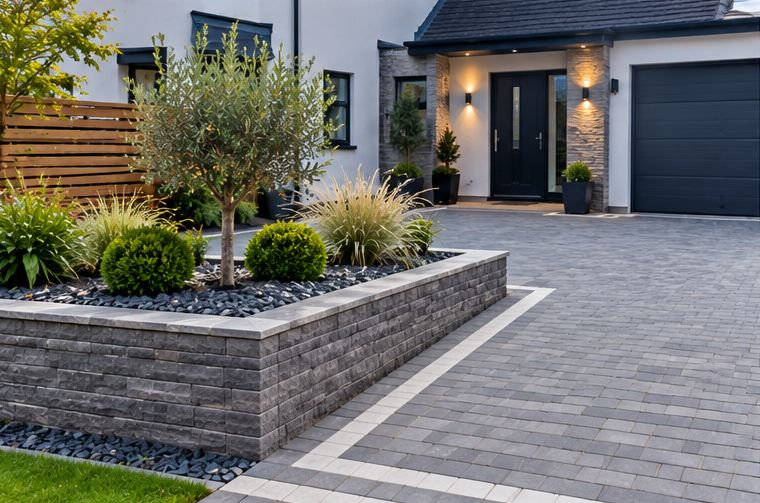
Planting that looks after itself
Bare earth is what makes weeding a constant job. The aim is to cover the ground, either with plants or with a thick layer of mulch. A few principles help:
- Choose shrubs and perennials that suit your conditions: shade-tolerant plants for north-facing terraces, tough, wind-tolerant ones for exposed upland gardens such as those around Merthyr Tydfil, and salt-tolerant ones on the coast at Port Talbot.
- Favour evergreens and slow-growing shrubs that hold their shape without regular pruning.
- Plant in groups rather than dotting single plants around, so they knit together and shade out weeds.
- Finish beds with a deep layer of bark over a membrane where appropriate, and top it up every year or two.
- Avoid lots of small pots, which need watering almost daily in a dry spell; a few large containers are far easier.
Raised beds and sleepers
Raised beds are one of the most useful features in a low-effort garden. They are easier on the back, they drain well on heavy clay, and they keep grass and weeds from creeping in from the edges. On sloping ground, sleepers or block walls can create level terraces that make the whole garden easier to use and maintain.
Timber sleepers look natural and are quick to build with. For something longer lasting, especially holding back soil on a slope, brick, block or stone is worth considering, and our brickwork and garden walls page covers that side.
Boundaries and structures
Fences, hedges and decks all need some upkeep. Concrete posts and gravel boards remove the most common fence repair, and a close board or slatted fence in a stained finish needs only occasional treatment. A clipped hedge looks lovely but needs trimming at least once or twice a year, so think about whether a fence with climbers might suit you better.
Timber decking needs cleaning and oiling to stay safe and good-looking in a damp garden, while composite decking needs little more than a wash. Our article on composite or timber decking explains the trade-offs.
Making it still look good
The risk with low-maintenance design is ending up with a garden that is tidy but lifeless. A few touches stop that happening: a mix of textures between paving, gravel and planting, one or two feature plants or a small tree, some garden lighting for winter evenings, and perhaps a simple water feature. Keep the layout clean, with clear edges and generous paths, and the garden will look cared for even when you have not touched it for a month.
If your garden is currently overgrown, the first step may be a garden clearance so you can see what you are working with. After that, we can talk through a layout that fits your time and your budget. Get in touch for free advice and a free quote, or read what customers say about us on our reviews page.
Talk to T J Landscapes about your garden
Free quotes and honest advice across South Wales.
Questions People Ask
What is the lowest maintenance garden surface?
Well-laid porcelain paving is hard to beat in a wet climate, as it resists moss and algae and cleans easily. Artificial grass on a good base is also low effort. Plain gravel needs more attention than people expect.
Is artificial grass a good idea in South Wales?
It can be, especially in small or shady gardens, but only with a properly drained base. Laid on wet clay without preparation it will puddle and smell.
Which plants need the least looking after?
Evergreen shrubs, ornamental grasses and tough perennials that suit your soil and exposure. Planting in groups and mulching well cuts weeding dramatically.
Can a low-maintenance garden still be good for wildlife?
Yes. Shrubs, a small tree, native hedging and a few flowering plants give birds and insects food and shelter without adding much work. Avoiding paving every inch also helps with drainage.
How much does a low-maintenance garden cost?
It depends on the size, the materials, the amount of groundwork and levelling, access and how much has to be removed first. Durable materials can cost more at the start but save work later. We will price your garden with a free quote.