
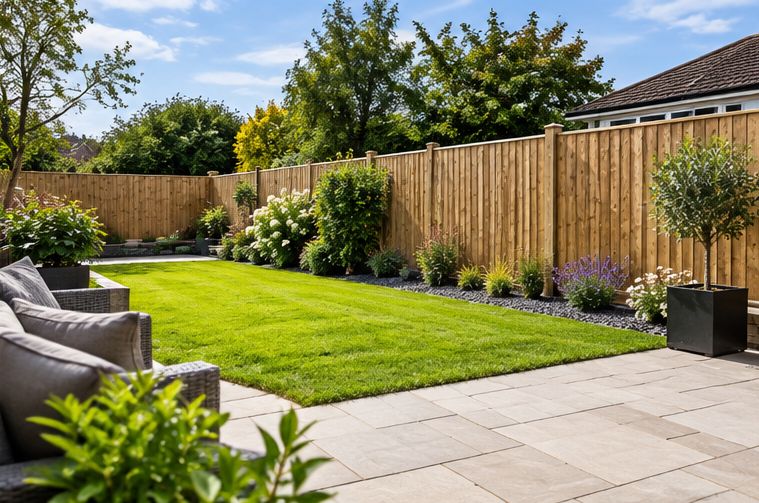
After every big autumn storm we get the same calls: a run of panels lying flat across a lawn, a post snapped off at ground level, or a whole section leaning into next door’s garden. It is one of the most common jobs on our fencing services page, and in most cases the fence was never going to survive the wind it was put up in.
South Wales is a hard place for a fence. Gusts funnel up and down the valleys, hilltop estates catch the full force of weather coming in off the Atlantic, and coastal towns get salt air on top of the wind. Here is how we think about choosing a fence that stays upright.
Why fences fail in the wind
A solid fence panel behaves like a sail. On a gusty day the load on a single panel is considerable, and all of it is passed to the two posts either side. If those posts are rotten at the base, set too shallow, or sitting in wet clay that has softened over the winter, they rock and eventually give way.
The weak points we see most often are:
- Timber posts that have rotted where they meet the soil, often hidden behind a gravel board or a flower bed.
- Posts set in a shallow hole with a little concrete at the bottom, or knocked in with a metal spike that has worked loose.
- Cheap overlap panels with thin slats and light frames that twist and pop out of their slots.
- No gravel board, so the bottom of the panel sits in wet soil and rots from below.
- A long straight run with nothing to stiffen it, on an exposed plot with nothing to break the wind.
Posts matter more than panels
If you only change one thing, change the posts. Concrete posts do not rot, and slotted concrete posts with concrete gravel boards are the most wind-resistant everyday option we fit. Panels slide into the slots, so on a wild night a panel can flex a little rather than wrenching the post. If a panel is damaged, it can usually be lifted out and replaced without disturbing the post.
Some people dislike the look of grey concrete. Heavy pressure-treated timber posts are fine where they are set properly, and they suit close board fencing and more rural settings. What matters is depth and a good concrete footing. As a rough rule, around a quarter of the post’s length should be in the ground, and deeper on soft or wet ground.
On steep valley gardens the posts often have to be stepped down the slope, and the ground can be a mix of clay, shale and old fill. We dig each hole to find firm ground rather than to a set measurement, because a post in loose made-up ground will move whatever it is made of.
Close board, panels or slatted: which design copes best?
The design of the fence changes how much wind it has to fight.
- Close board (featherboard): vertical boards nailed to horizontal rails between posts. Built on site, it is stronger than most ready-made panels and easy to repair board by board. A good choice for exposed boundaries where you want full privacy.
- Heavy-duty panels in concrete posts: quick to fit and easy to replace. Choose a sturdier panel with a proper frame rather than the lightest overlap type.
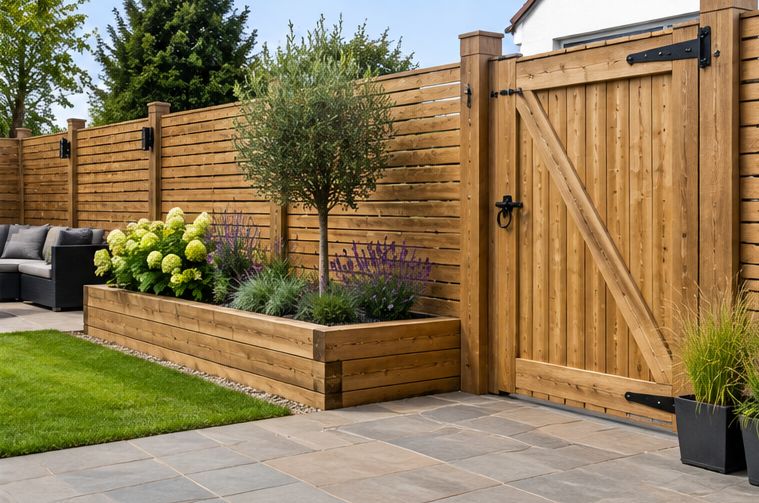
- Slatted and hit-and-miss fencing: small gaps let some wind pass through, which takes pressure off the posts. Hit-and-miss still gives good privacy because the boards overlap on alternate sides.
- Post and rail: barely troubled by wind at all, and a sensible choice for larger rural plots where privacy is not the aim.
Exposed hilltops, valleys and the coast
Where you live makes a difference. Homes high up in places such as Ebbw Vale or Merthyr Tydfil face stronger winds and wetter ground than gardens further down the valleys. For those plots we lean towards concrete posts, deeper footings and a design that lets some air through.
On the coast, in towns like Penarth or Port Talbot, salt air adds to the problem. Galvanised or stainless fixings last far longer than bright steel nails and screws, which rust and stain the timber. It is also worth treating or staining timber regularly on a seaward boundary.
Terraced valley gardens bring their own difficulty: fences often sit on top of a retaining wall. A tall solid fence on an old wall puts real leverage on the stonework in a gale. In that situation a lower fence, a slatted design, or a repair to the wall first can be the safer route, and our brickwork and garden walls work often goes hand in hand with fencing on those plots.
Height, neighbours and rules
A taller fence catches more wind, so there is a practical reason not to go higher than you need. There are also planning limits. As a general guide, a fence up to about two metres high in a back garden, or about one metre next to a road, does not usually need planning permission, but there are exceptions for listed buildings, conservation areas and some newer estates with conditions on boundaries. We are landscapers, not planners, so if in doubt check with your local council before you build.
It is also worth talking to your neighbour first, especially if you are not sure whose fence it is or you are replacing a shared boundary. Deeds sometimes show who is responsible for which side.
Hedges and windbreaks as an alternative
A hedge filters wind rather than blocking it, so it slows the air down without taking the full load. On very exposed plots, a fence with a hedge or shrub planting inside it can work better than a taller fence alone. Native hedging such as hawthorn, beech or hornbeam copes well with Welsh weather once it is established. It takes a few seasons to thicken up, and it needs trimming, which we can take care of through our tree surgery and hedge care service.
Looking after a fence so it lasts
A little attention each year adds a lot to the life of a fence. Keep soil and bark from piling up against gravel boards, cut back climbers that add weight and hold damp against the timber, and re-treat softwood every couple of years. After a storm, walk the fence line and look for posts that rock when you push them. Catching one loose post early can save the next three panels.
If your fence has already blown down, it is often a chance to fix the real cause rather than just putting the panels back. We are happy to look at it and give you free advice on whether a repair or a replacement makes more sense. Ask us for a free quote.
Talk to T J Landscapes about your garden
Free quotes and honest advice across South Wales.
Questions People Ask
What is the strongest type of garden fence for high winds?
For most gardens, slotted concrete posts with concrete gravel boards and sturdy panels, or a well-built close board fence on deep footings. If privacy is less important, slatted or hit-and-miss designs take less wind load.
Can I just replace the blown-down panels?
Sometimes, if the posts are sound. Push each post firmly: if it moves or is soft at the base, new panels will soon go the same way. Replacing failing posts is usually the better use of your money.
Are concrete posts ugly?
They are more functional than pretty, but once climbers or shrubs are growing along the fence they fade into the background. Timber posts are fine where they are properly set and the site is not too exposed.
Do I need planning permission for a new fence?
Usually not for a fence of normal height, but there are limits by roads, in conservation areas and on listed properties, and some estates have conditions. Check with your local council if you are unsure. We can talk through options, but we are not planning advisers.
How long does it take to replace a garden fence?
A typical back garden run is often done in a day or two. Steep ground, old concrete to break out, awkward access or a wall to repair first can all add time. We will tell you what to expect when we quote.