
People book a garden clearance for all sorts of reasons. A house has been empty for a while, a landlord needs a garden sorted between tenants, a family is getting a property ready to sell, or someone has simply lost a couple of summers and the brambles have won. Whatever the reason, it helps to know what to expect before anyone turns up with a van.
Here is how a clearance normally runs when you book one through our garden clearance service, and a few things worth thinking about beforehand.
Step one: a look at the garden
Every clearance is different, so we start by coming to see it. We want to understand how big the job is, what needs to go and what should stay, and how we will get the waste out. That last point matters a lot in South Wales. A back garden up a flight of steps behind a valley terrace, reached through the house or down a narrow rear lane, is a very different job from a flat garden with a side gate and a driveway.
It is worth walking round with us and pointing out anything you want to keep: a favourite shrub, an old rose, stone edging, a bench or a greenhouse. It is much easier to protect these before the work starts than to explain later what was meant.
Step two: an agreed plan and a free quote
After the visit we give you a free quote that sets out what we will do. The things that affect it are the size of the garden, how dense the growth is, access for barrows and the van, how much waste there is and what kind, and anything unusual such as tree work or old structures to take down.
This is also the moment to decide how far you want to go. Some people want everything cut to the ground so they can start again. Others want the garden tidied so the original layout is visible, with the lawn found again and the borders cut back. Both are fine, as long as everyone agrees beforehand.
Step three: cutting back and clearing
On the day, the order of work is usually:
- A last check for nesting birds in hedges and shrubs, and for anything hidden in the undergrowth such as glass, old wire or hazards.
- Cutting down brambles, nettles, long grass and self-seeded saplings, working from the edges inwards so we can see what is underneath.
- Pruning or reducing overgrown hedges and shrubs, and any tree work that has been agreed.
- Pulling out roots where the plan calls for it, especially bramble crowns, which will regrow quickly if left in the ground.
- Clearing rubbish, old pots, broken fencing and anything else agreed in the quote.
- A final rake and sweep so the ground and any paths are left tidy.
What happens to the waste
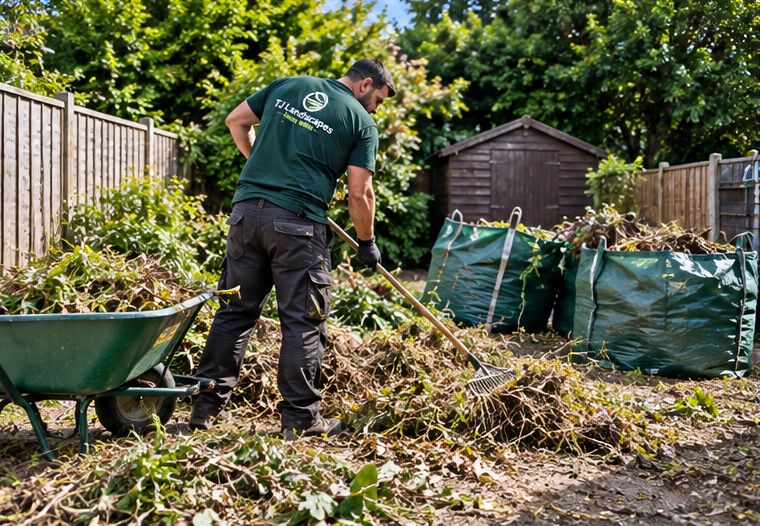
Most of what comes out of an overgrown garden is green waste: cuttings, grass, brambles and branches. We take it away with us, so you are not left with a heap to burn or a series of trips to the tip. Bulky branches can sometimes be chipped and the chippings left as a mulch on the borders if you would like them.
Some materials need more care. Rubble, soil, old slabs and general rubbish are dealt with separately from green waste. Whoever removes waste from your property, it is worth checking they are a registered waste carrier. As a householder you have a duty of care for where your waste ends up, and Natural Resources Wales keeps the public register in Wales.
Things we may need to flag
Clearances sometimes uncover things that need a different approach:
- Japanese knotweed. It is common along rivers, railway lines and old industrial land in the South Wales valleys, and it spreads into gardens. It must not go in with ordinary green waste, and digging it out without a plan usually makes it worse. If we spot it, we will tell you and leave it undisturbed so it can be treated properly.
- Old sheds, garages and roofing. Some older outbuildings have sheeting that may contain asbestos. We will not break it up, and it needs to be checked and removed by a licensed or suitably trained contractor.
- Protected trees. If a tree is covered by a Tree Preservation Order or sits in a conservation area, the council must be involved before work. Our guide on permission to cut down a tree in Wales explains more.
- Nesting birds. Active nests are protected by law, so heavy hedge and shrub clearance is best planned outside spring and summer where possible.
How long does a clearance take?
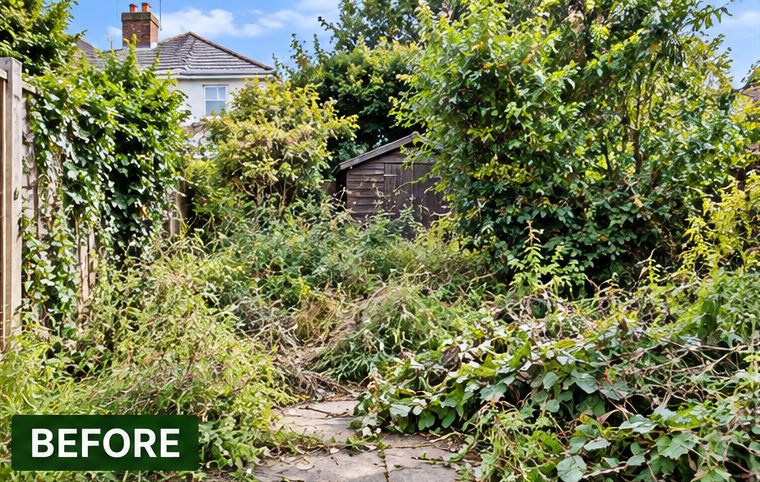
A small, straightforward back garden may take a day. A long garden that has been left for years, with dense brambles, a lot of waste and awkward access, can take several days. Steps and narrow lanes are often the biggest factor, as every barrow load has to be walked out by hand. We will give you a realistic idea of the timings when we quote.
After the clearance: what next?
A cleared garden is a blank canvas, and a lot of people find it far easier to picture a new layout once they can see the ground and the levels. Common next steps include new turf where the lawn has gone, replacement fencing where old panels have rotted behind the growth, or a full redesign through our landscaping and garden design service.
If the aim is to sell or let the property, a clear garden with defined edges and a tidy lawn makes a much better first impression, and it is a relatively quick win. If you are keeping the garden for yourself, it is worth thinking about how to stop it getting away again, which is where our guide to a low-maintenance garden comes in.
We cover Pontypool, where we are based, and towns across South Wales from Cwmbran to Cardiff. To arrange a visit, send us a message or call.
Talk to T J Landscapes about your garden
Free quotes and honest advice across South Wales.
Questions People Ask
Do I need to be at home during the clearance?
Not necessarily, as long as we can get into the garden and we have agreed exactly what stays and what goes. Many landlords and people clearing a relative’s house are not on site for the whole job.
Do you take the waste away?
Yes, green waste is taken away as part of the job. Other materials such as rubble or general rubbish can usually be removed too, and we will agree that when we quote.
Can you clear a garden in spring or summer?
Yes, although we check carefully for nesting birds and may leave some hedges or shrubs until later in the year. Autumn and winter are often easier for heavy clearance because growth has died back.
What affects the cost of a garden clearance?
The size of the garden, how overgrown it is, access, the amount and type of waste, and any extra work such as tree cutting or removing old structures. Every quote we give is free.
Will brambles grow back after clearing?
They will if the roots are left. Digging out the crowns, keeping the ground covered with turf, planting or mulch, and a little regular attention stops most of the regrowth.