
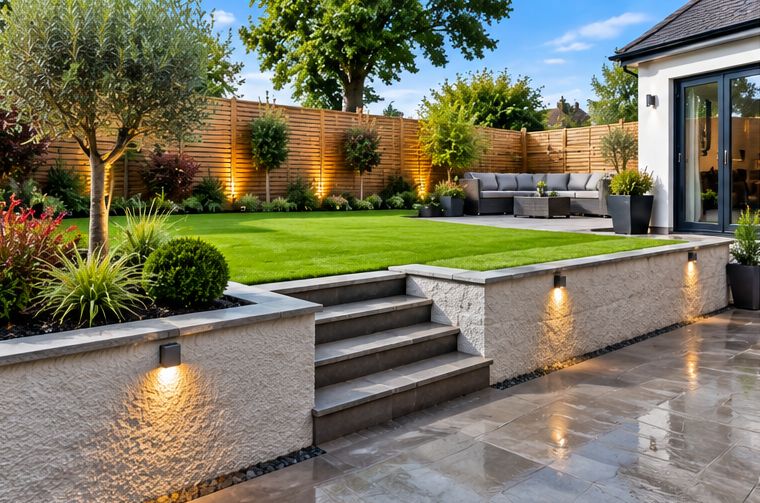
Newport has a lot of large, newer housing estates, and their back gardens tend to arrive in the same state: a rectangle of fresh turf, a small patio of grey slabs by the door, and a panel fence around the edge. It looks tidy on the day you move in. A year or two later, with children, a dog and a couple of wet winters, it often looks rather different.
This guide is about turning that blank rectangle into a family garden that works. It looks at what lies under a new-build lawn, how to split a modest plot into useful areas, and how to plan for children who will be toddlers one year and teenagers the next. If you live in an older semi instead, our garden makeover ideas for Newport semis may suit you better.
Look under the turf first
On many new estates, the ground was driven over by diggers and dumper trucks for months before the houses were finished. The result is compacted subsoil, often clay, sometimes with bricks, concrete and bits of plastic buried in it, covered by a thin layer of topsoil and new turf. That is why so many new-build lawns in Newport go soggy in winter and brown in summer.
Dig a couple of test holes a spade deep before you plan anything. If you hit hard, grey or orange clay and rubble within a few inches, the ground needs breaking up, clearing and topping with good soil before new planting or turf will thrive. It is far easier to do this once, at the start, than to fight it for years.
Split the plot into three zones
Even a small estate garden works better with clear areas for different jobs. We usually think in three: somewhere to sit, somewhere to play, and somewhere for the practical things.
- Sit: a patio or deck big enough for a table, placed where the evening sun lands rather than automatically by the back door.
- Play: an open lawn for kicking a ball, with a softer surface such as bark under a climbing frame or swing.
- Practical: a shed on a proper base, a spot for bikes and bins, a washing line and perhaps a couple of raised beds.
Paths tie the zones together and give wheels something firm to run on. A path of slabs or block paving to the shed means bikes and the lawnmower stop wearing a muddy track across the grass.
Keep the play area in view
With young children, the most useful design decision is where you can see them from. Stand at the kitchen sink and at the patio table and look out. The main play area should be clearly visible from both, which usually puts it in the middle or near side of the garden rather than hidden behind the shed.
As children get older, that priority flips. Teenagers tend to want a corner of their own, further from the house, which is a good use for the far end once the swing has gone. A layout that allows for that change saves redoing the garden in a few years.
Surfaces that can take it
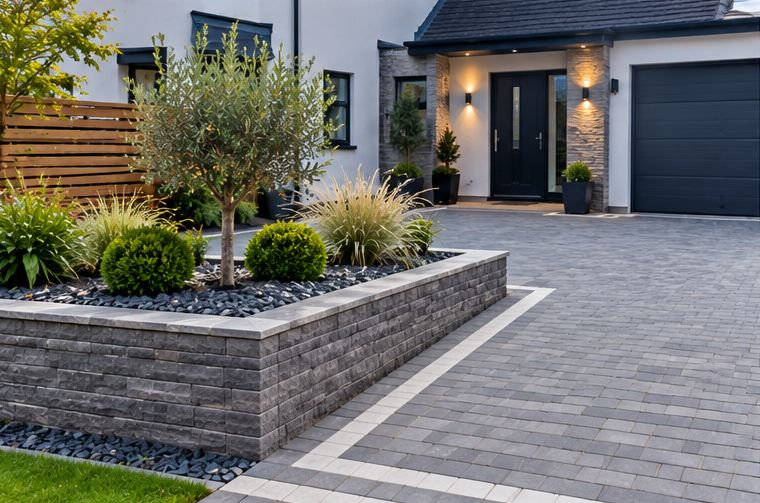
Family gardens get hard use, so the surfaces need to cope. A real lawn is still the nicest thing for children to play on, but it has to be laid on well-prepared ground to survive football and paddling pools. Our turf laying starts with that preparation, and the guide to laying turf in Newport explains what it involves on local soils.
Where grass simply will not grow, such as a shady strip or a heavily used corner, artificial grass is a practical option, as long as it goes down on a free-draining base. For seating areas, a textured porcelain or sandstone patio is hard-wearing and easy to wipe clean; our patio and paving page shows the choices. Composite or timber decking suits a garden that slopes up away from the house, which many Newport estate plots do, and our garden decking page explains the options.
Boundaries, pets and open-plan fronts
The panel fences put up by builders are often on the light side, and on exposed estates they can start to lean within a few years. If you have a dog or small children, a sturdier fence and a lockable gate is worth the investment. Keep gaps at the bottom closed off with gravel boards so pets cannot dig out.
Some newer estates have open-plan front gardens, and the deeds may include covenants about fences, walls or hedges at the front. It is worth reading yours, and checking with Newport City Council about heights beside a road, before planning anything along the front boundary.
Drainage and levels on a sloping plot
Newer estates are often built on sloping ground, and gardens are levelled roughly with a step or a bank at the back. A small retaining wall or sleeper terrace can turn a bank into a flat play lawn and a raised seating area. Walls that hold back much soil need proper design, so we will tell you if engineering advice is needed.
Water from higher gardens also tends to run downhill into yours. A land drain along the bottom of a bank, or a gravel trench behind a retaining wall, keeps the lawn below from turning into a bog. Our guide to patio drainage in Newport covers the paved areas.
Planning it with us
You do not need a finished drawing before you call. Tell us who uses the garden, what you would like to fit in and what bothers you about it now, and we will suggest a layout that suits the plot. Our landscaping and garden design service can then build it in one go or in stages. Tony and the team work across Newport, from Rogerstone and Bettws to Langstone, and quotes are free. Get in touch to arrange a visit.
Talk to T J Landscapes about your garden
Free quotes and honest advice across South Wales.
Questions People Ask
Why is the lawn on my new-build so waterlogged?
Usually because the subsoil was compacted during building and the topsoil on top is thin. Water cannot soak away, so it sits at the surface. Breaking up the ground and adding proper topsoil, or a drain where needed, usually solves it.
Can you build a garden around a trampoline?
Yes. We can set aside a level area with a soft surface or a lawn for it, and some families choose a sunken trampoline set into the ground, which needs drainage beneath it on heavy soil.
Is artificial grass a good idea for a family garden?
It can be, particularly in shade or where a lawn gets worn out. It needs a well-compacted, free-draining base, and it gets warm in strong sun, so many families keep some real grass as well.
Do you work on new estates all over Newport?
Yes. We cover the whole city and the surrounding area; see our landscaping in Newport page for more on the work we do there.
Can the garden be done in stages?
Yes. We plan the whole layout first so each stage fits, then usually start with drainage, levels and hard landscaping and finish with turf and planting.