
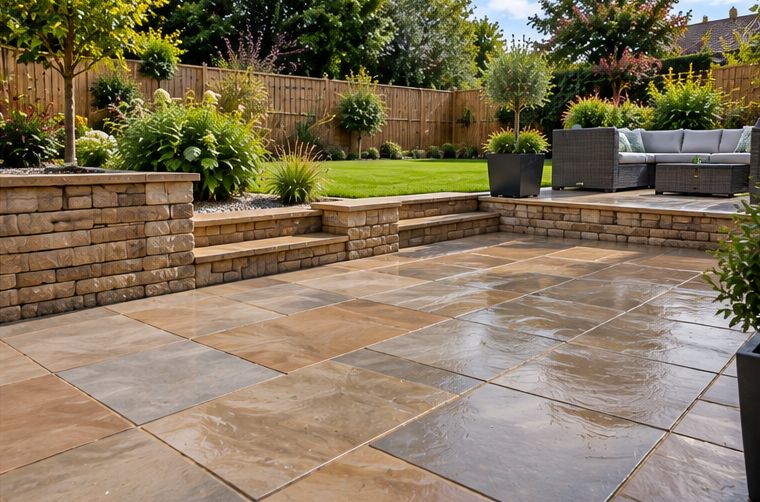
Standing water is one of the complaints we hear most often from patio owners in Newport. It leaves green slime and moss on the slabs, makes the surface slippery, and in winter the water freezes in the joints and slowly breaks them apart. Where it pools against the house, it can also push damp into the walls.
The good news is that it is almost always fixable. This guide explains why it happens in Newport gardens in particular, how to work out what is wrong with yours, and the range of fixes from a simple channel to a full relay. How a patio should be built in the first place is covered in How a Patio Should Be Laid, so here we concentrate on the water.
Why Newport gardens hold on to rain
Newport grew up along the River Usk, and a lot of the city is built on low ground beside it. Many gardens there sit on clay or silty soil that drains slowly at the best of times and not at all once it is saturated in a long wet spell. The water table can be high in winter as well, so there is less room below ground for rain to go.
Add in patios that were laid quickly, often on a few dabs of mortar with barely any slope, and you get the classic picture: a surface that looks fine in summer and holds a sheet of water from October to March. Not every Newport garden is like this, and higher ground up towards Bettws or Rogerstone can behave quite differently, but the pattern is common enough that we check drainage on every patio we quote for in the city.
Reading the puddles
Where the water collects tells you a lot about the cause. It is worth going out after heavy rain and taking a few photos before it dries.
- Small puddles dotted across the patio: individual slabs have sunk, usually because they were laid on dabs or the base underneath has settled.
- One large pool in the middle: the patio has dipped, often from a soft or poorly compacted sub-base.
- Water along the house wall: the fall runs the wrong way, towards the building rather than away from it.
- Water along the far edge: the fall is right but there is nowhere for the water to go, so it backs up against a lawn, wall or raised border.
- The whole surface stays wet: the patio may be almost dead level, or the ground beneath is so saturated that nothing drains.
Slabs that have sunk, cracked or started to rock are a separate issue as well as a drainage one; our guide to why patios sink, crack or lift explains the causes.
Fix one: get the fall right
Every patio needs a gentle slope so rain runs off. It should lead away from the house and towards somewhere the water can be dealt with, and it must never send water onto a neighbour's property. The slope is so slight you barely notice it underfoot, but it makes all the difference in a downpour.
If an existing patio has little or no fall, or falls towards the house, there is no way to add one without lifting the slabs. The good news is that sound slabs can often be cleaned and relaid on a new bed at the right angle, which saves buying new stone.
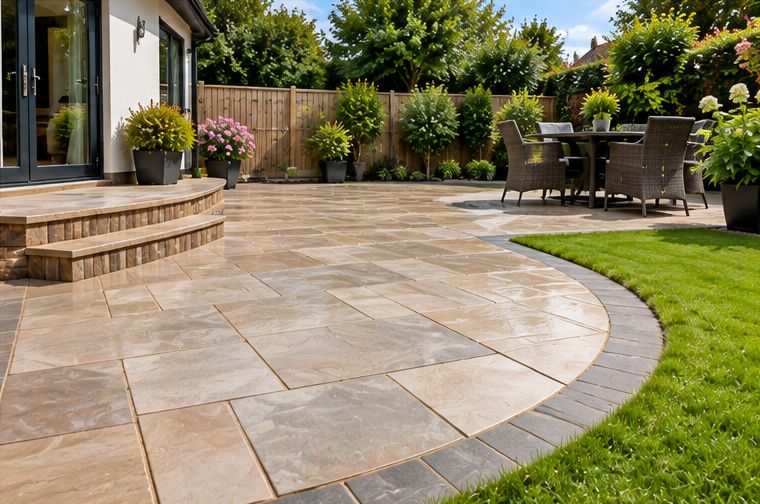
Fix two: catch the water with a channel drain
Sometimes the patio cannot fall away from the house, for example where it meets a back door or runs between the house and a higher lawn. A channel drain, also called a linear drain, is a narrow gully set into the paving with a grating on top. It collects the water along its length and carries it to a drain or soakaway.
Channels are also the usual answer where the patio must finish level with the door threshold, and along the edge of a patio that backs up against a retaining wall. They are neat, low-maintenance and only need the grating clearing of leaves now and then.
Fix three: give the water somewhere to go
Collecting the water is only half the job. It then needs a home. A connection to an existing surface water drain may be possible, but you cannot simply pipe rainwater into the foul sewer, so it is worth checking what the drains at your house are for. Otherwise the options are a soakaway, a gravel-filled trench, or a border or rain garden that can take the extra water.
Soakaways are where Newport's heavy ground bites. A crate or rubble pit buried in clay may fill up and stay full, so on slow-draining soil it has to be larger, placed well away from the house, or combined with a land drain that carries water further. We often dig a trial hole to see how quickly water drains before deciding. The wider options for wet ground are set out in How to Stop a Garden Waterlogging.
Fix four: let the surface breathe
On a new patio or path, a permeable design can reduce how much water needs collecting at all. Permeable block paving, or slabs laid with open gravel joints over a free-draining base, let some rain pass straight through. They are not a cure-all on clay, because the water still has to go somewhere once it reaches the ground, but they spread the load and slow the runoff.
Gravel strips between the patio and the lawn, or around the edge of a raised deck, do a similar job cheaply and look attractive too.
Thinking about a new patio?
If your current patio is past saving, a new one is the chance to design the drainage in from the start: the right levels against the damp-proof course, a proper sub-base, a full mortar bed, falls to a drain and a material that sheds water well. Our patio slabbing and paving page shows the options, and Which Patio Paving Copes Best With Welsh Rain? compares materials. The same thinking applies to a new driveway; see block paving or slabs for a Newport driveway.
Talk to T J Landscapes about your garden
Free quotes and honest advice across South Wales.
Questions People Ask
Can you fix the drainage without replacing my whole patio?
Often, yes. A channel drain along one edge or relaying a small area can solve the problem. If the whole patio falls the wrong way, the slabs need lifting and relaying, but sound ones can usually be reused.
Will a patio in Newport always get some puddles?
A well-laid patio should shed rain within a short time after it stops, even on heavy ground. A few damp joints are normal; water that sits for days is not.
Is green slime a drainage problem?
Usually it is a sign that the surface stays wet for too long, often in a shady spot. Cleaning helps, but improving the fall or drainage stops it coming straight back. Our guide to looking after a patio covers cleaning.
Do you work on patios across Newport?
Yes, from riverside gardens to Caerleon, Malpas, Bassaleg and Langstone. Our landscaping in Newport page covers the rest of the work we do in the city.
How do I get a free quote?
Send us a message with photos taken after rain if you can. Tony will visit, check the levels and ground, and suggest the simplest fix that will work.