
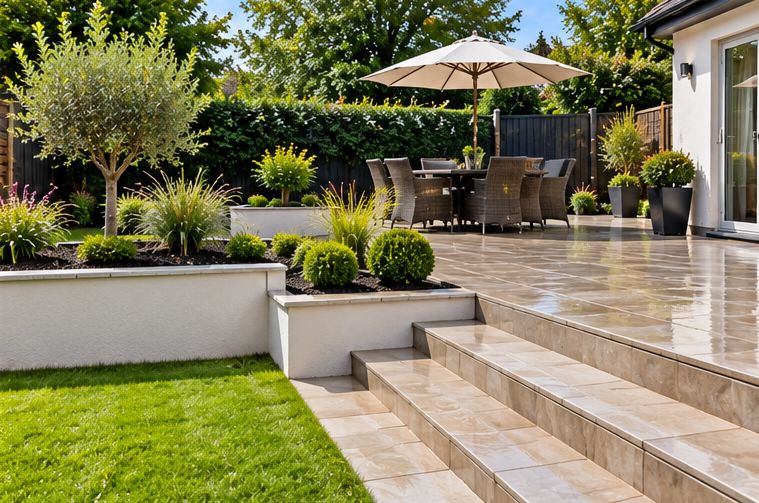
Walk along almost any road of semis in Newport, from Malpas to Bassaleg, and the back gardens have a lot in common. There is a small patio by the back door, a strip of lawn running away from the house, a shed at the far end and fences on both long sides. It works, but it rarely makes the most of the space.
Below are the ideas we suggest most often when a Newport family asks us to rethink the garden behind a semi. Most can be done in stages, and all of them start with the same thing: looking at the ground, the levels and where the water goes. For the wider picture of our work in the city, see our landscaping in Newport page.
Start with the shape you have
Interwar and post-war semis were usually built with gardens that are much longer than they are wide. That shape is the main thing to design around. Run everything down the middle and the garden feels like a corridor; break it into a few distinct areas and it suddenly feels bigger.
It also helps to stand at the kitchen window and at the far end and look back. Note where the sun falls in the afternoon, which corner stays damp, and where the neighbours can see in. Those three things tell you more about where a seating area should go than any drawing.
Idea one: a patio sized for the table you own
The original slab patio on many semis is barely wider than the back door. Extending it so a table and chairs fit with room to walk around them is often the single change people enjoy most. Measure your furniture before deciding on a size, and allow space to pull chairs back.
If the sun sits at the bottom of the garden for most of the evening, a second, smaller seating area there can be more useful than a larger one by the house. A path of slabs or gravel links the two. Our patio and paving page covers the materials we lay, and because a lot of Newport ground holds water, it is worth reading Patio Drainage in Newport before choosing where the new paving will fall.
Idea two: give the lawn a proper outline
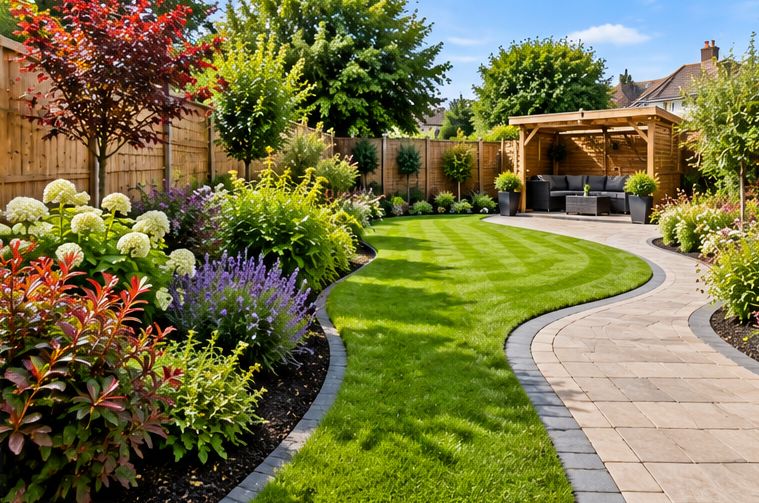
A lawn that simply fills whatever is left over always looks untidy. Giving it a clear shape, such as a rectangle with crisp edges, a circle or a gentle curve, makes the whole garden look planned. A mowing strip of bricks or slabs along the edge saves hours with the shears.
Where the grass is thin, mossy or bumpy, replacing it is often quicker than nursing it back. Our turf laying starts with loosening and levelling the ground, which matters on the heavier soils found in parts of Newport.
Idea three: raised beds, sleepers and planting
Raised beds along one long side of the garden break up the length, give children a place to grow vegetables and lift plants above wet ground. Oak or softwood sleepers are quick to build with and suit most semis; brick raised beds last longer and can match the house.
- Keep beds narrow enough to reach the middle without stepping in.
- Fill them with good topsoil rather than whatever came out of the patio dig.
- Plant evergreen shrubs at the far end to hide the shed or a neighbour's extension.
- Leave gaps for a water feature or garden lighting if you might want them later.
Idea four: fences and the side path
Many older semis in Newport still have their original concrete posts, and a garden makeover is a sensible moment to deal with a tired boundary. New fencing and gates make a surprising difference to how finished a garden looks. If the posts are cracked or leaning, our guide to replacing old concrete fence posts in Newport explains the options.
The side passage beside a semi is often a forgotten strip of cracked concrete and wheelie bins. A sturdy gate, a level path and a screened spot for the bins turn it into a useful route to the back garden rather than an eyesore.
Idea five: privacy without losing the light
Semis sit close to their neighbours, and on a lot of Newport roads the upstairs windows next door look straight down onto the patio. Raising the whole fence is rarely the answer, because it darkens a narrow garden and may need the council's permission above a certain height. A section of slatted screening or a pergola over the seating area gives privacy exactly where you sit and leaves the rest of the garden open.
Planting does the same job more softly. A small multi-stemmed tree, a row of pleached trees or tall grasses in a raised bed will break the line of sight without the solid feel of a wall. Where an existing tree or hedge already blocks too much light, careful crown lifting or hedge trimming can open the garden up again.
Idea six: do not forget the front
Front gardens on Newport semis are often being turned into parking, and that can sit alongside a back garden makeover. A driveway, a low brick wall and a small planted border can all be planned together so the materials match. Our comparison of block paving or slabs for a Newport driveway is a useful place to start, and remember that a dropped kerb needs the council's approval.
Doing it in stages
Few people redo a whole garden in one go, and there is no need to. The order that usually works best is groundwork and drainage first, then walls and paving, then fences, then turf and planting last so they are not trampled. If you plan the full design at the start, each stage fits with the next.
For a sense of what makes one garden project cost more than another, our guide to what affects the cost of garden landscaping explains the main drivers: size, access, ground, materials, levels and waste. Tony and the team are happy to walk the garden with you and give a free quote for all of it or just the first stage. Get in touch to arrange a visit.
Talk to T J Landscapes about your garden
Free quotes and honest advice across South Wales.
Questions People Ask
Can you design the garden as well as build it?
Yes. We talk through how you want to use the space, sketch out a layout and suggest materials, then build it. Our landscaping and garden design page explains how that works.
How do we get materials into the back garden of a semi?
Usually down the side passage. If there is no side access, everything comes through the house or over a neighbour's boundary by agreement, which takes more time and care. We look at access when we visit and plan around it.
Is it worth keeping the old concrete patio?
Sometimes it can be used as a base for decking, but old slabs laid on dabs of mortar are often uneven and hold water. We will tell you honestly whether it is worth keeping once we have seen it.
What is the quickest change that makes the biggest difference?
For most Newport semis it is a larger, well-laid patio and a lawn with a clean edge. Those two jobs alone make a long garden feel far more usable.
Do you work in all parts of Newport?
Yes, from the older roads near the centre to Rogerstone, Bettws, Malpas, Langstone and Caerleon. We are based in Pontypool, so Newport is close by.