
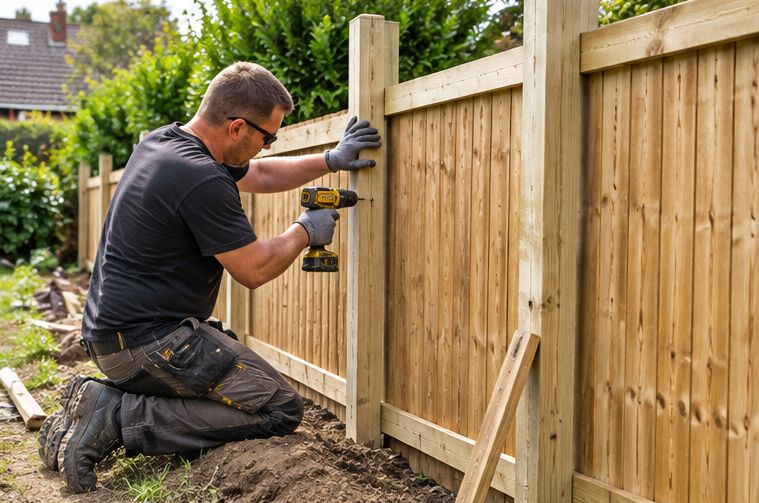
Fences cause more friction between neighbours than almost any other garden job, and a lot of it comes from simple uncertainty: how high can it go, whose side is it, and do we need to ask anyone? The answers for a Cardiff home depend on where the fence is, what kind of house it is and what was agreed when the house was built.
Below is a practical summary of the points we talk through before replacing a boundary. We are landscapers, not solicitors or planning officers, so for anything unusual, check with Cardiff Council or a legal adviser. For the bigger picture of our work in the city, see landscaping in Cardiff.
The usual height limits
Under the normal permitted development rules, most homeowners can put up a fence, wall or gate without planning permission as long as it stays within set heights. As a general guide:
- a fence between back gardens can usually be up to two metres high;
- a fence, wall or gate next to a road used by vehicles, or the footpath beside it, is usually limited to one metre;
- the height is normally measured from the ground on your side, and trellis on top counts towards the total.
On a sloping plot the ground level can differ on each side of the boundary, which makes measuring less obvious. If you are close to the limit, it is worth checking with the council before ordering materials.
Where the rules are tighter in Cardiff
The normal allowances do not apply everywhere. Several situations are common enough in the city to be worth checking:
- Conservation areas. Parts of Cardiff, including Llandaff, are conservation areas. Normal fence rights often still apply, but some streets have extra controls, and taking down an old front wall to put up a fence may need consent.
- Listed buildings. Any boundary within the grounds of a listed building may need listed building consent, even for a like-for-like replacement.
- Newer estates. On the edges of the city, estates such as Pontprennau were often built with open-plan front gardens, and the planning permission or the deeds may restrict fences in front of the house.
- Corner plots. A tall fence on a corner can block the view of drivers pulling out, so the one-metre limit near roads is especially important there.
If any of these might apply, a quick enquiry to Cardiff Council before work starts can save a lot of trouble later. Our guide on tree work in Cardiff conservation areas explains how to find out whether your street is covered.
Whose fence is it?
Many people believe the fence on their left, or the one with the posts facing them, belongs to them. Neither is a reliable rule. Responsibility for a boundary is usually set out in the title deeds, sometimes with a small T mark on the plan pointing into the garden that is responsible. Older Cardiff terraces may have deeds that say nothing useful at all.
Land Registry title plans show general boundaries rather than an exact line, so where there is real doubt it is sensible to agree the position with your neighbour and, if needed, take legal advice. We will always ask who owns a boundary before quoting to replace it.
Talking to the neighbours first
Even when a fence is entirely yours, it is on show to the people next door and often has to be built from their side. A short conversation before work starts goes a long way. It is also a good time to agree a few practical things:
- the style and height, so it suits both gardens;
- whether you are sharing the cost of a boundary that is jointly owned;
- access to their side to fix boards or take out old posts;
- what happens to plants, sheds or climbers growing on the old fence.
By tradition many people put the smooth face towards the neighbour, but that is courtesy rather than law. Keep the structure entirely on your own land unless both owners agree otherwise.
Walls, party walls and old brick boundaries
In the older streets of Roath, Canton and similar areas, many boundaries are brick walls rather than fences. The Party Wall Act can apply to work on a wall that sits astride the boundary or to new walls built on the line, and it may require formal notice to the neighbour. An ordinary timber fence on your own land does not usually bring the Act into play.
If a wall is leaning or crumbling and you would rather replace it with a fence, agree it with the neighbour first, and check it is not a feature protected in a conservation area. Our brickwork team can repair a wall if keeping it makes more sense.
Choosing a fence that suits the rules and the garden
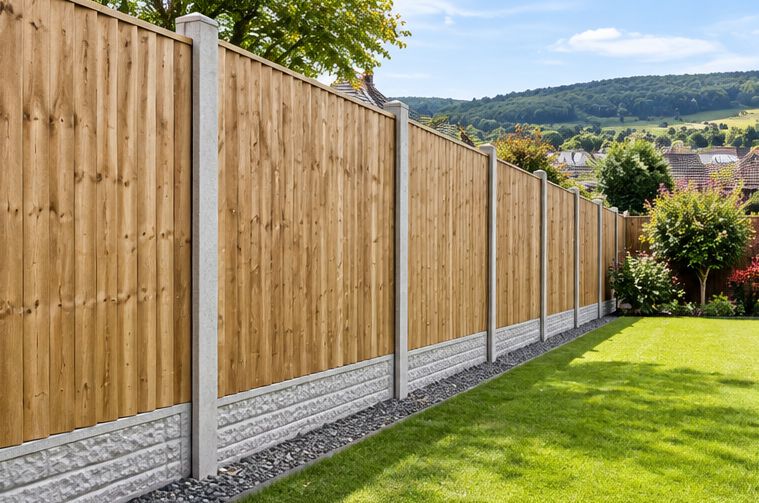
Once the height and position are settled, the style is up to you. In small city gardens, a slatted fence or trellis top can give privacy without making a narrow yard feel boxed in. On the longer plots in Whitchurch, Rhiwbina or Llanishen, close board or good-quality panels in concrete posts are hard to beat for strength. Our guide to close board, panel or slatted fencing compares them.
Think about what sits along the line, too. Mature hedges, tree roots, sheds built tight to the boundary and old concrete footings from a previous fence all affect where new posts can go. In Cardiff gardens that have been fenced and refenced over the decades, it is not unusual to find several generations of old posts buried in the same trench, and they need digging out before a straight new line can be set.
Tony and the team can look at your boundary, talk through heights and styles and give you a free, clear quote. See our fencing and gates page, or ask for a free quote.
Talk to T J Landscapes about your garden
Free quotes and honest advice across South Wales.
Questions People Ask
How high can a garden fence be in Cardiff without planning permission?
Usually up to two metres between back gardens and up to one metre beside a road or its footpath, including any trellis. Conservation areas, listed buildings and conditions on some estates can reduce that, so check with Cardiff Council if unsure.
Does trellis count towards the height?
Generally yes. The total height of the fence and anything fixed on top of it is what counts, measured from the ground.
Can my neighbour stop me replacing my own fence?
If the boundary is yours and the new fence is within the rules and on your land, they usually cannot stop it. Talking to them first still makes the job easier, especially if access to their side is needed.
Which side should the posts face?
There is no legal rule. Many people put the smooth face outward as a courtesy, but it is up to the owner. What matters more is that the fence sits on the right line.
Can you fence off an open-plan front garden on a new estate?
Sometimes, but many estates have conditions or covenants that restrict fences at the front. Check your deeds and ask the council before we price it. A low hedge or planting can be an alternative.