
Street parking is tight in plenty of Cardiff neighbourhoods, so it is no surprise that owners look at the patch of ground in front of the house and wonder if a car could live there instead. On some plots it is a sensible change. On others the space is too shallow, the kerb cannot be dropped or the result would lose more than it gains.
This guide walks through the questions to answer before you commit. We are landscapers, not planners, so treat it as a checklist to take to Cardiff Council rather than the final word. For more on how we work across the city, see our landscaping in Cardiff page.
Is there genuinely room for a car?
Start with a tape measure. The front gardens of many Victorian terraces are only a few steps from bay window to pavement, and a car parked there would overhang the footway, which is not allowed. Interwar semis in suburbs such as Whitchurch, Rhiwbina and Llanishen usually have deeper plots and sometimes a side drive already, which makes the job far more straightforward.
Measure the depth from the house wall to the back of the pavement, and the width between the boundaries. Then think about daily use:
- Can you open the car doors and still get out without climbing over the bay or a hedge?
- Will you still be able to reach the front door, the meter boxes and the bins with the car in place?
- Where will the wheelie bins and recycling boxes live once the garden has gone?
- Is the ground level with the pavement, or would the drive need steps, ramps or retaining walls?
The dropped kerb comes first
Driving across a raised kerb and footway without a proper crossing is not permitted, so a front drive almost always needs a dropped kerb. That is approved and arranged through Cardiff Council, not by the homeowner or the landscaper, and it is worth applying before any work begins in the garden.
The council will look at things like the position of street lights, trees and drains, how close you are to a junction, and whether the crossing would remove a marked parking bay. A new crossing also takes away the kerbside space in front of it, so on some streets you gain a space on the drive and lose one on the road. If the kerb is refused, the rest of the plan falls away, which is why we suggest getting an answer first.
Rainwater and planning permission
Paving a front garden with a hard surface that sends rain straight into the road or the drains can need planning permission. In general, a surface that lets water soak through, or that drains into a border or soakaway within the garden, is treated more favourably. The details can change, so check the current position with the council before you settle on a design.
Other factors can tighten the rules. If the house is listed, sits in a conservation area such as Llandaff, or is affected by a direction that removes normal permitted development rights, changes to front walls, gates and gardens may need consent. Taking down a front boundary wall can be one of those changes. Our article on tree work in Cardiff conservation areas covers how to find out whether your street is affected.
Choosing a surface that suits the street
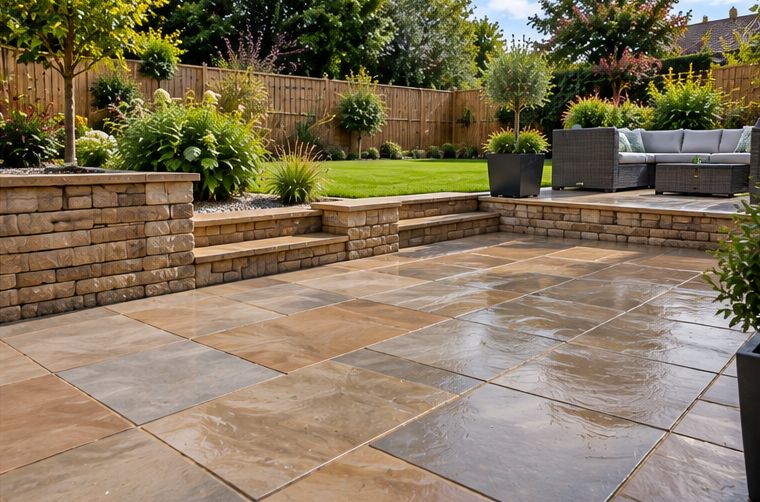
Once the permissions are in hand, the choice of surface is partly practical and partly about how the house looks from the road. The most common options we lay are:
- Permeable block paving, which has wider joints filled with grit so rain passes through into a free-draining base. Read more on our block paving driveways page.
- Standard block paving or slabs laid to fall into a planted strip or a drainage channel that feeds a soakaway.
- Gravel held in a stabilising grid, which drains freely and costs less to build, though it needs occasional raking and topping up.
Whatever the surface, a driveway needs a much deeper and stronger base than a garden path, because it carries the weight of a vehicle. On older plots we often find rubble, old footings and service pipes just below the surface, which is something we check for before quoting. The guide block paving driveways: what to ask before you book lists the questions worth putting to any installer.
What you lose, and how to keep some of it
A front garden does quiet work: it soaks up rain, softens the street and gives a bit of privacy from passers-by. Paving the whole thing wall to wall takes all of that away. A narrow planted border along the boundary, a small tree or shrub by the door, or a strip of low hedge keeps some green and gives water somewhere to drain.
Many Cardiff front gardens are edged by a low brick wall with piers and a gate. Where only part of the wall has to go for the new opening, the ends can be made good with new piers so it still looks finished. Our brickwork team can rebuild or shorten walls to suit.
If a driveway is not possible
Plenty of owners find out the plot is too shallow or the kerb cannot be dropped. That does not mean the front garden has to stay as it is. A clean path in good slabs, a proper bin store, a repaired front wall and a low-maintenance border can make a big difference to the look of the house and to daily life.
It also leaves space for bikes and a safe route to the front door. If you are weighing up the back garden too, our guide on making the most of a small Cardiff terrace garden may help.
How we can help
Tony and the team can come out, measure the plot, look at levels and drainage, and give free advice on whether a drive is realistic before you spend time on applications. Once the kerb and any permissions are agreed, we design and lay the drive, path and edging as one job. See our patio, paving and driveway service, or get in touch for a free quote.
Talk to T J Landscapes about your garden
Free quotes and honest advice across South Wales.
Questions People Ask
Do I need permission to park in my front garden in Cardiff?
You will almost certainly need a dropped kerb approved by Cardiff Council, and the surface may need planning permission if water cannot soak into the ground within your garden. Conservation areas and listed buildings can add further checks.
How deep does a front garden need to be for a car?
Deep enough that the car sits wholly inside your boundary without overhanging the pavement, with room to get in and out and reach the door. Measure your own car and plot, and we can check it on site.
Can I just put gravel down?
Loose gravel drains well but tends to spill onto the footway and move under tyres. Gravel set in a stabilising grid with a solid edge to the pavement is a better option for parking.
Will the drive be ready before the dropped kerb?
We can lay the drive first if the kerb has been approved, but you should not drive over the footway until the crossing has been built. Most people line the two up as closely as possible.
Is block paving or slabs better for a front drive?
Both can work if the base is right. Block paving copes well with turning tyres and comes in permeable versions; large slabs need a very solid base and careful laying to take a car's weight.