
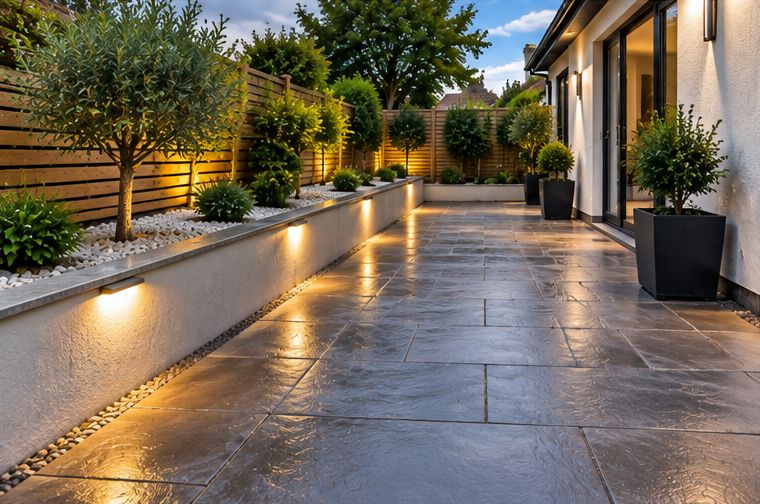
Block paving is one of the most popular driveway surfaces in the country, and for good reason. It looks smart, comes in plenty of colours and styles, and if a patch ever sinks or a service pipe needs digging up, the blocks can be lifted and put back. Laid well, a block drive will carry cars for many years.
Laid badly, it will rut where the wheels run, spread at the edges and hold puddles by the front door. The difference is rarely visible on the day the job is finished, which is why it pays to ask the right questions first. Here is what we would want to know if we were booking one ourselves. Block drives are part of our patio and paving service, and our block paving driveways page shows the kind of work we do.
How deep will the sub-base be?
This is the single most important question. A driveway needs a much stronger base than a patio because it carries the concentrated weight of vehicles. The usual approach is a compacted layer of crushed stone, typically Type 1, laid and rolled in stages. On firm ground that is often in the region of 150mm or more; on soft clay, made-up ground or anywhere a heavy van will park, it needs to be deeper, and sometimes a geotextile membrane goes in underneath.
Ask how it will be compacted, too. A heavy vibrating plate or roller, used on each layer in turn, is what stops the drive settling. A contractor who plans to skim a thin layer of stone over the old ground is saving time now at your expense later.
What will the blocks be laid on?
Standard block paving is not laid on mortar. The blocks sit on a screeded layer of sharp sand, usually a few centimetres thick, laid to an even depth over the compacted sub-base. Once the blocks are down, fine dry sand is brushed into the joints and the whole surface is run over with a plate compactor. That vibrates the blocks down into the sand and packs the joints tight, so the blocks lock together and spread the load.
It is worth asking what thickness of block is proposed. Thinner blocks are common on paths and patios, but a driveway usually calls for a heavier-duty block, especially if larger vehicles will use it.
Which laying pattern, and why?
Patterns are not only about looks. Herringbone, where blocks are set at right angles to each other in a zigzag, is the pattern normally recommended for driveways because it interlocks in every direction and resists the twisting force of tyres turning. Stretcher bond and basketweave can look lovely on paths and patios but are generally less suited to heavy traffic.
Borders in a contrasting block, or a soldier course along the edges, give a neat frame and help define parking areas and paths. Mixing block sizes can give a more natural, cobbled look.
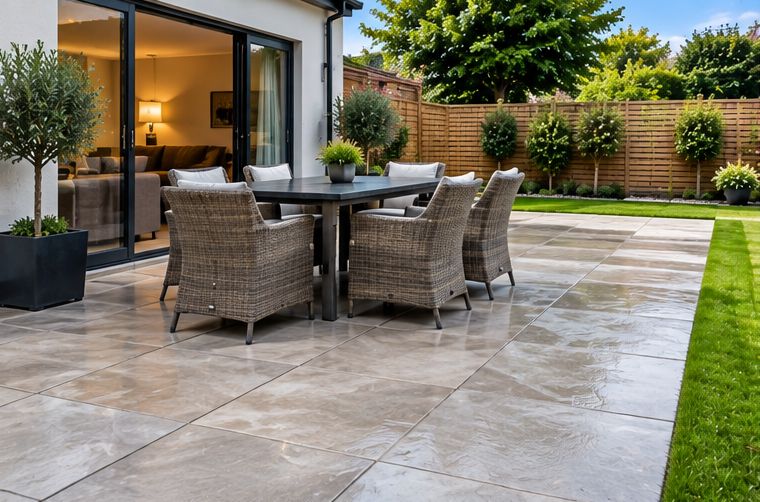
How will the edges be held?
Block paving relies on its edges. Without a firm edge restraint, the blocks slowly spread outwards under traffic and the joints open up. Along every open side there should be a kerb or edging course set in concrete, with a concrete haunch behind it. Where the drive meets a wall or an existing path, those may do the job, but they should be checked.
Ask what edging is planned and where. It is one of the details most often left out of a rushed job, and one of the hardest to add afterwards.
Where will the rain go?
A driveway sheds a lot of water, and on many South Wales streets front gardens slope towards the house or the road. The drive needs a fall that takes water away from the building and towards somewhere suitable: a channel drain across the entrance or in front of the garage, a soakaway, or a planted border that can absorb it. Letting it pour onto the pavement is not the answer.
In Wales, paving over more than a small area of front garden with an impermeable surface usually needs planning permission unless the water drains into your own lawn or borders or through a permeable surface. Larger schemes can also need drainage approval from the council under the sustainable drainage rules. The details matter, so check with your local council before work starts. Permeable block paving, laid on an open stone base with gritted joints so rain soaks straight through, is often the simplest way to stay on the right side of the rules.
Do you need a dropped kerb?
If you will be driving over the pavement to reach the new drive, you will usually need a dropped kerb, and that is a matter for the council as the highway authority, not something a landscaper can simply do. Councils normally have their own application process and rules on who may carry out the work. It is worth applying early, because a new drive without permission to cross the footway is not much use.
Other questions worth asking
Before you sign anything, run through a few more practical points with whoever is quoting.
- What happens to the old surface and the spoil, and is waste removal included?
- Are there manholes or inspection chambers to be raised or fitted with recessed covers?
- How will the drive meet the pavement, the garage and the front door?
- How long before you can park on it?
- Will any existing walls, steps or fences and gates need altering?
Getting a quote
Good answers to these show that the whole job has been thought through, not just the part you can see. Tony and the team lay block paving across the region, from the new town estates of Cwmbran to steep front gardens in Abertillery, and we are happy to walk you through all of it on site. Get in touch for a free quote.
Talk to T J Landscapes about your garden
Free quotes and honest advice across South Wales.
Questions People Ask
How long does a block paving driveway take?
It depends on the size of the drive, access, how much has to be dug out and what is found underneath. Excavation and the sub-base often take longer than laying the blocks. We will give you a realistic idea when we quote.
Can I park on it straight away?
A standard block drive laid on sand and compacted can usually take traffic soon after it is finished, though anything bedded in mortar, such as kerbs and haunching, needs time to cure. We will tell you when it is safe.
Why do weeds grow in block paving?
Seeds land in the jointing sand and root there, especially if the joints are not kept topped up. Regular brushing and refilling low joints helps a lot.
Can a sunken area be repaired?
Usually, yes. The blocks can be lifted, the base put right and the same blocks relaid. If the whole drive is sinking, the sub-base was probably too thin and a bigger job may be needed.
What does a block driveway cost?
The main factors are the size, how much digging and waste removal is involved, the ground conditions, drainage, edging and the block you choose. The simplest way to find out is a free quote on site.