
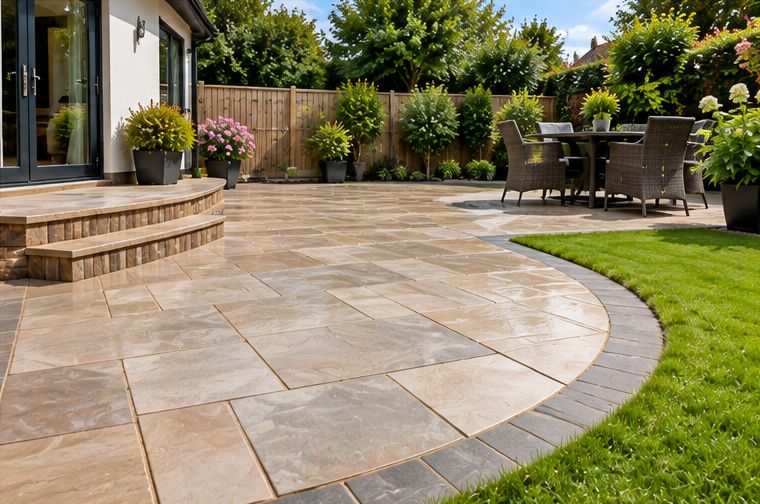
Choosing slabs is usually the part of a new patio people enjoy most, and also the part they worry about most. Walk round any stone yard and you will see dozens of colours and finishes, and the labels do not always tell you how a slab will behave after a few wet winters.
This guide compares the three materials we are asked about most often. We have kept it practical: what each one looks like, how it feels underfoot when it rains, what it asks of you once it is down, and what it means for the way the patio has to be built. For the full picture of what we lay, see our patio and paving service.
Start with the garden, not the brochure
Before comparing materials, it helps to answer a few questions about the space itself. The same slab can look lovely in a sunny, open garden and tired in a damp corner under trees.
- How much sun does the patio get? Shade and damp encourage algae, so porous materials will green up faster.
- What is the house built from? Stone cottages and Victorian terraces often suit natural stone; a modern render or brick finish can carry a crisp, contemporary slab.
- Who will use it? Children, older relatives and dogs make grip a bigger priority than a perfectly smooth finish.
- How much upkeep do you want? Some people like a patio that weathers and mellows; others want it to look the same in ten years as on day one.
Porcelain: crisp, consistent and easy to wipe down
Outdoor porcelain is made by firing clay at very high temperatures, which leaves a dense slab that takes in almost no water. That is why it resists staining so well: spilt wine, barbecue fat and leaf marks tend to sit on the surface and wash off rather than soaking in. Colours are even across a batch, and there are convincing stone-effect and wood-effect ranges as well as plain modern greys.
The points to weigh are grip and laying. Finishes vary a lot between products, so look for an outdoor slip rating and a textured surface wherever the patio will stay damp. Because porcelain is so dense, ordinary mortar does not grip it well, and each slab needs a bonding primer on the back. It is also hard to cut cleanly and needs a proper diamond blade. More detail is on our porcelain paving page.
Indian sandstone: natural colour and a riven texture
Indian sandstone has been one of the most popular patio stones in Britain for years. Each slab is quarried and split, so no two are the same, and the natural riven face gives a textured surface that most people find reassuring on a wet morning. Colours run from warm buffs and browns to cool greys and multi-toned mixes, and there are sawn, smooth-faced versions for a cleaner look.
Being a natural stone, it is porous. In a shaded or north-facing garden it will pick up green algae and, over time, the small black lichen spots that sandstone is known for. Thickness also varies from slab to slab, so each one is bedded individually to bring the surface level. Many people are happy to accept a little weathering in return for the character. You can read more on our Indian sandstone paving page.
Concrete slabs: practical and honest
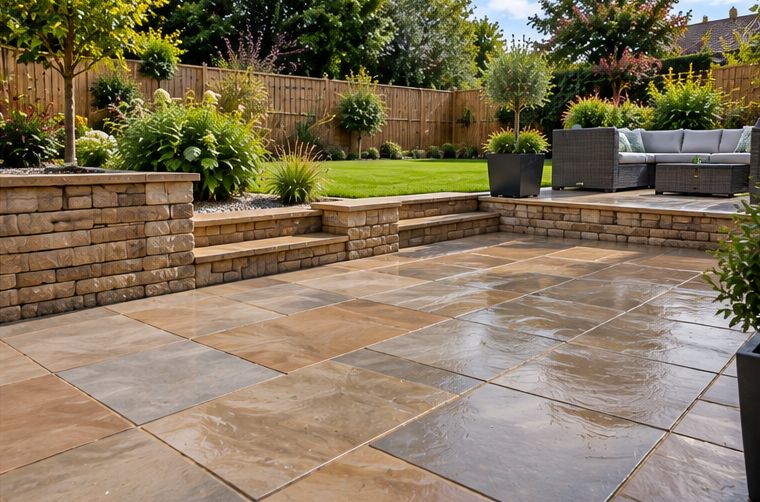
Concrete paving has a reputation left over from the plain grey squares of the seventies, but the better modern ranges are pressed or cast with textured faces and stone-effect colours. They are consistent in size, straightforward to lay and hard-wearing, which makes them a sensible choice for a busy family garden, a utility area by the back door or a large space where natural stone would stretch the budget.
Like sandstone, concrete absorbs some water, so expect it to green a little in shade and to fade gently over the years. Cheaper slabs can look flat and uniform, and some products show a white bloom of salts in their first months, which normally weathers away. It is worth seeing a few samples wet as well as dry.
Side by side: what really separates them
Put simply, porcelain wins on staining and day-to-day cleaning, sandstone wins on natural character and grip, and concrete wins on value and simplicity. None of them is the wrong choice in the right place.
- Looks: porcelain is uniform and modern; sandstone is varied and softens with age; concrete sits between the two, depending on the range.
- Grip when wet: riven sandstone is naturally textured; porcelain depends on the finish chosen; textured concrete is usually fine.
- Cleaning: porcelain needs least; sandstone and concrete need an occasional wash and some attention in shade.
- Laying: concrete is the most forgiving; sandstone takes patience because of uneven thickness; porcelain needs primer, careful cutting and tight, even joints.
Other stones worth a look
These three are not the only options. Limestone gives a softer, more refined look and often comes in smooth, sawn finishes. Granite is very hard wearing and suits steps, edging and heavily used areas. Our natural stone paving page covers the wider range, and if you want to know how each copes with a wet climate, our guide to which patio paving copes best with Welsh rain goes into it.
Whatever you pick, the base does the work
A good slab laid badly will still rock, crack or hold puddles. The sub-base, the bedding, the falls that carry water away from the house and the quality of the joints decide how long a patio lasts far more than the price of the stone. We explain each step in how a patio should be laid.
If you are still torn, the easiest thing is to see samples in your own garden, in your own light. Tony and the team can bring some along and talk it through with you, whether the job is a small seating area in Cwmbran or a large terrace in Monmouth. Ask us for a free quote and we will come and have a look.
Talk to T J Landscapes about your garden
Free quotes and honest advice across South Wales.
Questions People Ask
Which patio slab is the lowest maintenance?
Porcelain generally needs the least looking after, because it absorbs so little water and stains struggle to take hold. It still needs sweeping and the occasional wash, and a shady spot will still collect some grime.
Is Indian sandstone still a good choice?
Yes, for many gardens. It is widely available, looks natural and gives good grip when riven. Just expect it to weather and green a little in shade, and buy from a supplier who can tell you where it comes from.
Are concrete slabs a false economy?
Not if you choose a decent range and have it laid properly. The better textured slabs look smart and last well; very low-cost slabs can look flat and may fade faster. The saving on materials is also small beside the cost of the groundwork, which is the same whatever goes on top.
Can you mix materials in one patio?
Often, yes. A porcelain main area with a sandstone or granite border, or sandstone with a brick edge, can look good. Different materials have different thicknesses and bedding needs, so the levels have to be planned carefully.
Can we see samples before deciding?
Yes. We would always rather you saw a few options on site, ideally wet as well as dry, before you commit.