
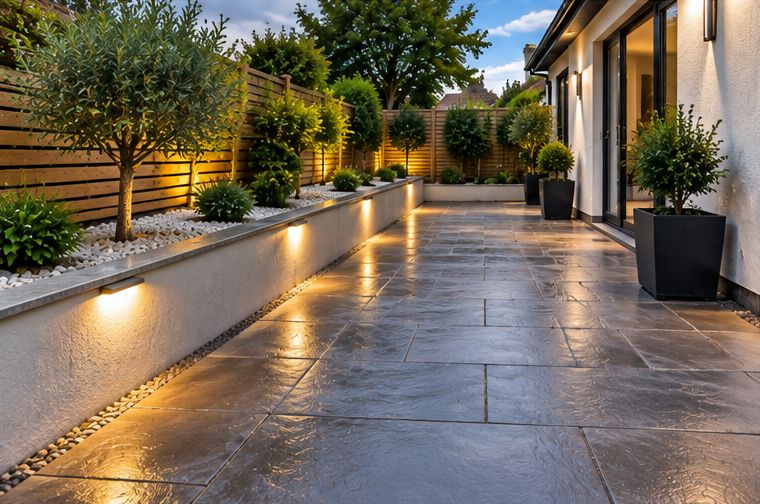
Raised beds bring planting up to where you can reach it, give you control over the soil and add structure to a garden all year round. Built in brick, they can match the house, frame a patio and double as extra seating when friends come round.
They are also one of the most common pieces of garden brickwork to go wrong, usually because they were built like an ornamental wall without thinking about the wet soil inside. Here is how we approach them as part of our brickwork and garden walls service.
Deciding on height, width and shape
Height depends on who will use the bed and how. Around knee height is comfortable for kneeling beside, while a bed built up to seat height lets you sit on the edge to weed and plant. Taller beds suit anyone who finds bending difficult, but the extra soil means more weight pushing on the walls.
Width matters more than people expect. If you can reach a bed from both sides, it can be wider; if it backs onto a fence or wall, keep it narrow enough that you can reach the back without climbing in. Long, thin beds along a boundary work well in narrow terraced gardens, such as the small walled back gardens behind many Victorian terraces in Cardiff, while L-shaped or stepped beds can wrap around a patio corner.
- Think about what will grow there: vegetables and herbs like depth and sun, while shrubs and trees need more soil volume.
- Leave paths wide enough for a wheelbarrow between beds.
- Consider a wider coping on top if you want to sit on the edge.
A proper footing, even for a low bed
Every brick bed needs a solid base. A concrete strip footing under the walls stops them settling unevenly and cracking, which is what happens when bricks are laid straight onto soil or an old path. The footing does not need to be as deep as one for a tall wall, but it does need to reach firm ground.
Building on top of an existing patio is sometimes possible if the slabs are sound and well bedded, but many older patios were laid on sand or spots of mortar and will not carry the weight evenly. We check what is underneath before deciding. Our guide to garden wall foundations explains the principles in more depth.
Getting the water out
This is the part that makes or breaks a raised bed in South Wales. A bed full of wet soil with no escape route becomes waterlogged, which is bad for plants, and it keeps the brickwork saturated, which is bad for the wall.
- Leave the base open to the ground beneath wherever possible, so water can drain down naturally. Break up any compacted subsoil first.
- Build in weep holes near the bottom of the walls, at regular spacing, so water that collects against the brickwork can get out.
- Add a drainage layer of clean stone or gravel at the base if the ground below is heavy clay, separated from the soil above with a membrane.
- Think about where the water goes once it leaves the bed, so it does not run across a patio or pool against the house.
A planter built on a patio or other hard surface needs extra thought, as the water has nowhere to soak away. Outlets through the base or the side of the wall, with a gravel layer inside, are usually the answer.

Protecting the brickwork from wet soil
Soil against a brick wall stays damp for months at a time, and in winter that damp freezes. Bricks used for raised beds should be rated for severe exposure, and it helps to use dense or engineering bricks for the courses in contact with the ground.
We often line the inside faces of the walls with a heavy-duty waterproof membrane before filling. It keeps the soil from touching the brick, which cuts down on frost damage and on the white salt staining that can come through onto the outside face. The membrane stops short of the base so drainage still works.
Our article on choosing bricks and coping has more on frost ratings, mortar and the different ways to finish the top.
Wall thickness and strength
A low bed can often be built with a single skin of brick, strengthened with piers at the corners and along longer runs. Taller beds, and those holding a lot of soil, are better built with a thicker wall, or with a block inner leaf and a brick face, because the soil pushes outward harder as the height goes up.
Where a raised bed is also holding back a slope, it is effectively a retaining wall and should be treated as one. On steep ground, our guide on sloping valleys gardens shows how beds can form part of a terraced layout, and for anything tall or close to a house or boundary it is worth reading when a retaining wall needs engineering advice.
Filling and planting
Resist the temptation to fill the bottom of a bed with builders' rubble to save soil. It can leave pockets where water sits, and it limits root depth. A good screened topsoil, mixed with compost or well-rotted organic matter, gives plants the best start. Soil settles over the first few months, so we fill slightly above the finished level or plan a top-up later.
Once the bed is filled, it is ready for planting, whether that is herbs by the back door, a cutting garden or evergreen shrubs for year-round structure. If you would like help with the planting plan, it can be part of a wider landscaping and garden design scheme.
Brick, sleepers or something else?
Timber sleepers are quicker to install and suit informal and cottage gardens, but they have a shorter life in wet ground. Brick costs more in labour, lasts far longer and can be matched to the house. Rendered blockwork gives a smooth, modern look, and natural stone suits rural plots. Many gardens use a mix, such as brick beds near the house and sleepers further down the garden.
Talk to T J Landscapes about your garden
Free quotes and honest advice across South Wales.
Questions People Ask
How high should a brick raised bed be?
It depends on use. Around knee height suits general planting, while seat height makes weeding easier and gives you somewhere to perch. Taller beds need thicker walls and more soil to fill them.
Does a brick raised bed need a bottom?
Usually not. An open base lets water drain into the ground and gives roots more room. A planter built on a patio or hard standing is the exception and needs drainage outlets.
Why is my raised bed wall going white and flaky?
Wet soil against the brick is the usual cause. Salts come through as white staining, and bricks that are not frost resistant enough start to flake. Lining the inside and choosing the right bricks prevents most of it.
Can you build raised beds on a slope?
Yes. Stepped beds can follow the fall of the ground, and on steeper plots they can act as low retaining walls. Taller ones need the same care as any retaining wall.
How do I get a price for raised beds?
Tell us roughly what you have in mind through the contact form. We will visit, measure up and give you a free quote. The size, the number of beds, access and the ground conditions all affect the cost.