
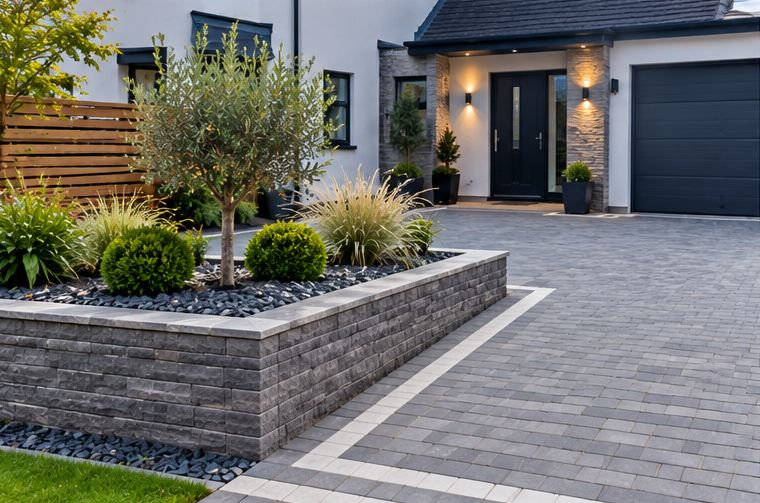
A house wall has a roof over it, gutters to carry the rain away and warmth from inside to dry it out. A garden wall has none of that. It stands in the open, catches driving rain on both sides and soaks up water from the ground at its base, then freezes and thaws through a South Wales winter.
That is why a brick that looks lovely on a showroom pallet can crumble in a few winters when used in the wrong place. This guide explains what we look at when choosing materials for a new wall, and it goes alongside our brickwork and garden walls page, where you can see the wider range of work we take on.
Start with frost resistance
The single most important question for any brick used outdoors is how well it copes with frost. Water gets into the pores of a brick, freezes, expands and slowly breaks the face away. You see the result on many older walls: bricks with their faces flaking off in layers, a problem known as spalling.
Clay bricks made to the current British and European standard are graded for frost resistance, and the grade is usually printed on the pack or the maker's data sheet. For garden walls, copings, steps and anything in contact with the soil, we look for bricks rated for severe exposure, which is usually shown as F2. Bricks with a lower rating are made for sheltered positions and are best kept for inside or under a roof.
- Clay facing bricks are the usual choice for a garden wall. Most modern ones are frost resistant, but always check the grade rather than assume.
- Engineering bricks are very dense and absorb little water. They are ideal for the courses at ground level, below the soil and on top of the wall, although their smooth, uniform look is not to everyone's taste.
- Concrete bricks are strong and consistent and can suit a modern garden, but their colour tends to fade and they do not weather in the same way as clay.
- Reclaimed bricks have real character and can match an old house well. Many were made for indoor or sheltered use, though, so they need sorting carefully, and soft ones should be kept out of the most exposed parts of the wall.
Matching the wall to the house and the street
Once durability is settled, the look matters a great deal. A new wall should feel as though it belongs with the house, even if it is not a perfect match. Red and orange bricks sit well against Victorian terraces, buff and cream blends suit many post-war homes, and multi-coloured blends help a new wall blend into an older setting.
Brick colour varies from batch to batch, so we mix bricks from several packs as we lay them to avoid bands of colour. It also helps to look at a sample panel outside, in daylight and when wet, because a brick can look quite different after rain. That matters here, where it is wet for much of the year.
In stone-built places such as Abergavenny and Chepstow, a stone-faced wall, or brick piers with stone panels, can suit the surroundings better than plain brick.
Coping, capping and brick-on-edge: what goes on top
The top of a wall takes more weather than any other part, and it is where water gets in if nothing stops it. A wall without a proper top will usually start to fail from the top down. There are three common ways to finish it:
- Coping is wider than the wall and overhangs it on one or both sides. The best copings have a groove, called a drip, on the underside of the overhang so rainwater drops clear of the face instead of running down it.
- Capping sits flush with the faces of the wall. It sheds water off the top but does little to keep the faces dry, so it suits more sheltered spots.
- Brick-on-edge is a row of bricks laid on their sides along the top. It is a traditional finish that looks right on many older walls, and it works well in hard, dense bricks, often with a course of creasing tiles underneath to throw water clear.
Copings come in stone, reconstituted stone, concrete and clay. Twice-weathered copings, which slope both ways from a central ridge, suit a freestanding wall seen from both sides. Once-weathered copings slope one way and are often used on boundary and retaining walls, with the fall set towards the side where water can run off harmlessly.
Mortar and joints
Mortar is easy to overlook, but it affects both the strength and the look of the wall. As a general principle, the mortar should be a little weaker than the bricks, so that any movement or frost damage shows up in the joints, which are easy to repoint, rather than in the bricks themselves. The mix is often made a touch stronger for copings and the courses in the ground, where conditions are harshest.
The joint finish matters too. A curved, pressed joint, often called bucket handle, or a sloping weatherstruck joint sheds water well. Deeply recessed joints look crisp but leave a ledge on every brick where water can sit and freeze, so we generally avoid them on exposed walls. The colour of the sand, or a mortar pigment, can make a big difference to how a wall reads from a distance.
Rendered block, stone and other options
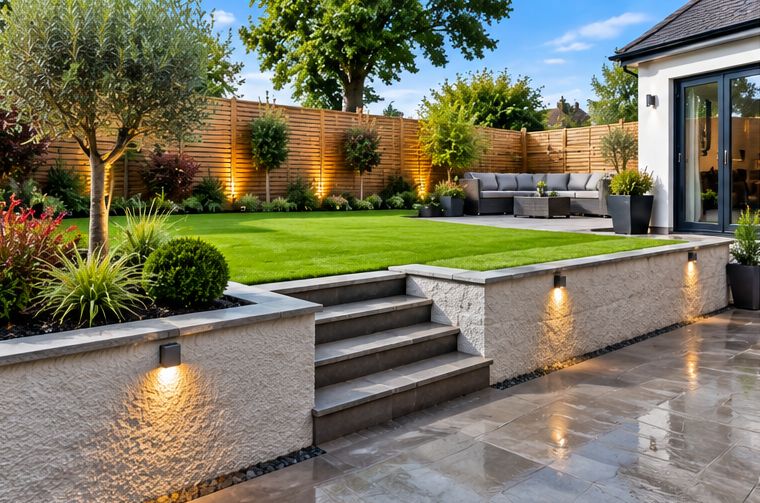
Brick is not the only way to build a good garden wall. A blockwork wall finished in a through-coloured render can look clean and modern, and it pairs well with porcelain paving or a contemporary patio. Render needs a good coping too, or it will stain and crack along the top.
Natural stone, either as solid walling or as a facing over a block core, suits rural gardens and older streets. It usually costs more in time because each piece is shaped and chosen by hand, but a well-built stone wall weathers beautifully.
Common problems and what they tell you
If you are looking at an existing wall and wondering whether to repair or replace it, the materials often explain what has gone wrong:
- White powdery deposits are usually efflorescence, salts carried out of the brick or mortar as it dries. On a new wall this normally fades over the first year or two and can be brushed off.
- Flaking brick faces point to bricks that are not frost resistant enough for their position, or to water getting in from the top.
- Crumbling, sandy mortar can simply be age, and repointing may be enough if the bricks are sound.
- A split or missing coping should be put right quickly, before water gets down into the core of the wall.
Cracks that run through the bricks, or a wall that leans, are more likely to be a foundation problem than a materials one. Our guide to garden wall foundations explains why.
Talk to T J Landscapes about your garden
Free quotes and honest advice across South Wales.
Questions People Ask
Can I use any brick for a garden wall?
No. Look for bricks rated for severe exposure, usually marked F2, especially for the top of the wall, anything below ground and walls that hold back soil. Softer bricks can fail after only a few hard winters.
Do I need coping on a low wall?
Yes, it is still worth having. Even a knee-high wall is soaked by rain from above, and a coping or a brick-on-edge finish protects the joints and bricks underneath.
Can you match the bricks on my house?
We can usually get close. We look at colour, texture and size, and we can bring samples to compare on site. An exact match to an older house is not always possible, so a complementary brick or stone can sometimes look better than a near miss.
Are reclaimed bricks a good idea for a garden wall?
They can be, and they suit period homes well. The key is sorting them, keeping soft or damaged bricks out of the exposed parts and using a hard brick or engineering brick at ground level.
How do I get advice on bricks for my wall?
Get in touch through the contact form. We will come out, look at the house and the site, and talk you through the options in a free quote.