
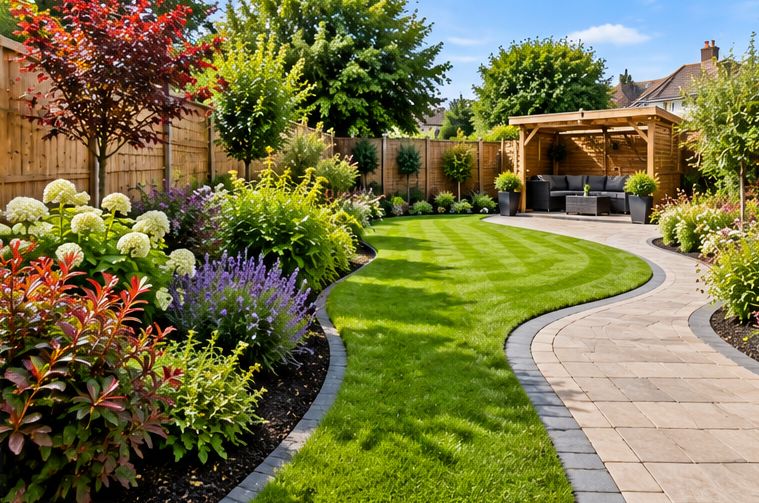
Anyone who lives in the valleys knows the problem. The terraces were built along the hillsides, so the back garden climbs sharply up towards the lane or drops away towards the house below. Too often it ends up as a steep bank of grass nobody wants to mow, a few crumbling steps and a shed perched at an odd angle.
The good news is that sloping gardens have real potential: more privacy, better views and the chance to create separate areas on different levels. This guide sets out the main options and the practical points that matter in places like Pontypool, Aberdare and Tonypandy. Our landscaping and garden design page has more about how we work.
Start with how you want to use the garden
Before thinking about materials, think about what each part of the slope is for. Most people want a flat area near the house for sitting and eating, a safe route up or down, and somewhere for the washing, the bins or the children. A vegetable patch or a shed often suits the higher, sunnier ground at the top.
Stand at the back door and at the top of the garden at different times of day and notice where the sun falls. On many valley terraces the top of the garden gets the evening light while the yard by the house is in shade, which can turn the usual layout on its head.
Terracing: turning one slope into several level spaces
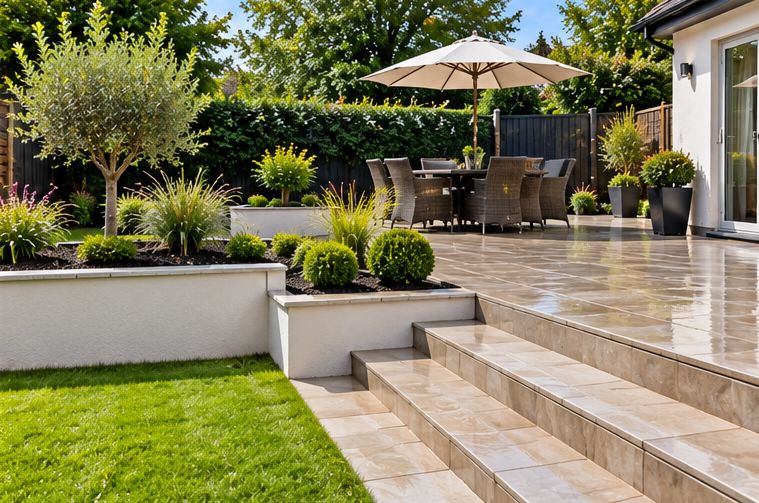
Terracing means cutting the slope into a series of flat steps, each held up by a retaining structure. Two or three generous terraces usually feel better than many narrow ones, and each can have its own job: a patio, a lawn, raised beds, a seating area.
Soil you dig from one level can often be reused to build up the next, which cuts down on waste. That said, valley gardens can hide rubble, old foundations and heavy clay, so there may still be material to take away.
Choosing a retaining wall
Retaining walls are the backbone of a sloping garden, and the part most worth getting right. Soil, especially wet soil, is very heavy, and a wall holding it back is under constant pressure, more so after a long spell of rain.
- Timber sleepers are quick to install, look natural and suit lower terraces. Use sleepers treated for ground contact and fix them securely; they will not last as long as masonry.
- Brick or block walls, faced with brick, render or stone, are strong and long-lasting and can be built with steps and planters worked in. See our brickwork and garden walls page.
- Natural stone suits older terraced streets where stone boundary walls are already part of the scene.
- Gabions, wire cages filled with stone, are free-draining and have a modern look on larger slopes.
Whatever the material, every retaining wall needs a way to let water out. Free-draining backfill behind the wall and weep holes or a drain at its base stop water pressure building up. Many walls that bulge or lean in the valleys have failed because water was trapped behind them.
Taller walls are a different matter. As a general rule, walls retaining more than about a metre of soil, or holding up ground near a house, a path or a neighbour's property, should be designed with proper engineering advice, and you may need to check with your local council. If a wall is on or near a boundary, talk to your neighbour early; in some cases party wall rules may apply, and that is a question for a surveyor rather than a landscaper.
Steps and paths that are safe in the wet
On a steep garden the steps get used every day, often in the rain and the dark. Consistent step heights matter more than anything: uneven steps are what trip people up. Wider treads with a gentle rise are more comfortable than steep, narrow ones, and a landing part way up makes a long flight easier.
Choose a surface with good grip, such as a riven stone, textured paving or a gripped timber tread, and consider a handrail and some low lighting. Our guide on paving in Welsh rain covers slip resistance in more detail.
Decking as an alternative to digging
Where a slope is very steep, or where digging would undermine a wall or a neighbour's ground, a raised deck can create a level space without cutting into the hill. It sits on posts of different lengths, so it can step out from the back door or sit at the top of the garden to catch the view. Our garden decking page and our timber or composite guide explain more. Raised decks can need planning permission, so check with the council first.
Dealing with water on a hillside
Rain on a slope runs downhill, and in a terraced street it often arrives from gardens higher up as well. Plan where that water will go. Each terrace can fall slightly towards a drain or a gravel strip, paths can shed water to the side, and a cut-off drain at the top of the garden can catch water coming down from above.
Avoid simply sending water towards the house or onto a neighbour's property. Our article on how to stop a garden waterlogging explains the main drainage options.
Planting and lawns on a slope
Grass on a steep bank is hard to mow and can wear badly. On the flatter terraces a lawn works well, and we can lay fresh turf once the levels are set. On the steeper banks between, ground-cover shrubs, grasses and tough perennials hold the soil with their roots and need far less work.
Bark or a mulch over a membrane helps keep weeds down while plants establish, although on steep ground it can wash down in heavy rain, so it is best kept to gentler slopes.
Access and getting the work done
The biggest practical challenge with a valleys garden is often getting materials in and waste out. Many terraces have no side access, so everything goes through the house or up the steps from a rear lane, by hand or by barrow. It is slower work, and it is worth knowing that from the start.
If the garden is badly overgrown, a garden clearance first helps show the real shape of the ground. Tony and the team are based in Pontypool and work on sloping gardens across the valleys. We will walk the garden with you, talk through the options and give you a free quote.
Talk to T J Landscapes about your garden
Free quotes and honest advice across South Wales.
Questions People Ask
Is it better to terrace a garden or deck it?
It depends on the slope, the ground and what you want. Terracing gives solid, permanent levels and suits lawns and planting; decking can be quicker on very steep ground and avoids digging near walls. Sometimes a mix of both works best.
My garden wall is bulging. Is it dangerous?
A bulging or leaning retaining wall should be taken seriously, especially after heavy rain. Keep people away from the base and get it looked at. We can advise whether it can be repaired or needs rebuilding, but a large or high wall may need an engineer's opinion.
Can you make a sloping garden fully flat?
Occasionally, but it usually means very high retaining walls and moving a lot of soil. Two or three terraces are normally more practical and look better.
How do you get materials into a terraced garden with no side access?
Usually by hand or barrow, through the house with floors protected, or from a rear lane. We plan access before we start so deliveries and waste are handled as smoothly as possible.
Do raised beds work on a slope?
Yes, very well. Sleeper or brick raised beds can double as low retaining walls and bring planting up to a comfortable height.