

When a garden wall cracks from top to bottom, leans towards the pavement or drops at one end, the brickwork usually gets the blame. More often, the real cause is below ground: a footing that was too shallow, too narrow, built on soft fill or never there at all.
A foundation is the least exciting part of any wall, and the easiest place for a cheap job to cut corners, because once the wall is up nobody can see it. This guide explains what a footing does and what affects it, so you know what to ask when you get quotes. It sits alongside our brickwork and garden walls page.
What a foundation actually does
A brick wall is heavy for its size and very stiff. It cannot flex, so if one part of the ground beneath it sinks or heaves more than another, the wall cracks. The job of the foundation, usually a strip of concrete under the full length of the wall, is to spread the load onto firm ground and keep the whole wall moving as one, if it moves at all.
It also gives the bricklayer a level, solid surface to start from. A wall set out on an uneven or soft base will be out of line from the first course, and the problem only grows as the wall gets taller.
Depth and width: what decides them
There is no single right size for a garden wall footing, which is why it is worth being wary of anyone who gives one without looking at the ground. As a broad guide, the footing needs to be wider than the wall it carries and deep enough to sit on firm, undisturbed ground, below the level where frost and seasonal drying can affect the soil.
The things that push a footing deeper or wider include:
- The height and thickness of the wall. A taller wall is heavier and catches more wind, so it needs a bigger base.
- Clay soil. Clay swells in wet weather and shrinks in dry spells, so footings in clay generally go deeper to reach ground that stays stable.
- Trees and large shrubs nearby. Roots draw water out of clay and can make it shrink, and growing roots can lift or crack a shallow footing.
- Loose or made ground. Old fill, ash, rubble and buried topsoil all need digging through until firm ground is found.
- Retaining soil. A wall holding back a bank needs a footing designed for the sideways push, not just the weight.
The ground beneath South Wales gardens
Much of the lowland area around the coast and the river valleys sits on clay, which holds water in winter and can crack in a hot, dry summer. In older towns and on the valley sides, gardens often hide the remains of earlier buildings, old walls, coal ash, cinders and rubble tipped when the houses were built. None of these makes a reliable base for a new wall.
Water is the other factor. On sloping ground, water moving through the soil can soften it and wash out fine material from under a footing over time. A wall across the line of a slope can also act like a dam, holding water back unless drainage is built in. Our guide to stopping a garden waterlogging covers the ways that water can be managed.
Walls on slopes: stepped footings
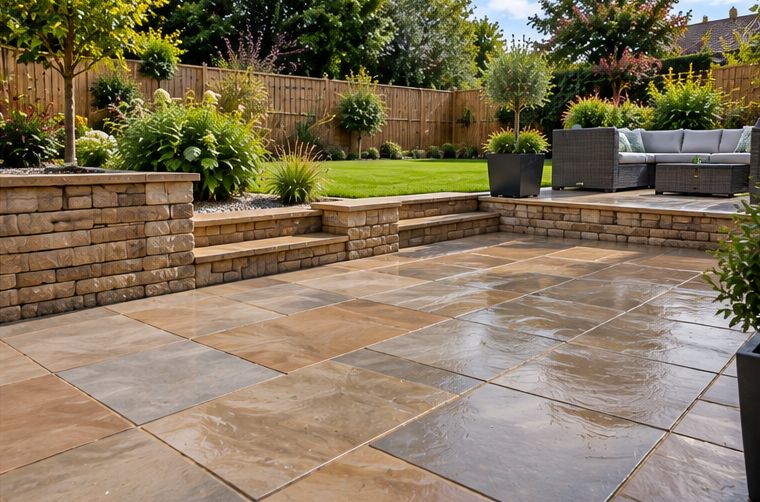
Where a wall runs up or down a slope, the footing is usually built in a series of level steps rather than following the slope in one sloping slab. Each step overlaps the one below, and the brickwork above is set out so the courses stay level. This stops the wall trying to slide downhill and keeps the brick courses neat.
Stepped footings take more care to set out and dig, particularly in the steep, narrow gardens found behind terraces in towns like Pontypool and Tonypandy, where the digging is by hand and every barrow of spoil has to be carried out.
Why not build on the old wall or patio?
It is tempting to build a new wall on the base of an old one, or along the edge of an existing patio, to save digging. We generally advise against it. An old footing may be shallow, cracked or undersized for a new wall, and a patio is laid to carry people walking on it, not a heavy line of brickwork. The new wall inherits every weakness of whatever it sits on.
There are exceptions, and sometimes an old footing turns out to be sound and generous. The only way to know is to dig down and look, which we do before recommending anything.
Signs an existing wall has a foundation problem
If you are unsure whether an old wall can be repaired, these clues point to trouble underneath rather than tired brickwork:
- Diagonal or stepped cracks, often wider at one end than the other.
- A wall that leans, especially if the lean has got worse over time.
- Cracks that line up with a tree, a drain run or a change in the ground.
- One end of the wall lower than the other, with the courses no longer level.
Surface problems such as crumbling mortar or a loose coping can usually be repaired. Structural movement generally means taking the wall down and rebuilding it on a proper footing. A retaining wall showing these signs needs particular care, and our article on when a retaining wall needs engineering advice explains why.
Rules and responsibilities
Many freestanding garden walls fall outside Building Regulations, but taller walls, walls beside a road and walls on a shared boundary can bring in planning, highways or party wall considerations. Check with your local council before building, and talk to your neighbour early if the wall is on or near the boundary. We can explain what we know, but formal advice should come from the council or a surveyor.
Talk to T J Landscapes about your garden
Free quotes and honest advice across South Wales.
Questions People Ask
How deep should a garden wall foundation be?
It depends on the height of the wall, the soil and what is nearby. The aim is always to reach firm, stable ground below the reach of frost and seasonal drying, which means deeper footings on clay and near trees. We decide after digging and seeing the ground.
Does a low garden wall need a foundation?
Yes. Even a short wall is heavy and stiff, and without a concrete footing it will crack and settle unevenly. The footing may be smaller than for a tall wall, but it still needs to be there.
Can tree roots damage a garden wall?
They can, either by lifting a shallow footing or by drying out clay so it shrinks. Where a wall must go near a tree, the footing may need to be deeper or bridge over roots. If the tree itself needs work, see our tree surgery page, and check first whether the tree is protected.
My wall has cracked. Can it be repaired?
Hairline cracks in mortar can often be repointed. Wider cracks through the bricks, or a wall that is leaning, usually point to foundation movement, and a rebuild on a new footing tends to be the lasting fix.
How do I arrange a visit?
Use the contact form to tell us about the wall. We will come out, look at the ground and give you a free quote with the footing we think the job needs.