
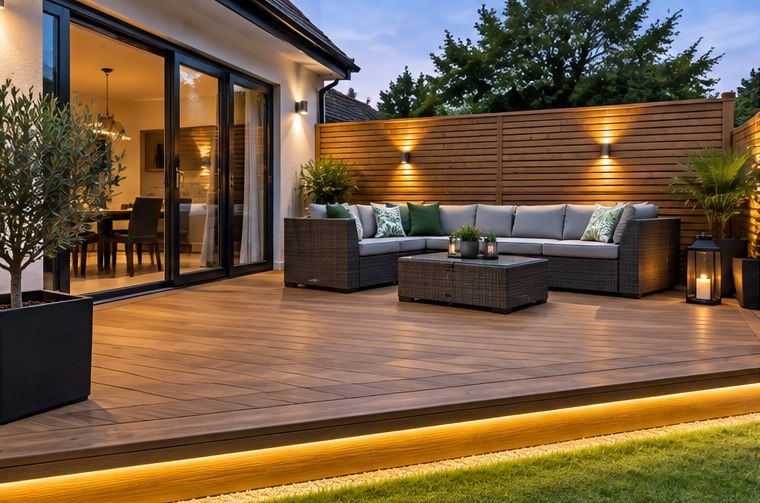
Decking makes a lot of sense in South Wales. On a sloping valleys garden it can create a level space without the digging and walling a patio would need, and on heavy clay it sits above the wettest ground. The question we are asked most is whether to go for traditional timber or composite boards.
Here is a plain comparison, written with our weather in mind. For more about what we build, see our garden decking page.
Timber decking: natural, repairable and easier on the budget
Most timber decking is pressure-treated softwood, which is treated to resist rot and insects. It looks natural, it is easy to cut and shape around trees and odd corners, and individual boards can be replaced if one gets damaged. It usually costs less to buy than composite, which is why it remains the most common choice.
The downside, in a climate like ours, is upkeep. Timber left untreated will weather to silver-grey, which some people like, but it will also be more prone to algae, splits and raised grain. To keep it looking its best it needs a clean and a coat of decking oil or stain every year or two. Hardwood decking is denser and more durable than softwood, but it costs more and is heavier to work with.
Composite decking: low upkeep, higher outlay
Composite boards are made from a mix of wood fibre and plastic. They do not need staining or oiling, they do not splinter, and they hold their colour far better than timber. For many people that is the whole appeal: a wash down a couple of times a year and the deck looks much as it did when it went in.
Quality varies a great deal. Better boards are capped, with a tougher outer shell that resists staining and fading; cheaper uncapped boards can mark and fade more. Composite also needs a closer joist spacing than timber, and it expands and contracts with temperature, so gaps and fixings have to follow the manufacturer's instructions. It is generally more expensive to buy, though the saving on yearly maintenance goes some way to offsetting that over time.
Grip in the wet
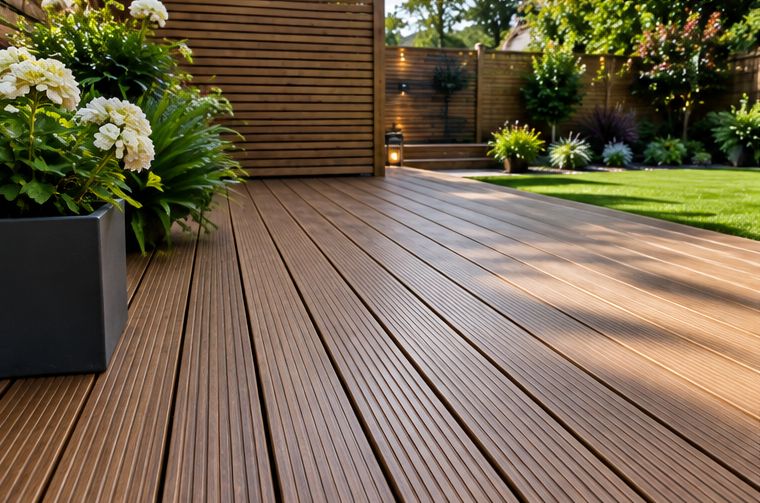
No decking is completely slip-proof when it is wet, green or covered in leaves, and in a damp, north-facing South Wales garden this matters. Timber tends to become slippery as algae builds up, which is why regular cleaning is important. Many composite boards are designed with a textured surface to give better grip, and because they are less porous, algae has less to hold on to.
Whichever you choose, a deck that gets some sun and air dries faster and stays safer. Where a deck sits in deep shade, it is worth thinking about anti-slip strips on steps or considering a patio instead.
What is underneath counts most
Many decks that fail early do so because of the frame, not the boards. Joists and posts sit close to damp ground for years, and in our climate that is where rot starts. Whatever the boards are made of, the subframe needs to be built to last.
- Timber for the frame should be treated to a standard suited to ground contact, and cut ends sealed.
- Posts are best set on or in concrete, or on adjustable supports, rather than buried straight into wet soil.
- A weed membrane and gravel beneath help keep growth down and water draining away.
- There should be enough gap under the deck for air to move, so the frame can dry out between showers.
- Boards need a slight fall or proper gaps so rain does not pool on the surface.
Decking on slopes and uneven ground
Decking really comes into its own on sloping ground. Rather than cutting into the hillside and building retaining walls, a deck can be supported on posts of different heights to create a level area. This is common in valley towns such as Abertillery and Pontypridd, where back gardens rise or fall steeply.
Be aware that raised decking can need planning permission. As a rough guide, a deck more than about 30cm above the ground, or one that covers a large part of the garden, may not be permitted development, and overlooking a neighbour can also be an issue. Rules can differ, so please check with your local council before building a raised deck. Raised decks also need balustrades for safety, and those should be sturdy enough for children to lean on.
How long will each last?
With a well-built frame and regular care, a treated softwood deck can give many years of service, and good hardwood longer still. Composite boards from a reputable maker are designed to last a long time with little work, and many come with manufacturer's cover on the boards themselves, although that applies to the product rather than to how it was fitted.
In reality, lifespan in South Wales depends as much on shade, drainage and airflow as on the material. A deck in a sunny, breezy spot will outlast the same deck squeezed into a damp corner under trees.
Which would we recommend?
If you enjoy a natural look, are happy with a yearly clean and oil, or are working to a tighter budget, timber is still a very good choice. If you want the least possible maintenance, or the deck sits in a shaded, damp spot where timber would struggle, a capped composite is usually worth the extra outlay.
Tony and the team build both, and often combine decking with fencing and screening, lighting or wider garden landscaping. We will look at the light, the levels and the ground, and give you free advice and a free quote. You might also find our guide to patio paving in Welsh rain useful if you are weighing up a deck against a patio.
Talk to T J Landscapes about your garden
Free quotes and honest advice across South Wales.
Questions People Ask
Does composite decking get hot?
It can warm up more than timber in strong direct sun, particularly darker colours. In most South Wales gardens this is rarely a problem, but lighter shades are worth considering for a south-facing deck.
Can you put composite boards on an old timber frame?
Sometimes, but only if the frame is sound and the joists are close enough together for the boards being used. Often it is better to renew the frame at the same time, since it will need to last as long as the new boards.
How do I clean decking?
Sweep off leaves regularly and wash it with a stiff brush and a suitable deck cleaner once or twice a year. Timber then benefits from oil or stain. Check the maker's advice before pressure washing either type.
Is decking a good idea on clay soil?
It can be, because it sits above the wet ground. The key is to make sure water drains away from beneath it and that the posts are well supported, since clay can move as it wets and dries.
Do I need planning permission for decking?
A low, ground-level deck usually does not, but raised decking may. Rules vary, so check with your local council before building anything high off the ground or close to a boundary.