
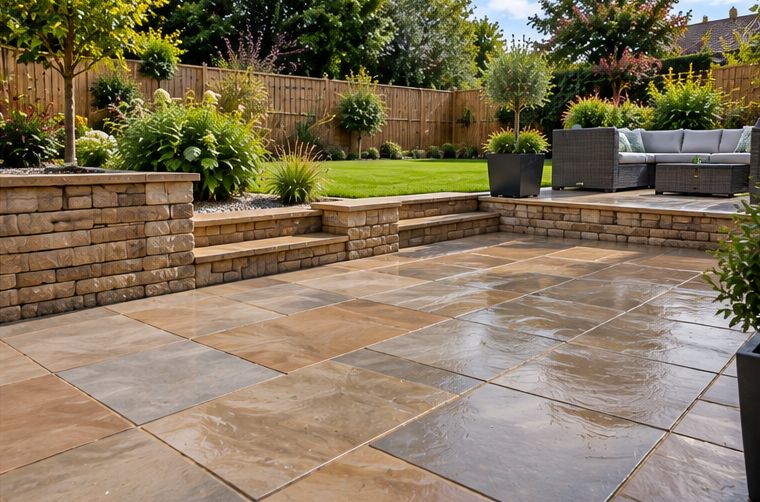
South Wales is a wet place. The valleys in particular get a lot of rain, gardens facing north or tucked below a hillside can stay damp for days, and many back gardens get little winter sun. So when people ask which patio will cope best, they usually mean three things: which one stays looking clean, which one is least slippery, and which one will not end up with puddles by the back door.
There is no single winner. Below we go through the common options honestly, then explain the laying details that make the biggest difference whatever you choose. If you would like us to look at your garden, our patio and paving page explains what we do, and quotes are free.
Porcelain: low upkeep, but check the grip
Outdoor porcelain has become popular for good reason. It absorbs very little water, so moss and algae have less to hold on to, and dirt usually washes off easily. It also keeps its colour well. In a shady, damp garden that would turn sandstone green, porcelain is often the easiest to keep looking smart.
The caution is grip. Some porcelain finishes can feel slick when wet, especially with a film of algae or wet leaves on top. Outdoor porcelain is normally sold with a slip rating, and a textured finish is worth choosing for steps, paths and any area that stays damp. It is also a harder material to cut and lay well, and needs a suitable bedding and a slurry primer so it bonds properly, so it is not the easiest material for a DIY job.
Natural sandstone and limestone
Natural stone, including the widely used Indian sandstone, has a warm, varied look that suits older houses and stone-walled gardens. Its riven surface gives decent grip. The trade-off is that sandstone is porous: in a damp, shaded spot it will pick up green algae and black spots more readily than porcelain, and it will need cleaning from time to time.
A good stone sealer can reduce staining, although opinions differ on whether sealing is worth it, and it changes the look of some stones. Limestone tends to be smoother and a little denser; it can look very smart but, depending on the finish, may be less grippy when wet than a riven sandstone.
Concrete slabs and block paving
Good-quality concrete paving has come a long way, with textured and stone-effect finishes that can look convincing. It is a sensible, hard-wearing choice for a family garden and is usually easier on the budget than natural stone or porcelain. Like sandstone it is porous to a degree, so expect some greening in shade.
Block paving is common on paths and driveways. Its many joints mean weeds and moss can creep into the sand between blocks over time, but it is easy to lift and relay a section if it ever settles. Permeable block paving, laid with wider joints on an open-graded base, lets rain soak through into the ground rather than running off, which can be useful where surface water is a problem.
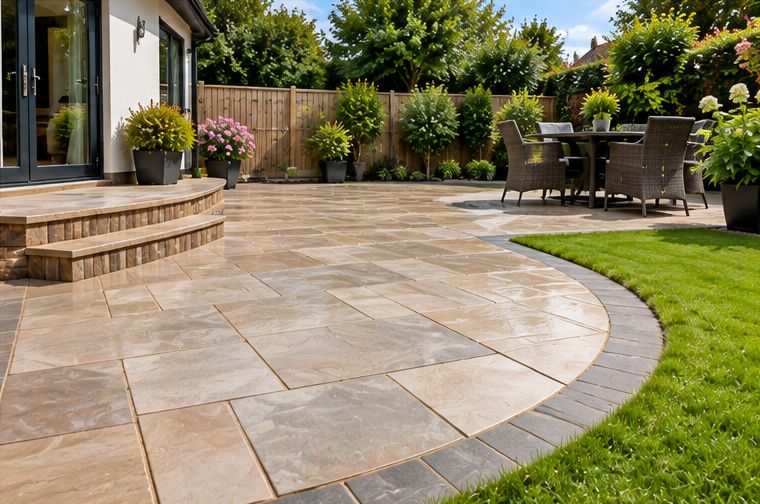
Gravel and resin-bound surfaces
Gravel is about as rain-friendly as a surface gets, because water simply drains through it. Laid over a good membrane and a stable base with firm edging, it is a practical choice for paths and side areas, and it suits informal and cottage-style gardens. On a slope it can migrate downhill, so it is better on the flat or held in a stabilising grid.
Resin-bound surfaces are also porous when laid on a suitable permeable base. They are neat and smooth to walk on, though they need careful installation in dry conditions, which is worth bearing in mind with Welsh weather.
Why the laying matters more than the material
Most patio problems we are asked to fix come down to how the patio was built rather than what it is made of. A beautiful porcelain terrace laid flat on a thin base will still hold puddles and may crack or rock. A modest concrete patio laid properly will shed water and stay level for years.
- A fall away from the house. Paving should slope gently so rain runs away from the walls, not towards them. The slope is slight enough that you will barely notice it underfoot.
- Below the damp-proof course. The finished surface should sit well below the damp-proof course of the house, so splash and standing water cannot bridge it. The usual guidance is at least two brick courses below.
- A proper sub-base. A compacted base of the right depth, which may need to be deeper on soft clay, stops slabs sinking and rocking.
- Somewhere for the water to go. A channel drain along a doorway, a soakaway, or an edge draining onto lawn or border rather than a neighbour's garden.
- Good jointing. Well-filled joints keep water out of the bed beneath and make weeds less likely.
Driveways and front gardens: check the rules
If you are thinking of paving a front garden for parking, be aware that rules on surface water apply. Broadly, larger areas of hard surfacing in front of a house may need planning permission unless the surface is permeable or the water drains to a lawn or border within your own property. Larger new schemes in Wales can also need approval for their drainage. The details change, so check with your local council before you commit. We are landscapers rather than planners, but we are happy to talk through permeable options.
So which one would we choose?
For a shaded, damp garden where you want minimal cleaning, a textured porcelain is often the easiest to live with. For a period home or a garden with existing stone walls, a riven sandstone usually looks more at home, as long as you are happy to give it a wash now and then. For a family patio on a sensible budget, good concrete paving does the job well. For paths and awkward corners, gravel can be both cheap and very forgiving of rain.
The right answer depends on your garden's light, how you use it and how much upkeep you want. Tony and the team are glad to bring samples and give free advice on site. We lay patios across the region, from shady terrace yards in Merthyr Tydfil to breezy gardens in Penarth, and often combine paving with low brick walls or wider landscaping.
Talk to T J Landscapes about your garden
Free quotes and honest advice across South Wales.
Questions People Ask
How do I stop my patio going green?
Some greening is natural in a damp, shaded garden. Regular sweeping to clear leaves and soil, an occasional wash and good drainage all help. Porcelain greens up less than porous stone, and cutting back overhanging shrubs to let in light and air can make a real difference.
Is porcelain paving slippery in the rain?
It depends on the finish. Choose a product with a good outdoor slip rating and a textured surface, particularly for steps and damp corners, and keep it free of algae and leaves.
Should I pressure wash my patio?
It is fine for most porcelain and concrete, used with care. On natural stone a very high pressure can damage the surface and wash out the joints, so a lower setting or a stone-safe cleaner is kinder.
Why does water sit on my patio?
Usually because it was laid without enough fall, or part of it has sunk. Sometimes it can be lifted and relaid on a better base; we can take a look and tell you honestly whether it is worth saving.
Can you lay a patio in winter?
Yes, in reasonable weather, although we avoid laying in frost or heavy rain because it affects the mortar and the finish. Planning in winter so the work is done for spring is a popular approach.