
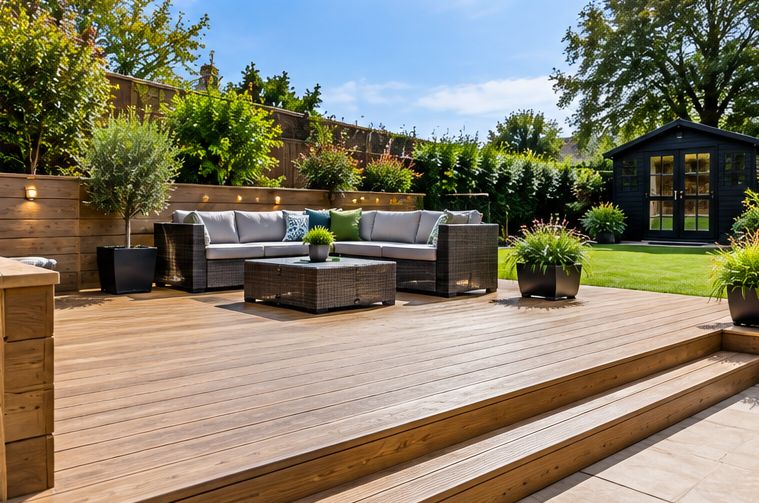
A bare deck is useful, but a few well-chosen extras turn it into somewhere you actually want to sit. The best time to plan them is before the deck is built, because cables, fixings and extra framing are far easier to fit while the boards are off.
This guide runs through the most popular finishing touches we are asked about, with the practical points that stop them causing trouble later. For the deck itself, see our garden decking page.
Lighting that makes the deck usable after dark
Lighting is the addition that makes the biggest difference to how often a deck gets used. In a South Wales autumn, when it is dark by teatime, a lit deck can still be a pleasant place to sit on a dry evening.
- Recessed deck lights, set flush into the boards, mark out edges and routes without anything to trip over.
- Step and riser lights make each tread visible, which is the most important safety use of lighting on a deck.
- Post cap lights sit on top of balustrade posts and give a soft glow around the edge.
- Strip lights tucked under a handrail, bench or step nosing give indirect light with no glare.
- Uplighters in nearby borders pick out a tree, a wall or planting beyond the deck.
Low voltage, mains and staying safe
Most deck lighting is low-voltage LED, run from a transformer. It is safer outdoors, the lights stay cool, and the running cost is small. The cable can be clipped to the joists as the deck is built, so it is hidden but still reachable.
Anything that connects to the mains, such as a new outdoor socket, a fused spur for the transformer or wiring back to the house, should be done by a registered electrician. We can plan the layout, fit the fittings and run low-voltage cable as the deck goes down, and leave the mains connection ready for an electrician to complete.
Solar lights are an easy add-on too. They are less bright and less reliable in our winters, but they need no cable at all and work well as accents.
Built-in planters
Planters soften the hard lines of a deck and bring greenery right up to where you sit. They can be built from matching boards around the edge, at the top of steps, or as a screen between you and a neighbour.
A planter full of wet soil is heavy, so where one sits on the deck the frame beneath needs to be designed to carry it. Inside, it should be lined with a membrane to protect the timber, with drainage holes and a layer of gravel at the base so roots are not left sitting in water. Where possible, a planter standing on the ground beside the deck is simpler and lasts longer than one sitting on the boards.
Hardy grasses, herbs, small evergreens and seasonal bedding all do well. For ideas on easy-care planting, our guide to planning a low-maintenance garden is a useful read.
Benches, storage and steps that double as seats
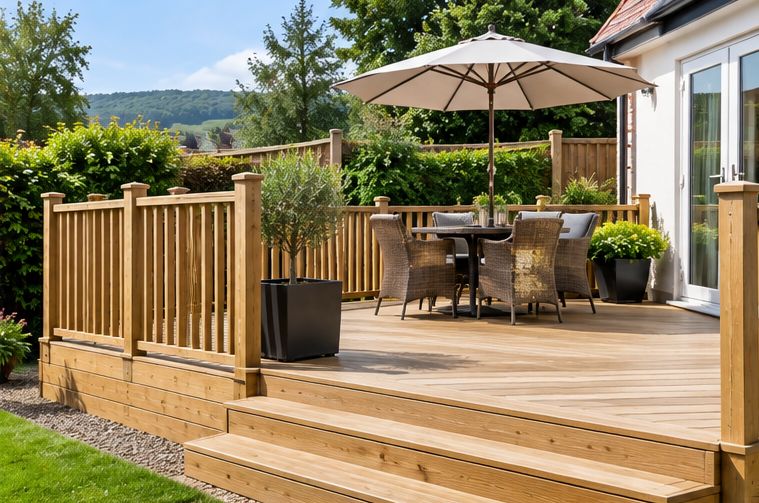
A built-in bench along one side of a deck saves space compared with loose furniture, and it can include a lift-up lid for cushions or garden tools. On a sloping site, wide deck steps can double as informal seating for extra guests.
Built-in seating works best with a backrest angled for comfort and a slight gap between the boards so rain drains off. Choosing boards that match the deck gives a tidy, joined-up look.
Storage under a bench or behind a deck step is handy for cushions, but anything kept there should be able to cope with some damp. A small gap at the back and a few drainage holes stop the space turning musty over winter.
Fascias, skirting and edges
The edge of a deck is what people notice first. A fascia board fixed around the outside hides the ends of the joists and gives a clean line. On a raised deck, skirting boards or trellis below the fascia hide the frame and stop leaves and litter blowing underneath.
Edges should never be sealed tight. A gap at the bottom, or open trellis, keeps air moving under the deck so the frame can dry out. Where the deck meets a lawn, a gravel strip or edging stops mud and grass clippings reaching the boards.
If you have a raised deck in mind, our guide to raised decking frames, steps and balustrades covers the structure these finishing touches attach to.
Screens, pergolas and shelter
Many decks in South Wales need some shelter from wind or neighbours. Slatted timber screens give privacy while letting some air through, so they cope better with gusts than solid panels. They can be built as part of the deck or as a separate section of fencing.
A pergola over part of the deck gives a frame for climbing plants, a place to hang lights and, with a canopy or sail, a little cover from showers. Bear in mind that any roof over a deck will shade it and slow drying, so a lighter, open structure is usually better than a solid cover.
Outdoor heaters and fire pits need care near timber and composite. Keep them well clear of the boards, stand them on a heat-proof base, and follow the maker's guidance on clearances.
Pulling the whole garden together
The finishing touches are what tie a deck into the rest of the garden. Tony and the team often build decks as part of a larger plan with landscaping, new turf or paving, so lighting, planting and paths all line up.
We work across the region, from coastal gardens in Penarth to rural plots near Abergavenny. Tell us what you have in mind and we will give you free advice and a free quote.
Talk to T J Landscapes about your garden
Free quotes and honest advice across South Wales.
Questions People Ask
Can lights be added to an existing deck?
Yes, in most cases. Recessed lights need holes drilling in the boards and access underneath for the cable, which is easier on a raised deck. Surface-mounted and solar lights are simpler still.
Do deck lights need an electrician?
Plug-in low-voltage kits often do not, but any new mains connection outdoors should be made by a registered electrician. We can plan the layout and leave the connection ready.
Will a planter rot my decking?
Not if it is lined, drained and raised slightly off the boards. Problems come from soil and water sitting against bare timber, so the construction of the planter matters.
Can I put a hot tub on my deck?
Only on a deck designed to carry it. A filled hot tub is extremely heavy, so it usually needs its own base or a much stronger frame. Tell us at the start if one is planned.
What finishing touches suit a small deck?
Keep it simple: a built-in bench with storage, a couple of step lights and one planter usually give a small deck the most use without cluttering it.