
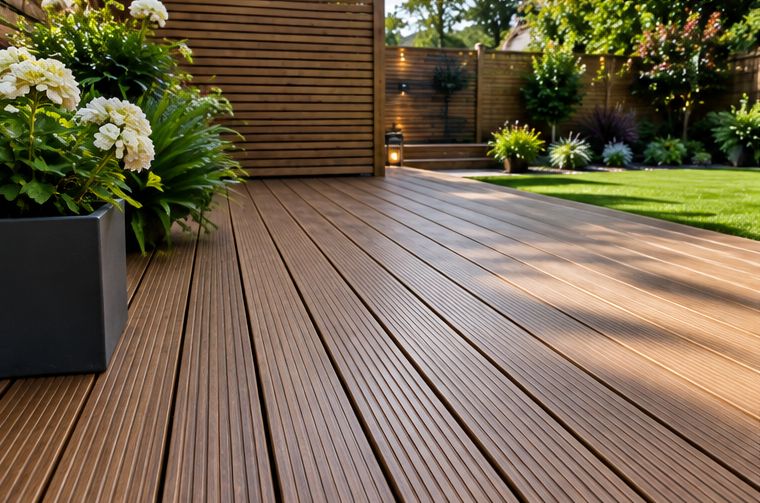
If there is one complaint we hear about decking more than any other, it is that it becomes treacherous in winter. In a climate as wet as ours, a deck that was perfectly safe in August can be like an ice rink by November, especially on the steps.
The good news is that it is rarely the boards themselves that are at fault. This guide explains what causes the slime, how to clean it off without damaging the deck, and what can be done to add grip for good. For help with a new or existing deck, visit our garden decking page.
Why decks turn slippery
The slippery film on a deck is mostly algae, with a bit of moss, lichen and fine dirt mixed in. It grows wherever the surface stays damp and gets little direct sun. Rainwater alone is not the main problem; it is the green layer that forms after weeks of damp weather.
Several things speed it up. Shade from a house, a high fence or trees keeps the boards wet. Leaves left lying hold moisture against the surface and rot down into a slick mat. Gaps between boards that are clogged with debris stop water draining. North-facing decks and those tucked into sheltered valley gardens are the worst affected.
Worn timber adds to it. As softwood ages, its surface opens up and becomes rougher and more absorbent, so it stays wet for longer after each shower and gives algae a better foothold. An older deck that has not been oiled for several years often turns green much faster than it did when new.
Clean it properly, and regularly
The single most effective step is cleaning. Sweep the deck often through autumn and winter so leaves never have a chance to settle, and run a thin scraper or putty knife along the gaps now and then so water can get away.
At least once a year, and more often on a shaded deck, give it a thorough scrub:
- Choose a dry spell and clear the deck completely, including pots and furniture.
- Wet the boards, then apply a cleaner made for decking, following the directions on the label.
- Scrub along the grain with a stiff brush, paying extra attention to steps and walkways.
- Rinse off thoroughly and let the deck dry before putting anything back.
- On timber, apply decking oil or an anti-slip treatment once it is fully dry.
A word on pressure washers
A pressure washer strips algae quickly, which is why so many people reach for one. The trouble is that on softwood it can also blast away the soft surface fibres, leaving the grain raised and furry. That rough surface then holds even more water and grows algae faster the following year.
If you do use one, keep to a low setting, hold the nozzle well back and work along the boards rather than across them. For composite, check the manufacturer's advice first, as some ranges allow it and others advise against it.
Adding grip that lasts
Cleaning removes the slime, but on steps and shady walkways it helps to build grip into the surface as well. There are several ways to do this, and they can be combined.
- Anti-slip strips screwed across the treads of steps or along the main route. They are hard-wearing and can be added to an existing deck.
- Anti-slip inserts, where boards are made with a gritted strip set into grooves along their length. These are usually fitted when the deck is built.
- Gritted oils and coatings, which leave a slightly rough finish on timber and need renewing over time.
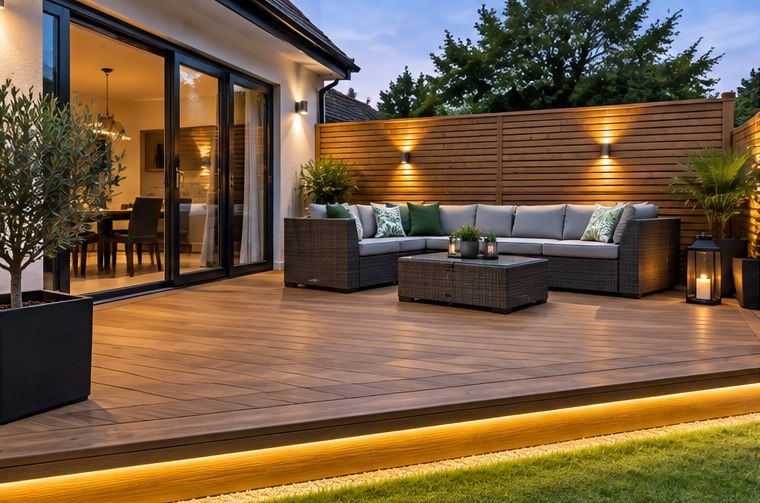
- Textured composite boards, many of which are designed with a surface pattern that gives better grip than smooth planed timber.
Grooves up or smooth side up?
Many timber boards have a ribbed face and a smooth face, and it is widely assumed the ribs are there for grip. In practice the ribs do not do much on their own. Water, dirt and algae settle in the grooves, and a green grooved board can be just as slippery as a smooth one.
Some people now lay the smooth face up, because it sheds water more easily and is simpler to keep clean. Either way, what matters more is keeping the surface clean and, where grip is important, adding inserts or strips. If you are choosing new boards, our comparison of composite and timber decking covers how each copes with the wet.
Changes that help at the design stage
If a deck is always going to be in shadow, some thought at the design stage saves years of scrubbing. Siting the deck where it gets even a few hours of sun, raising the crown of an overhanging tree to let in light, and lowering a high fence or swapping it for a slatted screen can all help it dry out.
Boards laid with proper gaps, with the deck built on a slight fall away from the house, let rain run off rather than sitting on the surface. Good airflow underneath helps the whole deck dry faster. Our tree surgery and hedge care team can lift or thin trees that shade a deck, and in very dark corners a textured patio may be the better choice.
Help with a slippery deck
If your deck has become hard to keep safe, Tony and the team can look at why, whether that is shade, drainage, the boards or the steps, and suggest the simplest fix. That might be grip strips on the steps, replacing a few worn boards, or re-boarding with a textured composite on the existing frame if it is sound.
We work right across South Wales, including the wetter upland towns such as Merthyr Tydfil and Ebbw Vale. Get in touch for free advice and a free quote.
Talk to T J Landscapes about your garden
Free quotes and honest advice across South Wales.
Questions People Ask
Can I use bleach to clean decking?
It is best avoided. Bleach can discolour timber and harm nearby plants and lawns. A cleaner made for decking, used as directed, does the job with less risk.
Is composite decking slippery when wet?
Any deck can be slippery when it is wet and dirty. Many composite boards have a textured surface that grips better than smooth timber, but they still need washing to stop algae building up.
How often should I clean a shaded deck?
A deck in shade may need a scrub two or three times a year, plus regular sweeping in autumn. A sunny deck can often get by with one good clean each spring.
Can anti-slip strips be fitted to an old deck?
Yes. They are screwed onto the surface, so they can be added to sound boards at any time. On steps they are one of the quickest ways to make a deck safer.
Would artificial grass or a rug on the deck help?
It can trap moisture against the boards and speed up rot, so we would not recommend covering timber decking. Cleaning and adding grip are the safer routes.