
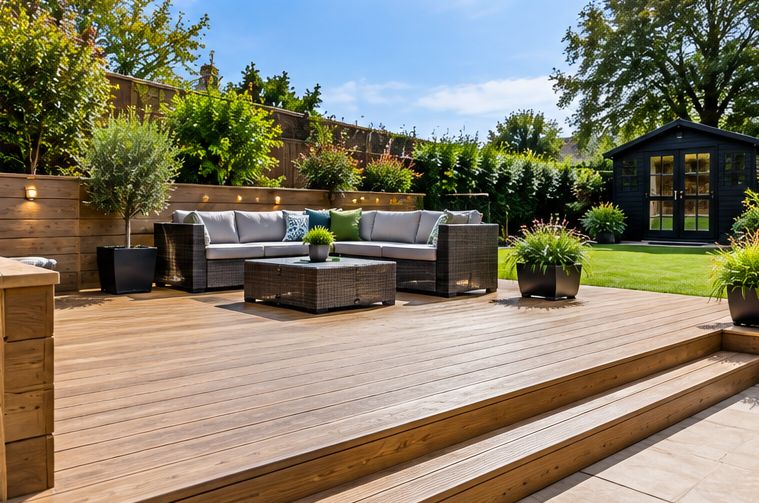
People often ask us how long a new deck will last before they commit to one, and just as often we are called to look at a deck that has gone soft and spongy after a surprisingly short time. The honest answer is that two decks built from the same boards can have very different lives.
This guide explains what a reasonable lifespan looks like, what cuts it short in our wet climate, and how to spot trouble early. If you are still choosing materials, our comparison of composite and timber decking covers that side in more detail.
A fair expectation for each type of deck
There is no single figure, but some broad expectations hold. A treated softwood deck that is well built and cleaned and oiled regularly will usually give somewhere around ten to fifteen years, and often more. Neglected, in a damp corner, the same deck can start to fail in well under ten.
Hardwood decking is denser and naturally more resistant to decay, so it tends to outlast softwood when it is looked after. Composite boards are made to last longer than timber with very little attention, and many manufacturers put a long life on the boards themselves. That figure only means something if the frame underneath lasts as long.
Why the frame decides the real lifespan
The boards are the part you see, but the joists, bearers and posts are the part that fails. They sit in the shade, close to the soil, and they stay damp for long periods after rain. Once rot takes hold in a joist, the boards above start to flex and screws lose their grip, however good the boards are.
This is why we pay so much attention to the subframe on every garden decking job. A few details make a big difference:
- Framing timber treated for ground contact (often called Use Class 4), not the lighter treatment used for boards.
- Every cut end and drilled hole re-treated with an end-grain preservative, because cutting exposes untreated wood.
- Posts set in concrete or on proper supports, with the top of the concrete shaped so water runs away from the timber.
- Space under the frame for air to move, and nothing piled against it that holds moisture.
- Stainless or coated fixings that will not rust and stain the boards.
What shortens a deck's life in South Wales
Our weather is the obvious enemy. Long spells of rain, mild damp winters and not much drying wind in sheltered valley gardens give fungi and algae plenty of time to work. A deck built in a hollow, against a bank, or under overhanging trees can stay wet for weeks at a time.
Ground that holds water makes things worse. On heavy clay, or at the bottom of a slope where run-off collects, the soil under the deck may never dry out, and the frame sits in a permanently humid pocket. Sorting the drainage first, or raising the frame and improving airflow, is often the difference between a deck that lasts and one that does not. Our guide on stopping a garden waterlogging explains the options.
Leaves and soil left lying on the boards also do damage. They trap moisture in the gaps, feed algae and let seeds root between the boards.
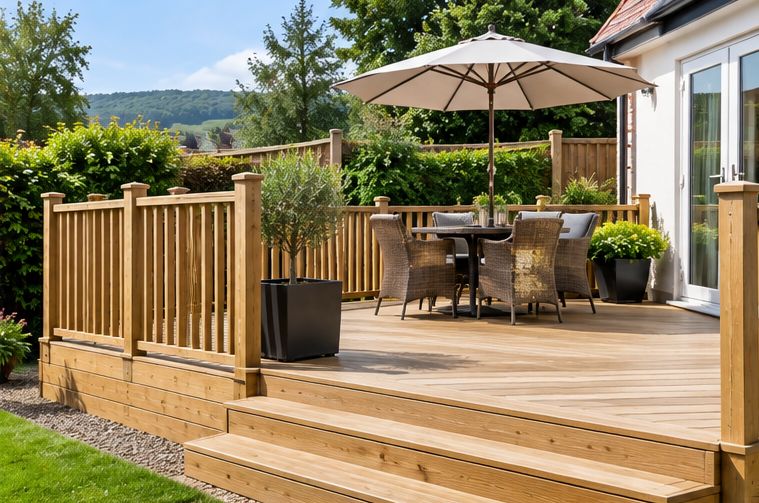
Warning signs worth checking for
Once or twice a year, it is worth walking the deck slowly and looking underneath where you can. Catching a problem early often means replacing a few boards or a joist rather than the whole structure.
- Boards that feel soft, bounce or sag when you step on them.
- A screwdriver that pushes easily into a board, joist or post.
- Dark staining, crumbling wood or fungus around fixings and board ends.
- Screws that have lifted or spin without tightening.
- Posts that move, lean or have gaps around their base.
- Balustrades or handrails that wobble when you lean on them.
Simple care that adds years
Most of the work is quick. Sweep the deck regularly, especially in autumn, and clear the gaps between boards so water can drain. Give it a proper wash with a stiff brush and a deck cleaner at least once a year, ideally in spring.
Timber benefits from a coat of decking oil or stain after cleaning, applied on a dry day when the wood has had time to dry out. Composite needs no oiling, but it still needs washing, because dirt and algae sit on the surface. Keep pots on feet rather than flat on the boards, and trim back shrubs and hedges that shade the deck or rub against it.
Check the maker's advice before using a pressure washer. Used too close or too hard, it can tear the surface of softwood and raise the grain, which then holds more water.
Repair, re-board or rebuild?
When a deck starts to show its age, the frame tells you what to do. If the joists and posts are sound, replacing tired boards can give the deck a new life for much less work than starting again. If the frame is soft in places, patching can buy a little time, but it rarely lasts.
Laying new composite boards on an old timber frame is a common request. It only makes sense if the frame is in good condition and the joists are close enough together for the new boards, since the frame will then need to last as long as the composite does. Often the better answer is a new frame and new boards together.
Tony and the team will happily look at an existing deck, tell you honestly whether it is worth saving, and give you free advice and a free quote for either route.
Planning a deck that lasts from day one
If you are starting from scratch, the siting matters as much as the materials. Put the deck where it gets sun and a breeze if you can, keep it clear of trees that drop leaves and sap, and deal with any wet ground first. On steep valley plots, a deck is often the neatest way to create a level space, and the same rules apply to the posts and frame on the high side.
We build decks across South Wales, from compact terraces in Tonypandy to larger gardens around Monmouth, and often pair them with paving or new fencing as part of a wider plan.
Talk to T J Landscapes about your garden
Free quotes and honest advice across South Wales.
Questions People Ask
Does decking oil make timber last longer?
It helps. Oil and stain slow down water getting into the surface of the boards, which reduces splitting and algae. It does not protect the frame underneath, so good construction still matters most.
Is composite decking maintenance free?
Not quite. It does not need oiling or staining, but it should still be swept and washed, because dirt and algae build up on any outdoor surface, particularly in damp or shaded spots.
Can one rotten board be replaced on its own?
Usually, yes. A single damaged timber board can be lifted and replaced. It is worth checking the joist underneath at the same time, because a rotten board is sometimes a sign of a wet frame.
Why has my deck gone soft after only a few years?
The usual causes are framing timber that was not treated for ground contact, cut ends left untreated, posts buried straight into wet soil, or a deck built where water collects and air cannot circulate.
Should decking be replaced or should I switch to a patio?
It depends on the ground and how you use the space. On a slope a deck is often the simpler option, while on flat ground a patio may suit you better. We can talk through both when we visit.