
Turning a front lawn into parking is one of the most common requests we get from Newport homeowners. On roads of semis and terraces where the kerb is full of cars every evening, a drive is less a luxury than a practical fix. The question that follows is almost always the same: block paving or slabs?
There is no single right answer. This guide sets out how each one performs, what the choice means for drainage on the heavier ground found in parts of Newport, and the questions to settle before any digging starts. Our patio slabbing and paving page covers the full range of surfaces we lay.
What a drive asks of any surface
A patio carries people and furniture. A drive carries a car or van turning its wheels on the same spot twice a day, every day, plus the odd delivery lorry reversing over the edge. That weight is concentrated through four tyres, and turning wheels twist the surface as well as pressing on it.
So whichever surface you choose, the real strength is underneath. A driveway needs a deeper, well-compacted stone sub-base than a garden patio, laid over firm ground with any soft clay or old topsoil dug out. Get that right and both block paving and slabs will last. Get it wrong and neither will.
Why block paving is the usual choice
Block paving is made of small, thick units laid tightly together on a bed of sand and locked in place with kiln-dried sand brushed into the joints. Because each block is small, the load spreads across many of them and the surface flexes slightly rather than cracking. It is the traditional driveway surface for good reason.
- It copes well with turning wheels and the weight of a car parked in the same place.
- Individual blocks can be lifted and relaid if a patch sinks or a pipe needs to be reached.
- Patterns such as herringbone lock the blocks together more tightly, which suits a drive.
- Permeable versions let rain soak through the joints rather than run off.
Our page on block paving driveways shows the colours and styles available.
When slabs make sense on a drive
Slabs can work on a drive, but they have to be chosen and laid for the job. Large, thin patio slabs are prone to cracking under a car, so a driveway needs smaller formats or thicker, vehicle-rated slabs, laid on a full mortar bed over a solid base. Some porcelain and natural stone ranges are made in thicker versions for exactly this purpose.
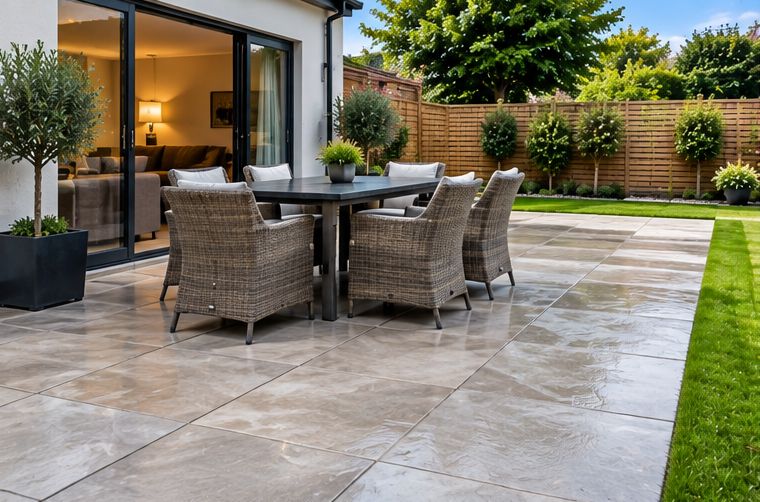
The attraction is looks. A drive in the same stone as the back patio, or in a smooth porcelain or crisp granite, can suit a modern house or a period front very well. It simply needs more care in the specification, and a slab that cracks is harder to patch than a block.
Newport's wet ground and where the rain goes
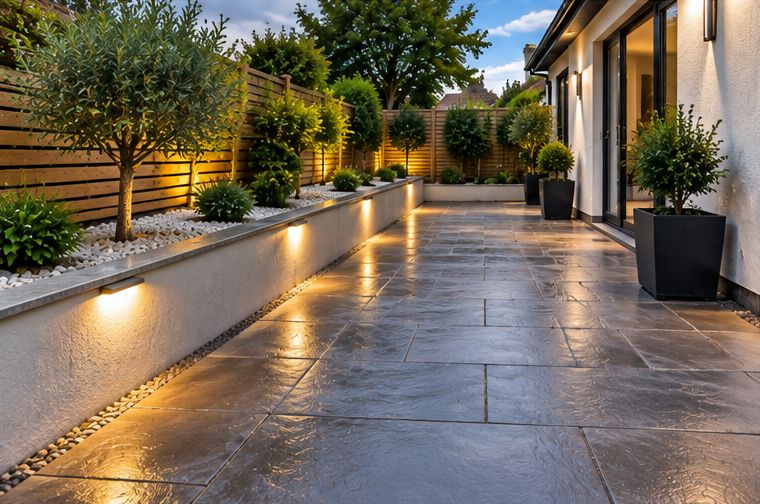
This is where the choice matters most in Newport. Parts of the city sit low beside the River Usk on heavy, slow-draining ground, and a front garden that used to soak up rain will send it somewhere once it is paved. A drive that sheds water straight onto the pavement adds to the puddles and runoff that already build up on some roads.
Permeable block paving is designed to let rain pass through gaps in the joints into a deep, open stone base, from which it drains away slowly. On heavy clay it may need a pipe to carry the water on. With slabs or standard blocks, the water is collected by falls and a channel drain and taken to a soakaway, a rain garden or a border. Our guide to patio drainage in Newport goes into how falls and drains are planned.
Permission and the dropped kerb
Two checks come before anything else. First, crossing the pavement to reach a new drive needs a dropped kerb, which has to be approved by Newport City Council and is usually built by a contractor they approve. Second, paving over a front garden with a surface that does not let water drain away may need planning permission, depending on its size and where the water goes.
We are landscapers, not planners, so we always suggest you check the current rules with the council before committing. What we can do is design a drive that drains properly, which is what the rules are aiming for.
Matching the drive to the house
On a Victorian terrace, a tumbled block in muted reds or a sandstone slab often looks right. Interwar and post-war semis suit a charcoal or brindle block with a contrasting border. On a newer estate in somewhere like Rogerstone or Langstone, a clean grey block or a porcelain slab can match the modern brick. It helps to look along the road and pick something that sits well with it.
Edging matters too. A drive usually needs kerbs or a haunched border to stop the edge blocks creeping, and a low brick wall or a narrow planted strip can soften the front and keep a bit of green.
Quick comparison
- Strength under a car: block paving is more forgiving; slabs need the right thickness and bed.
- Repairs: blocks lift out and go back; a cracked slab has to be replaced and matched.
- Drainage: permeable blocks can deal with rain on site; slabs rely on falls and drains.
- Upkeep: block joints need topping up with sand now and then; slab joints are usually mortar or compound.
- Looks: slabs give a smoother, more contemporary finish; blocks suit most houses.
Before you book anyone, our checklist Block Paving Driveways: What to Ask Before You Book lists the questions that separate a sound quote from a quick one.
Talk to T J Landscapes about your garden
Free quotes and honest advice across South Wales.
Questions People Ask
Which is cheaper, block paving or slabs?
It depends more on the drive than the material: its size, how much digging is needed, the ground, drainage, edging and the product you pick. Some slabs cost less than some blocks and some more. We give a free quote for both if you are undecided.
Can you lay a drive over my old concrete?
Occasionally, if the concrete is sound and the levels allow. More often it is cracked, too high against the house or has no falls, and it is better to break it out and start with a proper base.
Will a new drive in Newport stop water running onto the road?
It can help, if it is designed for it. Permeable block paving, or falls leading to a soakaway or border, keeps rain on your property rather than sending it onto the pavement.
Do you also do the front wall and path?
Yes. We often combine a drive with a new path, steps, a garden wall or planting so the whole front is finished together. See our Newport page for the other work we do in the city.
How do I get a quote?
Send us a message with a rough idea of the size and a photo if you can. Tony will arrange a visit, look at the ground and levels, and give you a free quote.