
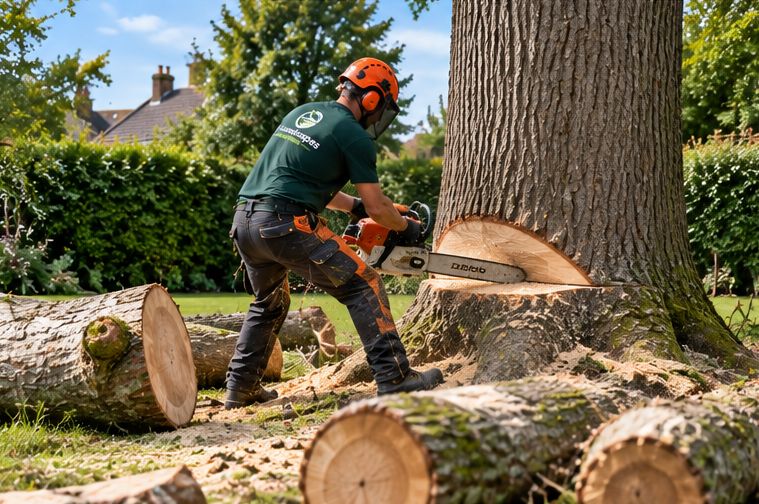
Drive out of Abergavenny in almost any direction and you pass field hedges that have been cut and laid for generations. Many gardens on the edge of town, and plenty of cottage plots in the villages around it, have the same kind of mixed native hedge along at least one side. Left to itself, that hedge grows tall and leggy, thins out at the bottom and lets the wind and the neighbour's sheep straight through.
This guide explains what hedge laying is, when it is worth doing, and how to look after a hedge in the years between. For the routine side of trimming, see our general piece on how often and when to trim a hedge.
What hedge laying actually involves
Laying turns an overgrown row of upright stems back into a thick, living barrier. Each main stem is cut most of the way through near the base, leaving a hinge of bark and wood still attached to the roots. The stem, called a pleacher, is then bent over at a low angle and laid along the line of the hedge, overlapping the one before it.
Stakes are driven in along the line to hold the laid stems in place, and on many styles long, flexible rods such as hazel are woven along the top as a binding. Because the hinge keeps the stem alive, it sprouts new shoots all along its length, and the stump sends up fresh growth from the base. Over the next few seasons the hedge thickens from the ground up.
Different parts of Britain have their own traditional styles, varying in how the stems are laid and bound. For a garden hedge the aim is simpler: a thick, stock-proof, wind-filtering boundary that looks tidy and lasts.
Signs your hedge is ready to lay
Not every hedge suits laying, and not every tired hedge needs it. These are the signs that laying is likely to be the best fix rather than more trimming:
- The hedge has grown into a line of small trees, with bare trunks and all the leaf at the top.
- You can see or walk through gaps at the bottom.
- Main stems are roughly wrist to forearm thickness, which is thick enough to lay but not so thick they will not bend.
- It is made up mostly of native species such as hawthorn, blackthorn, hazel, field maple or holly, which all respond well.
Conifer hedges such as leylandii cannot be laid, and they do not regrow from old bare wood, so an overgrown one usually needs reducing gradually or replacing. Our tree surgery and hedge care page covers reductions and removals as well.
Timing around the seasons and nesting birds
Hedges are laid while they are dormant, from late autumn through to late winter, when the sap is down and there are no leaves in the way. Around Abergavenny that often means working on short, cold days with the Skirrid or the Sugar Loaf white with frost in the background, which is simply the way the job has always been done.
It also keeps the work outside the main bird nesting season, which runs roughly from early spring to late summer. Active nests are protected by law, so heavy cutting, laying and removal are best left to the colder months. The same goes for major trimming. If you are unsure whether a job is allowed at a particular time, it is worth checking before anyone starts.
Field hedges in the countryside can also be covered by hedgerow rules, particularly where removal is concerned. If your hedge runs along farmland or is very old, check with Monmouthshire County Council before taking any of it out. Laying and trimming are normal hedge management, but it is sensible to ask if in doubt.
Filling the gaps
Old hedges often have holes where a plant has died or been shaded out. When we lay a hedge, we plant new whips into those gaps at the same time so the finished hedge is continuous.
A native mix suits the edge of town and the countryside around Abergavenny: hawthorn for the backbone, blackthorn and holly for density and winter cover, hazel and field maple for variety, with perhaps some dog rose or guelder rose for flowers and berries. Bare-root whips are planted in the dormant season too, so they fit in neatly with laying. They need weeding around and watering in a dry spring for the first year or two.
Looking after a hedge between layings
A newly laid hedge wants a light trim to shape for its first few years while the new growth thickens. After that, a regular trim keeps it dense and at the height you want, and it may not need laying again for a long time if it is kept in hand.
- Trim to an A shape. Wider at the base than the top lets light reach the lower branches and helps it shed snow and wind.
- Trim after nesting. Late summer into autumn suits most native hedges, and a winter tidy is fine if needed.
- Leave some berries. Trimming every other year on part of a long hedge feeds birds through the winter.
- Keep the base clear. Brambles and nettles smothering the bottom will shade out new shoots.
If a hedge has become a jungle of bramble and ivy before any of this can start, a proper clear-out comes first. See Clearing a Garden Before Landscaping in Abergavenny for how we tackle that.
Why a hedge beats a fence on exposed plots
On the open, higher gardens around Abergavenny, a solid fence takes the full force of every gust, while a hedge lets some air through and slows the rest. That calms the wind over a much wider area behind it and puts less strain on the boundary. A hedge also grows back from damage, feeds wildlife and softens the view rather than cutting across it.
A lot of gardens use both: a fence or wall close to the house for instant privacy, and a hedge on the field or hillside boundary. Our article on windproof fencing for exposed Abergavenny plots covers the fencing side. To see how shelter fits into a whole design, visit our Abergavenny landscaping page, or ask for a free quote and Tony will come and look at the hedge with you.
Talk to T J Landscapes about your garden
Free quotes and honest advice across South Wales.
Questions People Ask
How long does a laid hedge take to thicken up?
You will see new shoots along the laid stems and from the stumps in the first spring. It usually looks properly dense within two or three growing seasons, depending on the species and how much light it gets.
Can a garden hedge near a house be laid?
Yes, if the stems are the right size and the species suits it. A laid hedge sits lower and wider than a trimmed one at first, so it needs a little room either side.
Is it better to lay a hedge or replant it?
If most of the old plants are alive and the stems are a good size, laying keeps the established roots and gives a thick hedge far sooner than starting again. If the hedge is mostly dead, very gappy or a species that will not regrow, replanting is the better route.
Can you remove a hedge altogether?
Yes, and we take the arisings away. Do it outside the nesting season, and check with the council first if it is an old countryside hedgerow. We can then put in a new boundary, whether a fresh hedge, fencing or a stone wall.
What happens to the cuttings?
Brash that is not used for binding or staking is cleared up and taken away as green waste, so the garden is left tidy.