
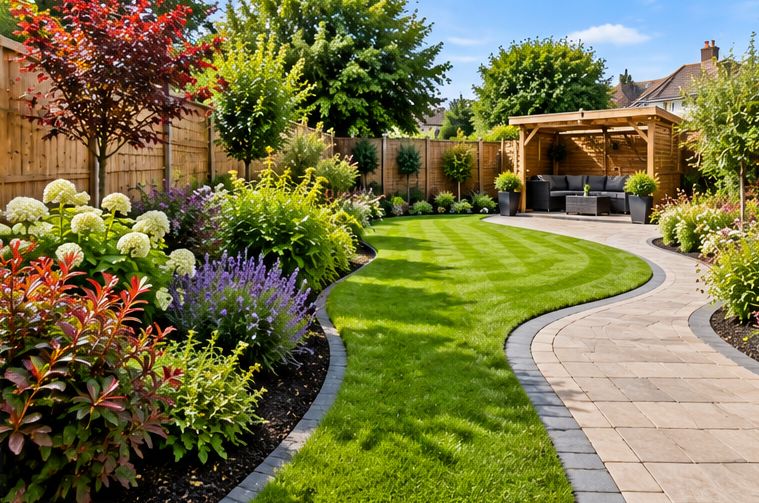
Plenty of homes in Abergavenny were built or bought for the outlook. From one garden it is the rounded top of the Sugar Loaf, from another the long flank of the Blorenge or the broken ridge of the Skirrid. Yet the garden itself is often laid out as if the hills were not there: a patio squeezed by the back door, a lawn in the middle and a fence cutting straight across the best part of the scene.
This guide is about turning that round. It covers how we read a plot before drawing anything, how to deal with the levels that come with hillside ground, and how to plant and shelter a garden without losing the thing that makes it special. For an overview of the town and the gardens we work on there, see our landscaping in Abergavenny page.
Find the viewpoint before you plan anything else
The first job is simply to walk the garden and look. The spot with the finest view is rarely the one right outside the kitchen. It might be halfway up the slope, in a far corner, or on the only bit of high ground where the neighbour's roof drops out of the way.
We look from standing height and from sitting height, because the two can be very different. A view that is clear when you stand can vanish behind a hedge once you sit in a chair. We also look back towards the house, since the route from the back door to the viewpoint matters as much as the viewpoint itself.
- Morning and evening light. In the Usk valley, the hills catch low sun beautifully at the ends of the day, so note where you would want to be at those times.
- Seasonal change. Deciduous trees may hide a view in summer and open it in winter. Decide which season matters most to you.
- What you want to hide. Most views have something in them you would rather not see, such as a garage, a road or a telegraph pole. Knowing that early lets us screen it and leave the rest open.
Getting up, or down, to the view
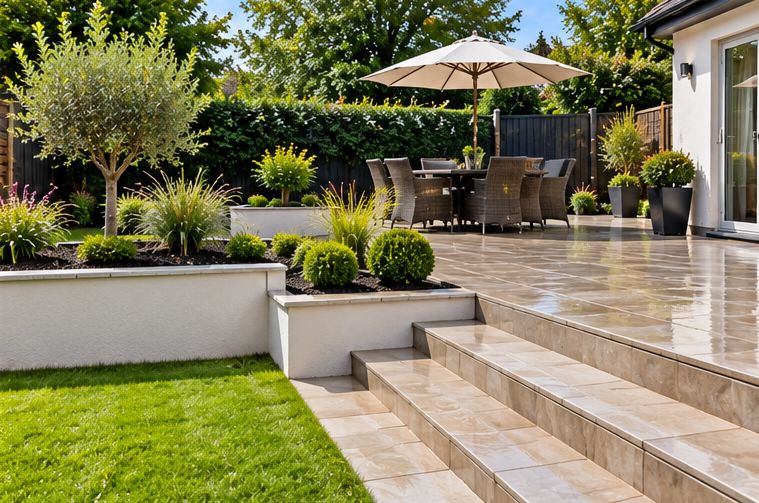
Hillside plots around Abergavenny often need some reshaping to make a viewpoint usable. A flat terrace held by a stone or block retaining wall gives you a level place for a table and chairs. On gentler ground, a run of timber sleepers can do the same job for less disruption. Where digging would undermine the slope, a raised deck on posts can create a platform without cutting into the hill.
Steps and paths then link the levels. A path that curves slightly as it climbs is easier underfoot than a straight flight and lets the view open up gradually. Our general guide to landscaping a sloping garden covers the structural side in more depth, including drainage behind walls.
Keep the foreground simple
A mountain view is busy enough on its own. The part of the garden between you and the hills works best when it is calm: an open lawn, low planting or a plain gravel area. Clutter in the middle distance, such as a tall shed, a washing line or a mix of ornaments, pulls the eye away from the horizon.
Materials help too. Natural stone paving in soft greys and buffs, or the reddish tones of local sandstone, tends to sit quietly in front of green and purple hills, while very bright or glossy surfaces can compete with them. Our article on patio ideas for Abergavenny stone cottages looks at paving choices in more detail.
Planting that frames rather than blocks
Think of taller planting as a picture frame. A small tree or a group of upright shrubs on either side of the sightline draws the eye through the middle towards the mountain. Lower, looser planting along the bottom edge softens the boundary so the garden seems to run on into the fields and slopes beyond.
Where the far boundary is a fence, a native hedge in its place, or in front of it, blends far better with the landscape. Hawthorn, hazel, field maple and holly all suit the area and give wildlife cover. Keep future growth in mind: a conifer planted as a small screen can swallow a view within a few years.
Shelter where you sit, openness everywhere else
The best viewpoints in Abergavenny are usually the most exposed. Wind comes up the valley and over the ridges, and the weather can change quickly. Rather than fencing the whole garden, we concentrate shelter around the seating area: a low stone wall behind the bench, a slatted screen on the windward side or a short run of hedge.
Filtering the wind is better than stopping it dead, because a solid barrier creates eddies on its sheltered side. Our guide to windproof fencing for exposed Abergavenny plots explains the options, and hedge laying and hedge care covers the living alternative.
Enjoying the view after dark
Long summer evenings are when a view garden really earns its keep. Low, warm lighting on steps and along paths keeps everyone safe on a slope without flooding the garden with light, which would stop you seeing the hills fading into the dusk. Keeping lights low and pointed downwards also respects the dark skies that many people value around the town.
See garden lighting ideas for Abergavenny evenings for more on fittings and placement.
Permissions and neighbours
Most garden landscaping does not need planning permission, but some things can: raised decks and platforms, tall walls and fences, work to listed buildings, and changes in a conservation area. Some properties on the hills around the town also fall within the national park, where the rules can be different. Check with Monmouthshire County Council, or the national park authority if that applies to you, before starting anything significant.
If a tree that blocks your view belongs to a neighbour, or is protected, you cannot simply cut it back. Our guide on permission for tree work in Wales sets out the general position. A friendly conversation with the neighbour is always the best first step.
How we approach a view garden
Tony and the team start with a visit. We walk the garden with you, stand in the likely viewpoints, look at the slope, the soil and the access for materials, and talk about how you want to use the space. From that we put together a layout and a free quote that sets out each stage clearly.
Larger jobs can be done in phases: levels and walls first, then paving and paths, then planting. That spreads the work and lets you live with the new shape of the garden before the finishing touches go in. Our landscaping and garden design page describes the full service, and you can ask for a free quote whenever you are ready.
Talk to T J Landscapes about your garden
Free quotes and honest advice across South Wales.
Questions People Ask
Should the patio go by the house or at the viewpoint?
It depends on the plot. If the best view is well away from the house, a small paved area by the back door for everyday use plus a second seating spot at the viewpoint often works better than one large patio in the wrong place.
Will a hedge block my view?
Only if it is allowed to grow too tall. A hedge kept to a set height with regular trimming gives shelter and privacy while the hills stay in sight above it. Choosing slower-growing native species makes that easier.
Can you work on a very steep Abergavenny plot?
Yes. Steep ground takes more planning, more retaining and often more barrowing by hand, but it usually gives the most dramatic views. We will explain what is involved when we visit.
What affects the cost of a view garden?
The steepness of the plot, how much retaining and levelling is needed, access for materials, the paving and walling you choose, drainage and how much waste has to go. We cover all of it in a free quote. Our guide to what affects landscaping costs explains more.
When is the best time to start?
Structural work such as walls and paving can go ahead most of the year if the ground is not waterlogged or frozen. Planting and turf are best done in autumn or spring, so we often plan the hard landscaping to finish ahead of those seasons.