
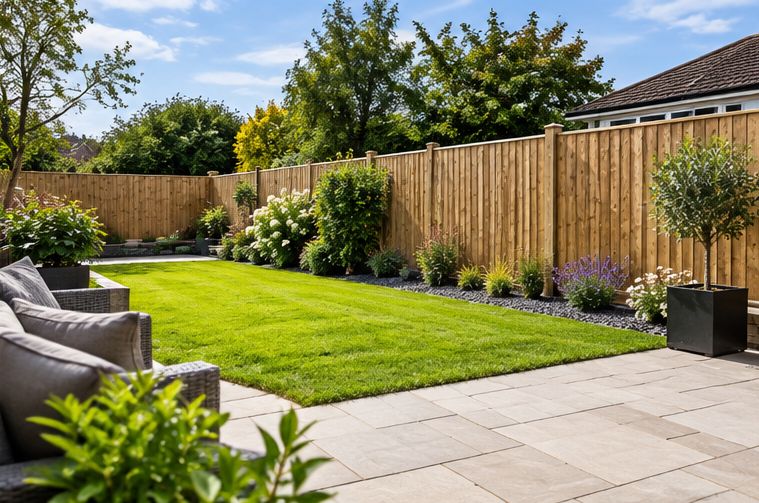
Abergavenny sits in a bowl of hills, and that shapes its weather. Wind is channelled along the Usk valley and spills over the shoulders of the Blorenge and the Sugar Loaf, so gardens on the upper slopes and on open edges of town can take a real battering, while a house a few streets lower barely notices.
If your fence panels end up in the neighbour's garden every winter, the answer is rarely a thicker panel. It is a different design, a better post and sometimes a hedge doing part of the job. This guide explains what works on exposed ground. For wider garden ideas in the town, see our landscaping in Abergavenny page, and for the full service, fencing and gates.
Is your plot really exposed?
Not every garden in the town needs a heavy-duty fence. The signs that yours does are usually obvious once you look for them.
- Panels have blown out, or posts lean in one direction, more than once.
- Trees and hedges nearby grow bent away from the prevailing wind.
- The garden faces open fields or a valley view with little in between.
- You are on a slope near the top of a street or on the edge of a development.
- A gap between houses acts as a funnel, and one stretch of fence always suffers most.
The last point matters. Often only one run of fence takes the brunt, and upgrading that section alone is enough.
Why solid panels give up
A standard lap or solid panel fence behaves like a sail. All the wind load lands on a flat surface and is passed straight to the posts. When a gust hits, something has to give: the panel pops out of its slot, the post snaps at ground level or the whole run rocks loose in its footings.
Solid barriers also create turbulence on their sheltered side, so the calm you hoped for behind the fence can be patchy. That is why a design that slows the wind, rather than trying to stop it, usually gives you a more comfortable garden as well as a longer-lasting fence.
Designs that let the wind through
These are the styles we most often recommend for open Abergavenny gardens.
- Hit-and-miss. Boards fixed alternately on each side of the rails. You cannot see straight through, but air passes between the boards. A good choice where privacy still matters.
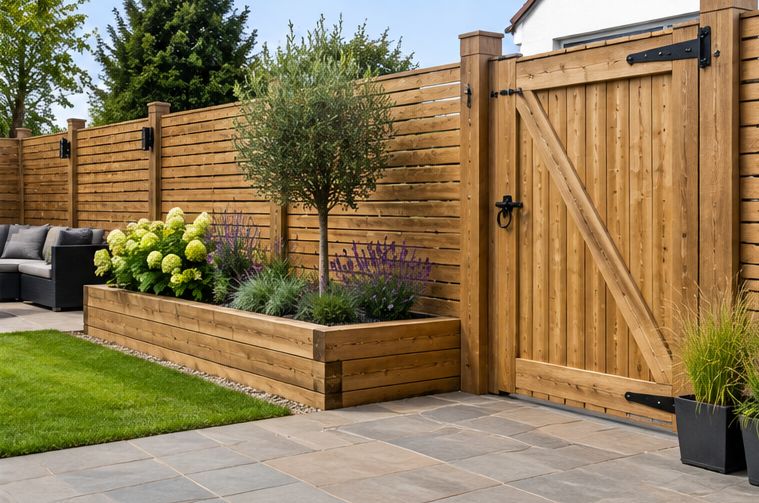
- Slatted or horizontal batten fencing. Narrow gaps between boards cut the wind load and look smart with modern or villa-style gardens.
- Close board with a trellis top. Close board built on site, with individual boards rather than panels, is far sturdier than a lap panel. A trellis top lets gusts pass over the upper section.
- Post and rail with hedging. On rural edges, a simple rail fence to mark the line and a hedge planted along it gives shelter that gets better every year.
Our comparison of close board, panel and slatted fencing goes into each type, and which garden fence stands up best to Welsh wind looks at the wider picture.
Posts and footings for high ground
Most fence failures start at the post. On an exposed plot we use concrete posts or heavy timber posts treated for ground contact, set deeper than usual and bedded in concrete. Concrete posts do not rot at ground level, which is where timber posts usually break after years of wet weather.
Ground conditions around the town vary a lot. Some slopes have stony, shallow soil over rock, others heavy ground that holds water. On rock we may need to break out a proper hole rather than settle for a shallow footing, and on wet ground we make sure the base of the post can drain. Our guide to concrete or timber posts covers the pros and cons.
Gates that do not slam or sag
A gate on a windy boundary gets thrown open and shut all winter. It needs a solid frame with a diagonal brace running the right way, heavy-duty hinges, a strong latch and a stop so it cannot swing past its post. A drop bolt or a hook to hold it open is worth having on a gate you use for barrows or bins.
Gate posts carry more strain than any other post in the fence, so they should be heavier and set deeper still. For more detail, see choosing and fitting a garden gate.
Let a hedge share the load
The traditional answer to wind in the hills around Abergavenny is a good thick hedge, and it still works. A hedge filters the wind over a long distance, never blows down in a single gust, and gives birds and insects a home. Hawthorn, blackthorn, hazel and field maple all do well locally, with holly or beech for winter cover.
A hedge takes a few years to get going, so a common plan is to put up a permeable fence now and plant a hedge alongside it. By the time the fence needs replacing, the hedge is doing most of the work. Our guide to hedge laying and hedge care around Abergavenny explains how to keep one dense and healthy.
Heights, boundaries and neighbours
As a general guide, fences and walls up to about two metres at the back, and about one metre beside a road or footpath, do not usually need planning permission, but rules change for listed buildings, conservation areas and some other sites. Check with Monmouthshire County Council if you are unsure.
Be clear about who owns the boundary before replacing a fence, and talk to your neighbour first. A fence that falls into their garden is a shared problem, and a shared plan for a stronger one usually suits everyone.
Getting the right fence for your plot
Tony and the team will look at the whole boundary with you, note which stretches take the worst of the weather, check the ground for posts and suggest the fence, gate and hedge mix that suits the garden. Our advice and quote are both free, so get in touch to arrange a visit.
Once a fence is up, a little care makes it last. See how to make a garden fence last longer for simple steps.
Talk to T J Landscapes about your garden
Free quotes and honest advice across South Wales.
Questions People Ask
What is the most wind-resistant fence for an Abergavenny garden?
A permeable design such as hit-and-miss or slatted fencing on concrete or deep-set heavy timber posts. It lets some wind through, so the load on the posts is much lower than with solid panels.
Can you just replace the panels that keep blowing out?
Sometimes, but if the posts are loose or rotten the new panels will go the same way. We check the posts first and tell you honestly whether a repair or a replacement makes more sense. See fence repair or replacement.
Will a slatted fence still give me privacy?
Narrow gaps give a good level of privacy while letting air through. Hit-and-miss gives more, because there is no straight line of sight between the boards.
Is a hedge better than a fence on an exposed plot?
For shelter, a mature hedge usually is. It takes time to establish, though, so many people combine a fence now with a hedge planted alongside it.
Can you fence on rocky or sloping ground?
Yes. On slopes we step the fence panels or rake the rails to follow the ground, and on rock we cut proper post holes so each post is firmly anchored.