
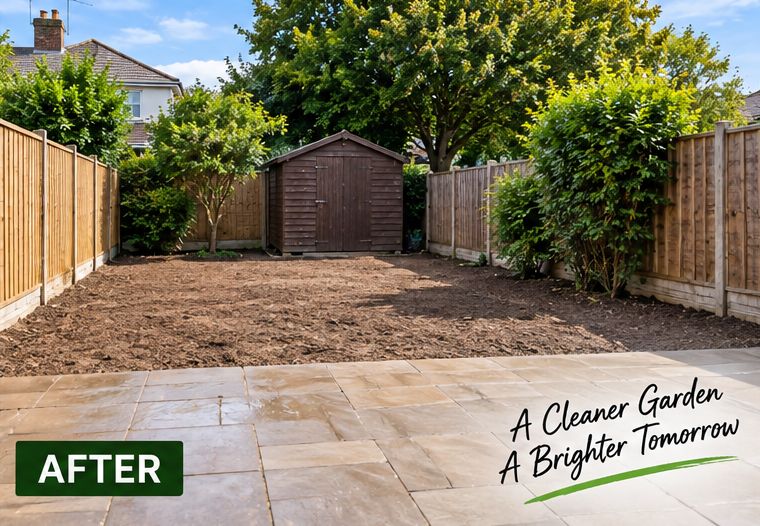
Plenty of people in Abergavenny buy a house with a garden that has had little attention for years. Brambles have crept over the lower terrace, a leylandii has swallowed the view of the Blorenge, and there is a shed in the corner that nobody wants to open. It is tempting to plan the new patio straight away, but the design almost always improves once the old growth and clutter are gone.
This guide covers how we approach a clearance when it is the first stage of a bigger project, rather than a one-off tidy. For the general process, our article on what happens during a professional garden clearance gives the full picture.
Why clear before you design?
Overgrowth hides the things that matter most to a landscaping plan. Until it is cut back you cannot see the real levels, where water gathers after rain, which walls are sound, or how much light each corner actually gets.
On a hillside plot in Abergavenny the difference can be dramatic. A bank that looked like one steep slope sometimes turns out to be two old terraces with a buried stone step between them. A dark corner can open up to a view of the Skirrid once a tangle of self-sown sycamore comes out. Designing before all that is known means redesigning later.
The soil tells its own story too. Once the surface is bare, we can dig a few test holes and see whether the ground is deep and workable, heavy and wet, or thin over stone and old rubble. On the lower ground near the Usk, a cleared garden sometimes shows a soggy patch that the weeds had been hiding, which is far better found now than after a new lawn has gone down. If that turns up, our guide on stopping a garden waterlogging explains the usual fixes.
Deciding what stays
A good clearance is selective. Before anything is cut, we walk the garden with you and agree what is worth keeping. Older Abergavenny gardens often have features that are well worth saving and very hard to replace.
- Old stone walls and steps, even if they need rebuilding later.
- Established trees and shrubs that give shelter from the wind or frame the view.
- Native hedging that can be cut back or laid rather than grubbed out.
- Reclaimable stone and slabs that can be reused in paths, edging or a new patio.
- Fruit trees and bushes in an old kitchen garden.
Anything marked to keep is protected while the rest of the work goes on around it. Where a tree needs pruning rather than removing, our tree surgery and hedge care service can do both jobs at once.
What comes out
Once the keepers are marked, we strip back everything else in a sensible order, working from the top of a sloping garden downwards where we can so that cut material is not dragged back over cleared ground.
- Brambles, nettles, bracken and overgrown shrubs, cut down and the main roots dug out.
- Self-sown saplings and unwanted trees, where no permission is needed.
- Old sheds, rotten fencing, broken greenhouses and tired timber edging.
- Cracked concrete, failed paving and rubble dumped over the years.
- Old turf and weed-choked lawn, stripped back ready for regrading.
Some items cannot go in with ordinary garden waste, such as asbestos sheeting on old sheds or invasive plants like Japanese knotweed, which need handling under their own rules. We will flag anything like that before the clearance starts. See What Can and Cannot Go in a Garden Clearance for the details.
Timing, wildlife and trees
Heavy clearance of hedges, scrub and trees is best done outside the main bird nesting season, which runs roughly from early spring to late summer. Around Abergavenny, overgrown gardens often back onto fields or woodland and can be busy with birds, so we check before cutting and leave anything with an active nest until later.
Some trees in and around Abergavenny are protected by tree preservation orders or conservation area rules. If a clearance involves any sizeable tree, check with Monmouthshire County Council first. Our guide Do You Need Permission to Cut Down a Tree in Wales? explains what to look for.
Access and taking the waste away
Access shapes a clearance more than most people expect. A cottage garden reached through a narrow side path, or a hillside plot with steps down from the road, means everything is carried out by hand. A wider drive may allow a small machine in. We look at this on the first visit so the plan and the quote reflect the real job.
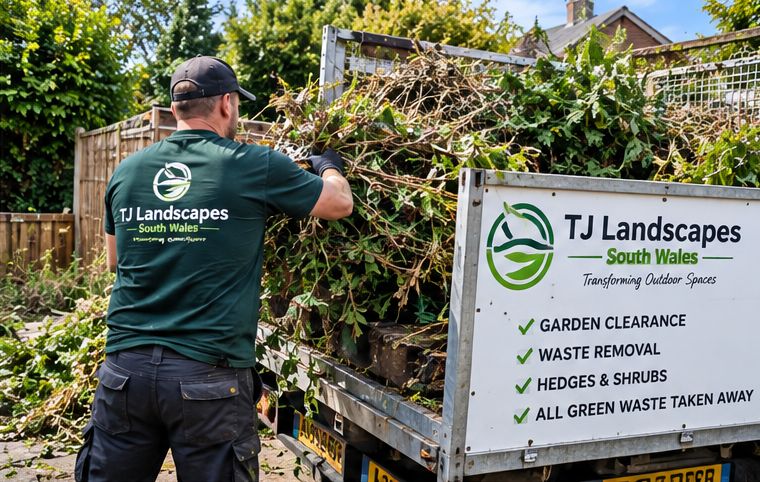
All green waste is loaded and taken away, so you are not left with a pile at the bottom of the garden or a string of trips to the tip. Soil, stone and rubble are handled separately, and anything useful for the new garden can be kept on site. Our garden clearance page explains the service in full, and Garden Waste: Where It Goes and Why It Matters covers where it ends up.
From a cleared plot to a new garden
Once the ground is clear, the garden is ready for a proper survey of levels, drainage and views. That is the moment to settle where a patio, lawn or terrace should go. Tony and the team can then move straight on to groundwork, walls, paving and planting, so there is no gap for the brambles to creep back.
Many clearances lead naturally to new walls, a fresh lawn or a raised kitchen garden. Our guides to turf or seed for an Abergavenny lawn and kitchen gardens and raised beds in Abergavenny pick up from there. For the design side, see our landscaping in Abergavenny page or arrange a free quote for the clearance and the new garden together.
Talk to T J Landscapes about your garden
Free quotes and honest advice across South Wales.
Questions People Ask
Can the clearance and the landscaping be done as one job?
Yes, and it is usually the better way. We plan both together, keep what is useful, and move from clearing to building without leaving the ground bare for weeks.
Do I need to be at home while you clear the garden?
Not necessarily, as long as we have access and have agreed what is staying. Most people like to be there at the start to walk round with us, and we keep you updated as the work goes on.
Will you remove tree stumps?
Yes, where they are in the way of the new design. Stumps can be dug or ground out depending on their size and what is going in their place.
What if the garden has a lot of rubble or old concrete?
We break it out and take it away, or keep suitable hardcore on site if it can be reused under a path or patio. It is one of the factors we take into account when pricing the job.
Is there a best time of year to clear before landscaping in Abergavenny?
Autumn and winter suit heavy cutting because nesting birds are not an issue and the growth has died back. That also leaves the ground ready for spring building and planting.