
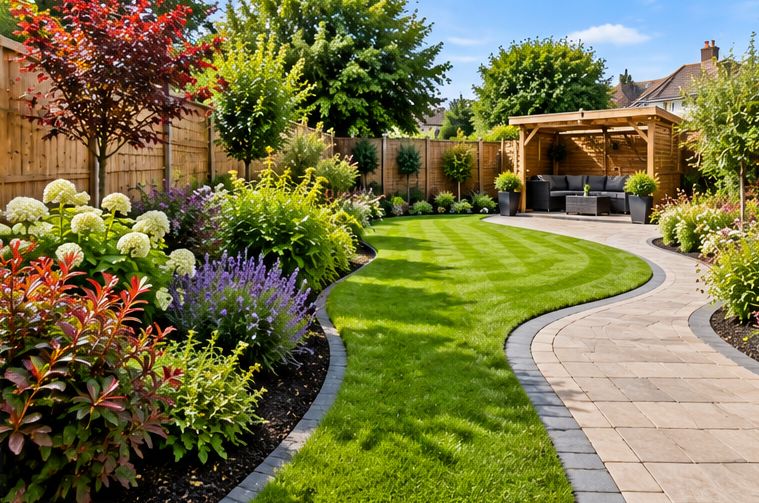
Wet lawns, puddles that sit for days and a patio that turns green by February are some of the most common problems we are asked about. South Wales gets a lot of rain, especially up the valleys and on the edge of the Beacons, and many gardens were never set up to cope with it.
The good news is that most waterlogged gardens can be improved a great deal. The key is working out where the water is coming from and where it can go, before spending anything on a fix. This is how we approach drainage as part of our landscaping and garden design work.
First, find out why the water is sitting there
Before choosing a solution, it helps to watch the garden after heavy rain. Where do the puddles form? How long do they last? Is the water coming from the house, from the neighbours’ land above, or does it simply never soak in? The usual causes are:
- Heavy clay soil. Much of lowland South Wales sits on clay that drains slowly and holds water through the winter.
- Compaction. On newer estates, builders’ machinery often leaves a hard layer under a thin covering of topsoil, and turf laid straight on top never drains properly.
- Water running in from above. On valley sides, rain and spring water run down through the ground and surface in lower gardens, often at the foot of a slope or the back of a terrace.
- Hard surfaces shedding water. Patios, paths, driveways and roofs can send far more water onto the lawn than it would ever receive from rain alone.
- A blocked or broken drain, such as a collapsed old land drain or a downpipe that empties onto the ground.
A simple test you can do yourself
Dig a hole about the depth and width of a spade in the wettest part of the garden and fill it with water. Let it drain, then fill it again and see how long the second lot takes to go. If it is gone within a few hours, the soil drains reasonably and the problem is more likely surface water or compaction. If water is still standing by the following morning, you are dealing with heavy clay or a high water table, and you will need a way to take the water somewhere else.
The same test is a good first step if you are thinking about a soakaway, because a soakaway only works where the ground can absorb water.
Improving the soil and the lawn
For mildly wet lawns, the fix may be in the soil itself. Hollow-tine aeration relieves compaction, and brushing in sharp sand or a sandy top dressing afterwards keeps the channels open. Repeating that each autumn for a few years can make a real difference to a lawn that stays spongy.
Where the lawn is poor anyway, it is often better to start again: strip the old turf, break up the compacted layer, add good quality topsoil and lay new turf on a properly prepared base. Our turf laying page explains how that preparation is done. Levels matter too; a lawn that falls gently away from the house sheds water rather than collecting it by the back door.
French drains, land drains and soakaways
When the water needs to be moved, these are the main options:
- French drain: a trench lined with membrane, filled with clean stone, usually with a perforated pipe in the bottom. It collects water from the ground around it and carries it along the trench. Ideal along the bottom of a slope or the edge of a patio.
- Land drains: a network of perforated pipes laid across a lawn or bed, often in a herringbone pattern, feeding into one outlet. Used for larger areas of wet ground.
- Soakaway: a pit filled with stone or a crate unit that stores water and lets it soak slowly into the surrounding ground. Only useful where the soil drains well enough, so it is not a cure for heavy clay on its own.
- Channel drains: slotted channels set into paving or at the edge of a driveway to catch surface water before it reaches the lawn or the house.
Where can the water go?
Every drain needs somewhere to discharge, and this is where many DIY schemes come unstuck. Water can go to a soakaway, to a ditch or watercourse where you have the right to use it, or sometimes to an existing surface water drain. It should not be connected into a foul sewer, and you should not simply redirect it onto a neighbour’s land.
If you are unsure what your existing drains connect to, or you are thinking of discharging to a ditch or public drain, check with the council or the water company first. We are landscapers rather than drainage engineers, so for anything involving public sewers we will always point you to the right people.
Slopes, terraces and valley gardens
Hillside gardens in towns such as Pontypridd, Tonypandy and Abertillery have a particular pattern: water running down through the hillside collects behind retaining walls and at the foot of each terrace. If it cannot escape, it pushes against the wall and keeps the lower level permanently damp.
The answer there is usually a drain behind the wall with weep holes or an outlet, and a French drain along the base of each level. Where old walls are bulging, the drainage and the wall need sorting together, which is often part of a wider brickwork and garden walls job. Our guide on landscaping a sloping valleys garden goes into more detail.
Working with the water instead of fighting it
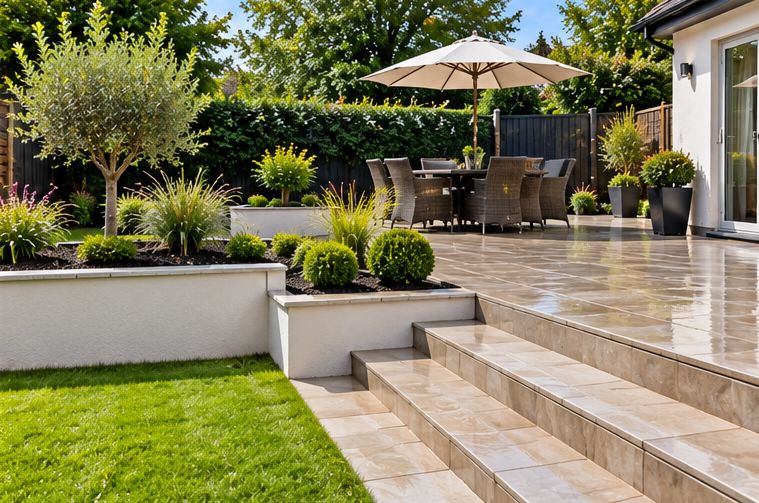
Sometimes the most practical answer is to design around wet ground rather than drain it completely. Raised beds give plants free-draining soil above the wet layer. A patch of the garden can be turned into a rain garden or bog planting that enjoys damp conditions. Paths and patios can be laid on a permeable base so water soaks through rather than running off.
If you are paving a front garden, the rules generally expect new hard surfaces to be permeable or to drain into a planted area within your property rather than onto the road. Check with your council before you start. Our patio and paving page covers the materials, and we are glad to talk through permeable options with you.
Talk to T J Landscapes about your garden
Free quotes and honest advice across South Wales.
Questions People Ask
Will a French drain fix my waterlogged lawn?
It helps where water runs in from one side or collects along a line, such as the bottom of a slope. For a lawn that is wet all over because of clay or compaction, soil improvement or land drains are usually needed as well.
Can I put a soakaway in clay soil?
Usually not on its own, as clay absorbs water too slowly for a soakaway to empty between storms. A percolation test tells you whether the ground is suitable.
Is artificial grass a good answer for a wet garden?
Only if the base drains. Artificial grass laid over wet clay without a proper free-draining base will still puddle. With the right preparation it can work well.
When is the best time to install garden drainage?
Drainage can be put in most of the year, but late spring to early autumn is usually easiest because the ground is firmer and machinery does less damage. Winter is the best time to see where the water actually collects.
How much does garden drainage cost?
It depends on the size of the area, how far the water has to be carried, access for digging, the soil type and how much material has to be taken away. We are happy to look at it and give you a free quote.