
Ask people with a hillside terrace garden in Abertillery what they would change, and the answer is rarely a bigger patio. It is usually less mowing, fewer weeds and not having to lug a mower, a hose and bags of cuttings up a flight of uneven steps every weekend from spring to autumn.
This guide looks at where that effort actually goes on a stepped plot in the Ebbw Fach valley and how to design it out. It works alongside our landscaping in Abertillery page and our main landscaping and garden design service. For the general principles, see how to plan a low-maintenance garden that still looks good.
Where the time really goes on a slope
On a flat suburban garden, upkeep is mostly mowing and trimming. On a steep terrace, the slope multiplies every task. Mowing a bank is slow and awkward, weeds colonise the gaps in old steps and walls, and everything you cut has to be carried somewhere. Heavy rain also washes soil and bark down onto paths, so there is sweeping to do as well.
Before choosing materials, it helps to list the jobs you do most and dislike most. That list usually points straight at the parts of the garden that need changing.
- Mowing grass on a slope or in narrow strips
- Weeding between old slabs, steps and wall joints
- Cutting back an overgrown hedge or tree at the top
- Carrying waste, compost and tools up and down the garden
- Clearing soil and leaves washed onto paths after rain
Retire the steepest grass
A sloping lawn is the single biggest time-eater in most valley gardens, and it is often the least used part of the plot. Where the ground is too steep to sit on, there is little point keeping it as grass. Terracing it into a flat level, or replacing it with planting or gravel, removes the job entirely.
If you would like to keep some lawn, keep it on the flattest, sunniest level and give it a firm edge so it can be mowed in one go without trimming. Artificial grass is another option for a small level that children use, though it still needs sweeping and the odd weed pulling from its edges. Our guide to laying turf on a slope in Abertillery explains when real turf is worth it.
Hard surfaces that do not become a chore
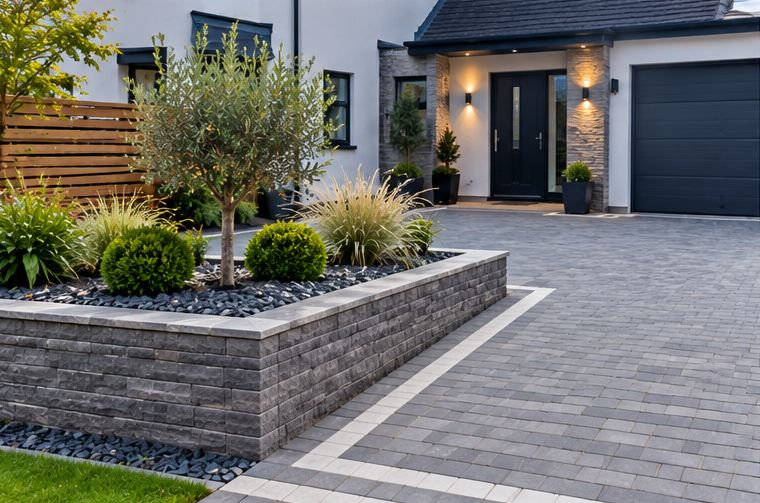
Paving and gravel are the backbone of an easy-care terrace, but only if they are laid well. Slabs on a full bed with properly filled joints give weeds little chance, while slabs laid on spots of mortar or sand soon grow moss and sink. On the damper, shadier levels, choose a paving that does not hold water. Our patio slabbing and paving page shows the options.
Gravel is quick to lay and drains freely, which helps in a wet valley, but on a slope it will creep downhill unless it is laid on a stabilising grid or kept to level areas. A good membrane underneath and a solid edge to hold it in place make all the difference.
Planting that holds a bank without fuss
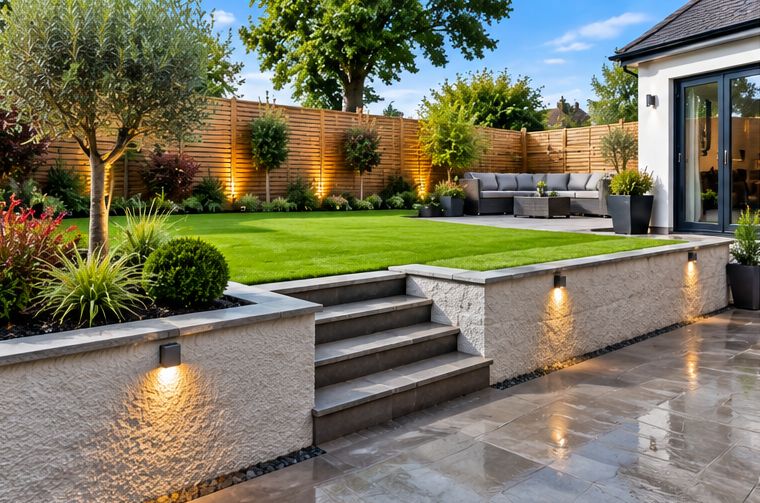
Where a slope is too steep to terrace, planting is often the answer. Dense, low shrubs and ground cover knit together, shade out weeds and hold the soil with their roots. Once established, they need a trim once or twice a year rather than weekly attention.
Plant through a membrane or into a thick layer of bark and they will get away faster with less weeding in the first seasons. Choose plants that cope with wet winters and some shade. Evergreens keep the bank looking dressed in winter, and a few flowering shrubs give colour without extra work. Bark laying on the bank tidies it straight away while the plants grow in.
Raised beds at a sensible height
If you enjoy growing vegetables or flowers, raised beds bring the work up to you. Built from sleepers, brick or block along the edge of a level, they drain well, warm up earlier in spring and stop you kneeling on wet ground. They are also easier to keep weed-free because the soil is new and contained.
In a narrow Abertillery garden, long slim beds against the boundary walls work better than square ones in the middle. Our guide to building brick raised beds and planters covers the masonry side.
Cut down the carrying
Much of the effort in a terraced garden is fetching and carrying. A few practical changes save a surprising amount of legwork over a year.
- Put the compost bin and green waste bags at the lane-gate end, where they can go straight out
- Keep a small store for tools on the level where they are used
- Fit a water butt at the top of the garden as well as by the house
- Rebuild uneven steps so a barrow or a bag can go up them safely
- Add a handrail on longer flights for carrying loads
Deal with the big jobs once
A lot of ongoing upkeep comes from one or two large problems: a hedge that has grown out of control, a tree shading the whole slope, or a corner full of bramble and old rubbish. Tackling these properly, once, makes the rest of the garden far easier to keep on top of. See overgrown tree and hedge work in Abertillery and our garden clearance service.
After that, a well-planned stepped garden should only need a tidy-up in spring, a trim in summer and a clear-out of leaves in autumn. If you would like help working out which changes would save you the most time, see making the most of a narrow Abertillery terrace garden, then ask us for a free quote.
Talk to T J Landscapes about your garden
Free quotes and honest advice across South Wales.
Questions People Ask
Is artificial grass really maintenance-free?
Not quite. It needs brushing to keep the fibres upright, leaves clearing, and the odd weed removing from the edges. It does save mowing, feeding and watering, which is a real help on a small, awkward level.
Will gravel wash away on my sloping garden?
On a steep slope, loose gravel does tend to move downhill in heavy rain. Laying it on flat terraces, using a stabilising grid, and giving it firm edges keeps it where it should be.
Which plants suit a shady, damp valley garden?
Ferns, hardy geraniums, evergreen shrubs and many ground cover plants do well in shade and wet winters. We can suggest planting that suits your garden when we visit, and plant it as part of the job.
Can you just do part of the garden to begin with?
Yes. Many people start with the worst area, often a steep lawn or an overgrown top end, and do the rest later. We will help you decide what to tackle first so the work does not have to be undone.
What affects the cost of a low-maintenance makeover?
The size and steepness of the garden, how much needs clearing, whether levels or walls are needed, the surfaces and plants you choose, waste removal and access from the lane. We give a free quote after a visit.