
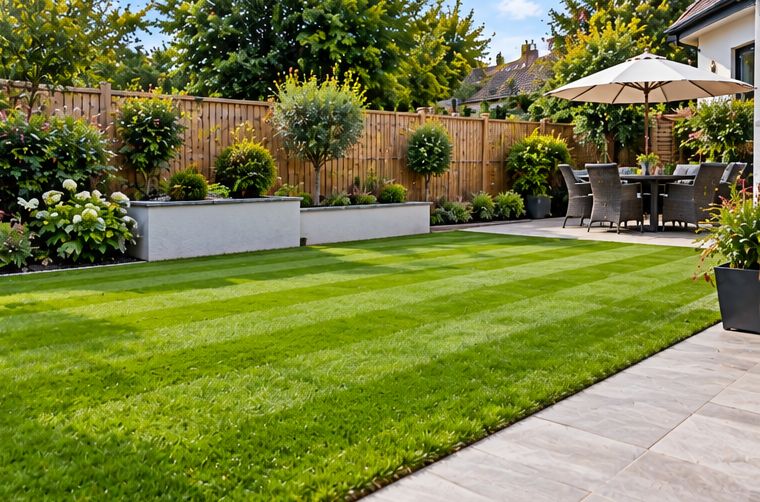
Plenty of people in Abertillery would like a bit of green behind the house. The trouble is that the back gardens on the valley sides rarely sit flat. Grass on a steep strip can be awkward to mow, slow to root and quick to wash out in heavy rain.
This guide covers the local side of laying turf on a slope: how to tell whether your gradient suits a lawn, what the soil in an Ebbw Fach terrace garden tends to need, how the rolls are laid and fixed, and how to get it all up the garden. Our turf laying page explains the service more widely, and our landscaping in Abertillery page shows how a lawn fits with steps, walls and paving on these plots.
First question: can you mow it safely?
Before thinking about turf at all, picture yourself mowing the slope on a damp Saturday. A gentle incline is fine with an ordinary mower. As it gets steeper, pushing a mower uphill is hard work, a heavy machine can run away downhill, and wet grass under your feet is slippery.
A simple test is to stand on the slope and see whether you feel steady walking across it. If you would not want to walk it with a mower when it is wet, a lawn is probably the wrong answer for that part of the garden. We will give you an honest view when we visit rather than lay turf where it will become a problem.
Three ways to handle an Abertillery slope
On most terrace gardens the choice is not simply lawn or no lawn. It is usually one of these:
- Turf the slope as it is, where the gradient is gentle enough to mow and walk on comfortably.
- Cut a level for the lawn, holding the ground back with sleepers or a wall, so you get a flat patch of grass on one tier of the garden.
- Turf the flatter parts and plant the steep bits, using shrubs, ground cover or bark on the banks between levels.
The second option is popular in Abertillery because a flat lawn, even a small one, is far more useful for children and pets than a sloping one. It does mean building a retaining edge, and our guide on landscaping a sloping valleys garden explains how levels are formed.
What the soil is usually like
Terrace gardens in the valley have often been dug, filled and built up over many decades. Under a thin top layer we regularly find stone, clinker, old ash or builders' rubble, and on the hillside the soil can be shallow over rock. Grass roots need a decent depth of good soil to find water in dry spells and to grip the slope.
Preparation is where most of the work goes. We clear weeds and stones, break up compacted ground, bring in topsoil where the existing layer is too thin or poor, and firm and rake it to an even surface that follows the slope without dips where water can collect. There is more on this in our guide to preparing the ground before laying turf.
Water is the other local issue. Rain runs down valley gardens, and on heavy clay it can sit at the bottom of the slope. If the lower end of your garden stays boggy, it may need drainage before any turf goes down. Our guide on stopping a garden waterlogging covers the options.
Laying rolls so they stay put
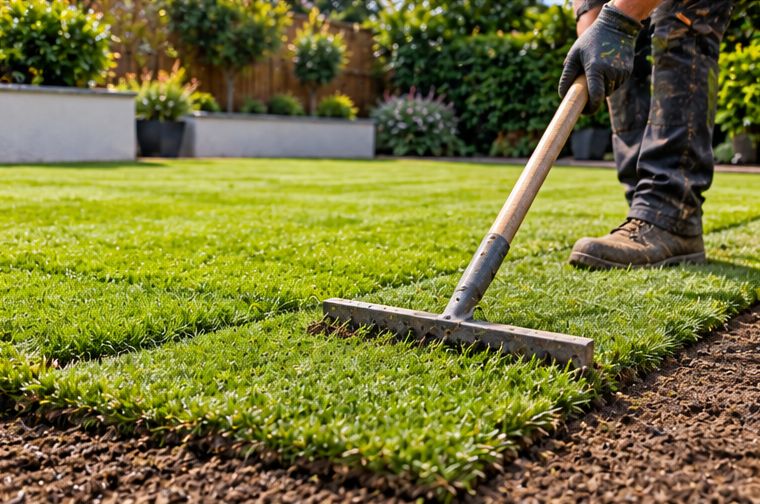
On a slope, turf is laid across the gradient rather than up and down it, with the joints staggered like brickwork so there is no straight channel for water to run down. Each roll is butted tight to the next and firmed down so the roots meet the soil everywhere.
On the steeper sections, the rolls are pinned with wooden or biodegradable pegs until the roots take hold, which stops them creeping downhill after the first downpour. At the top edge, where water arrives first, a firm edge helps stop the soil washing out from under the turf.
Carrying the turf up the garden
Turf is heavy, and it dries out if it sits rolled for too long. On an Abertillery terrace it usually arrives by the rear lane and goes straight onto prepared ground, so we plan the delivery for the day we lay rather than leaving pallets in a shared lane. Where the lane is at the bottom and the lawn is at the top, that means a lot of barrow trips on steps, and we allow for it in the time we quote.
If you are planning several jobs, it makes sense to do the heavy work, such as walls or paving, before the turf goes in, so the new lawn is not used as a route for barrows. Our guide to getting materials into an Abertillery back garden explains how we plan access.
Helping a hillside lawn get going
New turf on a slope dries out faster at the top than at the bottom, because water runs downhill. Water little and often to begin with, paying extra attention to the upper part, and keep off it until the rolls have rooted and will not lift when you tug a corner.
Timing helps too. Autumn and spring usually bring enough rain in the valleys to keep new turf moist, while a dry spell in summer means more watering. Our guides on the best time to lay turf and caring for new turf in the first six weeks go through it step by step.
Talk to T J Landscapes about your garden
Free quotes and honest advice across South Wales.
Questions People Ask
How steep is too steep for turf in Abertillery?
There is no single figure, because it depends on the soil, how you mow and how confident you feel on the slope. If walking across it when wet feels unsafe, it is too steep to mow. We look at each Abertillery garden and suggest turf, levelling or planting to suit.
Should I use turf or seed on a slope?
Turf is usually the better choice on a slope, because it covers the soil straight away and holds it together. Seed can wash down the hill in heavy rain before it establishes. Our turf or seed guide compares the two.
Would artificial grass work instead?
It can, particularly on a small, flat level where real grass struggles with shade. It still needs a well-prepared, free-draining base, and on a slope the base has to be built carefully so it does not shift. We can talk through the options when we visit.
What affects the cost of turfing a sloping garden?
The area, how steep it is, how much soil needs bringing in or taking away, whether levels or retaining edges are needed, drainage, and how far everything has to be carried from the lane. Ask us for a free quote and we will look at your Abertillery garden.
Will the new lawn slide in heavy rain?
Laid across the slope on well-prepared soil, with joints staggered and pegs on the steeper parts, it should hold. The risk is highest in the first few weeks, before the roots grip, so try to avoid walking on it and keep an eye on the top edge after a storm.