
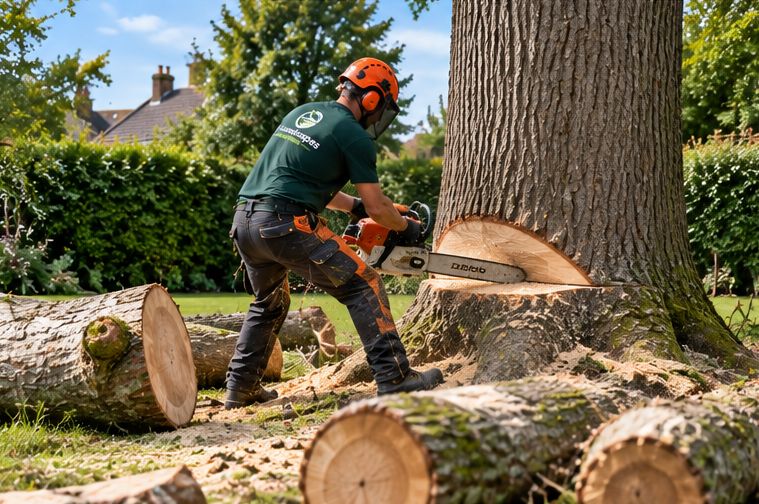
A cottage or farmhouse near Talgarth can come with a line of mature oaks along the lane, an ash or two in the paddock, a shelter belt of conifers someone planted decades ago and several hundred metres of field hedge. None of that fits the idea of a quick garden tidy. Big trees and long hedgerows need looking at as a whole, with a plan for which jobs come first and which can wait.
This guide covers the local side: what to look for on a rural plot at the foot of the Black Mountains, how the seasons and the rules shape the timing, and how we approach the work. For the techniques themselves, our guide to crown lifting, thinning and reduction explains the terms.
Walk the boundary before anyone picks up a saw
The most useful first step is a slow walk round the whole property, ideally in winter when the leaves are off and you can see the structure of each tree and hedge. On a big plot near Talgarth it is easy to forget the far corner where a hedge has grown into a row of small trees, or the field gate that is slowly being pushed over by a trunk.
Make a rough note of what you find. It turns a vague worry into a list we can price and put in order when we come out.
- Dead or hanging branches over a lane, drive, footpath or roof.
- Trees leaning more than they used to, or with cracks, fungus or loose bark near the base.
- Hedges gone tall and thin, with gaps at the bottom where sheep or deer get through.
- Conifer shelter belts that have outgrown the space and now shade the lawn or the house.
- Ivy smothering a tree so heavily that you cannot see the trunk to judge its condition.
Ash dieback and the other big-tree questions
Ash is one of the most common trees in the hedgerows and field corners of Powys, and ash dieback has spread through much of Wales. Affected trees thin out from the top, with dead twigs and patchy leaf, and in time the wood can become brittle. A dying ash in the middle of a field may be left for wildlife; one standing over a lane, a drive or a garden where children play is a different matter.
Big oaks are usually far tougher and can live for centuries, but they still shed heavy limbs now and then, especially after a dry summer or a winter storm. Crown lifting over a track or a light reduction of an over-long limb is often all that is needed. Felling a healthy mature oak is rarely the right answer, and our page on deciding between felling and pruning sets out how we weigh it up.
Conifer belts are the other common issue on country plots. Planted as windbreaks, many have grown far taller than intended. They do not regrow from old bare wood, so cutting them back hard can leave brown stumps. Sometimes the kindest option is to take out every other tree and plant native hedging or broadleaves in the gaps.
Rules worth checking in and around the national park
A lot of the land around Talgarth sits inside the Brecon Beacons (Bannau Brycheiniog) National Park, which has its own planning authority. Some trees carry tree preservation orders, and some villages and town centres are conservation areas where work to trees needs notice first. Before any large tree is felled or heavily cut, check with the national park authority or Powys County Council.
Countryside hedgerows can also be protected, particularly where someone wants to remove a length of hedge rather than trim it, and felling a larger volume of timber away from a garden can need a felling licence from Natural Resources Wales. We are landscapers, not planners or solicitors, so we will always suggest you check with the right body. Our general piece, do you need permission to cut down a tree in Wales?, is a sensible starting point.
Nesting birds are protected wherever they are. Big hedges and old trees are full of nests from early spring to late summer, so the heavy work is best planned for autumn and winter.
A calendar for rural tree and hedge work
On a large property it helps to spread the work across the year rather than cram it into one visit. A typical pattern for a place near Talgarth looks something like this:
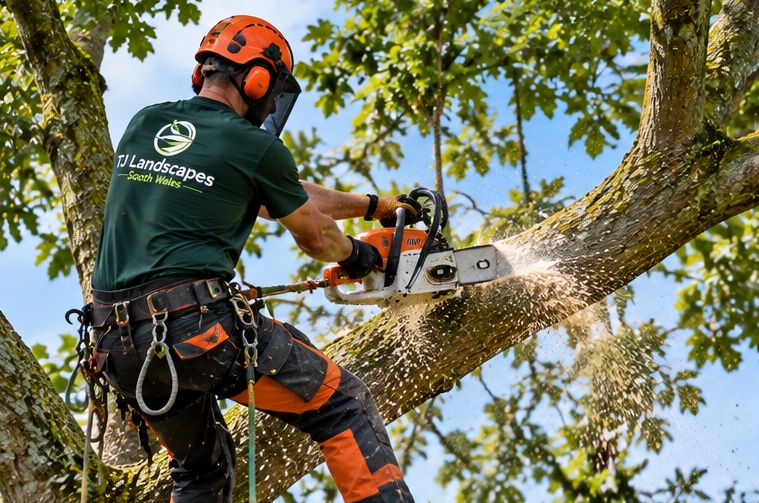
- Late autumn to late winter: felling, reductions, crown lifting, hedge laying and hard cutting back, while the birds are not nesting and the leaves are down.
- Late winter: planting bare-root native whips to fill hedge gaps or replace a removed conifer belt.
- Spring and early summer: leave hedges alone, check new planting and deal with anything urgent, such as a branch brought down by a storm, carefully.
- Late summer into autumn: routine hedge trimming once nesting has finished. Our guide to how often and when to trim a hedge covers this.
Bringing an old field hedge back to life
A lot of Talgarth properties have a hedge that was once kept low and stock-proof but has since been left to grow up. There are three broad options. Trimming keeps it in shape if it is still dense at the base. Coppicing cuts it right down to near ground level so it regrows thickly. Laying, the traditional craft of part-cutting and bending the stems over, rebuilds a thick, living barrier from the bottom up.
Which one suits depends on the species, the thickness of the stems and what the hedge needs to do. If it has to keep sheep out of your garden this year, a run of stock fencing alongside a newly laid or coppiced hedge gives it time to thicken without the neighbour's flock getting in.
Access, timber and what happens to the waste
Big trees produce a lot of material. Before we start, we agree what you want to keep: logs for the stove, cordwood stacked to season, brash left in a heap for wildlife, or everything taken away. Chipped material can often be spread as mulch around new hedging on site.
Access matters on a rural plot. We check gateway widths, soft ground and overhead lines at the first visit, and plan when the ground is firm enough for the equipment. Where a clear-out of scrub has to happen first, see clearing overgrown land around a Talgarth property.
For the full range of pruning, felling and hedge work we carry out, visit our tree surgery and hedge care page, or see how this fits into a whole-garden plan on our Talgarth landscaping page.
Talk to T J Landscapes about your garden
Free quotes and honest advice across South Wales.
Questions People Ask
Can you work on trees next to a lane or road near Talgarth?
Yes, with planning. Work over a public lane may need signs or someone controlling traffic, and it is best done at a quiet time of day. We look at this during the free visit and build it into the quote.
Should I have an ash with dieback felled?
Not always. If it stands in a field away from people, it may be fine to leave or reduce. If it overhangs a drive, lane, house or play area, it is sensible to have it looked at and dealt with before it becomes brittle.
Can a big old hedge be cut down to a manageable height in one go?
Often it can, in winter, but it depends on the species. Native hedges such as hawthorn and hazel usually regrow well from hard cutting. Conifers do not, so they need a more gradual approach or replacing.
Do you keep the logs for us?
If you would like them. Tell us at the quote stage and we will cut timber to lengths you can handle and stack it where you want it, and take away the rest.
How do I book a visit?
Send us a message with a few photos and a rough idea of the trees and hedges involved. Tony will arrange a time to walk the property with you and give you a free quote.