
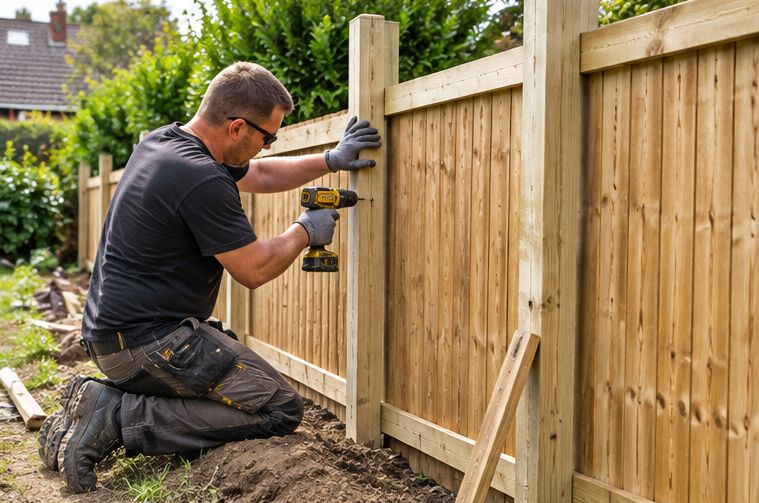
Around Talgarth, a garden boundary often does two jobs at once. It has to look tidy from the house, and it has to keep sheep, horses or cattle in the field next door rather than in your vegetable beds. Add stony ground, slopes running down from the Black Mountains and wind that finds every weak post, and it is easy to see why rural fencing needs more thought than a suburban panel fence.
This guide walks through the choices, stretch by stretch. It builds on our fencing and gates service and the landscaping in Talgarth page.
Start with who is on the other side
The first question we ask on a Talgarth boundary is not what style you like, but what the fence has to stop. The answer changes the design completely.
- Sheep. Woven stock netting on timber stakes, pulled tight between strong straining posts, with a plain or barbed line wire above if the farmer next door prefers it.
- Horses. Post and rail, or post and rail with netting behind. Barbed wire is a poor choice anywhere a horse can reach it.
- Cattle. Heavier posts and more line wires, because cattle lean and push in a way sheep do not.
- Rabbits, deer and dogs. Finer mesh at the bottom, sometimes turned out and buried, and extra height where deer or a determined dog are the problem.
If the field belongs to a neighbour, it is worth a friendly word before we start. Many farmers have firm views on what works with their stock, and agreeing the fence line and style early avoids trouble later.
What makes stock netting last
A stock fence is only as good as its tension, and its tension is only as good as the straining posts at each end and corner. These are larger posts, set deep and braced with a diagonal strut so they do not lean inwards as the netting is pulled tight. The intermediate stakes between them are there to hold the height, not to take the strain.
Long runs, changes of direction and dips in the ground all need extra straining points. On a sloping Talgarth field, netting that is simply stretched over a hollow will lift at the bottom and leave a gap that lambs find within days, so we tie it down or add a stake in the low spot.
Treated timber and good galvanised netting give the longest life. Keeping brambles and bracken cleared along the fence line also helps, because vegetation holds moisture against the stakes and hides damage until it becomes a gap.
Post and rail along drives and paddocks
Post and rail is the classic country fence. It suits a drive, the edge of a paddock or the line between a lawn and a field, and it keeps the view open, which matters when the Black Mountains are what you bought the house for.
Two or three rails work for most garden uses; add netting on the field side if smaller animals need keeping in or out. Rails are usually fixed to the side facing the stock, so a horse pushing against the fence presses the rail onto the post rather than off it.
Close board and privacy near the house
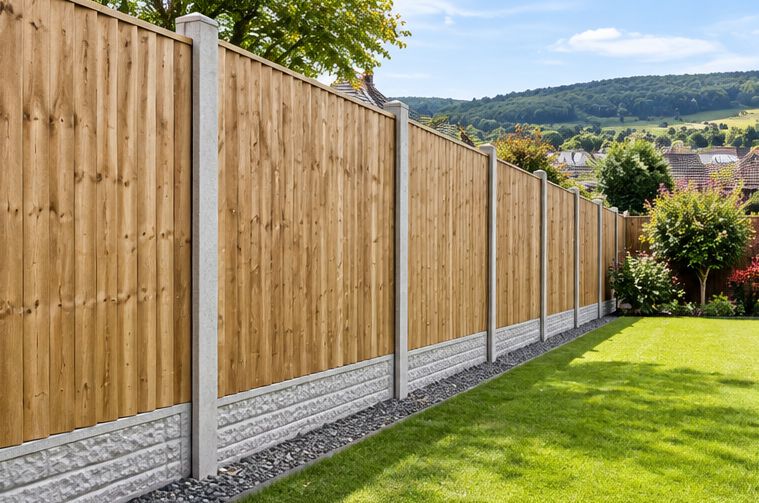
Nearer the cottage or farmhouse, you may want privacy and shelter rather than a view. Close board fencing gives both, and a well-built run can make a seating area far more pleasant on a breezy evening. On exposed plots we use strong posts, set firmly, because a solid fence catches the wind like a sail.
A slatted or hit-and-miss fence lets some wind through and can survive better on the most open ground. Our general article on which garden fence stands up best to Welsh wind compares the options, and close board, panel or slatted fencing explains the differences between them.
Field gates and garden gates
Gates get more use and more abuse than any other part of a rural boundary. A field gate needs a hanging post big enough to carry its weight without dropping, and a clear, level swing so it does not drag in the mud. Where tractors or trailers need access, measure the widest vehicle before choosing the gate width.
Pedestrian gates between the garden and the field should be self-closing if livestock or dogs are involved. For entrances with stone piers, see stone walls and gateways for Talgarth properties, and for hanging and hardware, choosing and fitting a garden gate.
Stony ground, slopes and wet hollows
The ground at the foot of the Black Mountains can be hard going. Some Talgarth boundaries are full of stone just below the turf, while others sit in low, wet ground where posts can loosen over a wet winter. We check the ground before quoting, because it affects how posts are set and how long the job takes.
On slopes, post and rail and close board can be stepped or raked to follow the land. Stock netting follows the ground naturally but needs extra fixing at changes of gradient. On soft ground, longer posts and firmer footings help, and sometimes a little drainage along the fence line solves the problem at its source.
Hedges, rights of way and checking first
Many Talgarth boundaries are partly hedge. It is often better to keep an old hedge and run stock netting just inside it than to grub it out, and some countryside hedgerows are protected in any case. See managing big trees and hedgerows near Talgarth.
If a public footpath crosses or runs along the boundary, any stile or gate on it has to stay usable, so check with the council before changing it. New fences beside a road or within the national park may also need checking with the planning authority. We are landscapers, not planners, but we will point out anything you should ask about.
Talk to T J Landscapes about your garden
Free quotes and honest advice across South Wales.
Questions People Ask
Can you fence a long boundary in stages?
Yes. On a big Talgarth plot we often start with the stretch that matters most, such as the side next to livestock, and come back for the rest. Planning the whole line first keeps the straining posts and gates in the right places.
Can you repair an old stock fence rather than replace it?
Sometimes. If the straining posts are sound, loose netting can often be re-tensioned and broken stakes swapped. If the end posts have rotted or leaned, replacement is usually the better value. Our guide to fence repair or replacement explains how to tell.
Do you clear the fence line first?
Yes. Brambles, scrub and old wire usually have to come out before a new fence goes in, and we take the waste away as part of the job.
What affects the cost of rural fencing?
The length of the run, the type of fence, the number of corners and gates, how stony or wet the ground is, slopes, access for materials and how much old fencing has to be removed. Tony will walk the line with you and give a free quote.
How do we arrange a visit?
Tell us roughly how long the boundary is and what is next to it using the enquiry form, and we will come out to look.