
Buy a cottage or smallholding near Talgarth and there is a fair chance part of it has been left to go wild. It might be an old orchard lost under brambles, a paddock turning to bracken and gorse, a bank of blackthorn creeping out from the hedge, or a corner where old fencing, sheets of tin and rubbish have been swallowed by growth. Sometimes the whole garden has simply been left for years while a house stood empty.
This guide explains how we approach clearing overgrown land on a country property, what to think about before the work starts, and how to stop it all growing straight back. For the general process, see getting an overgrown garden back under control.
What rural overgrowth around Talgarth usually looks like
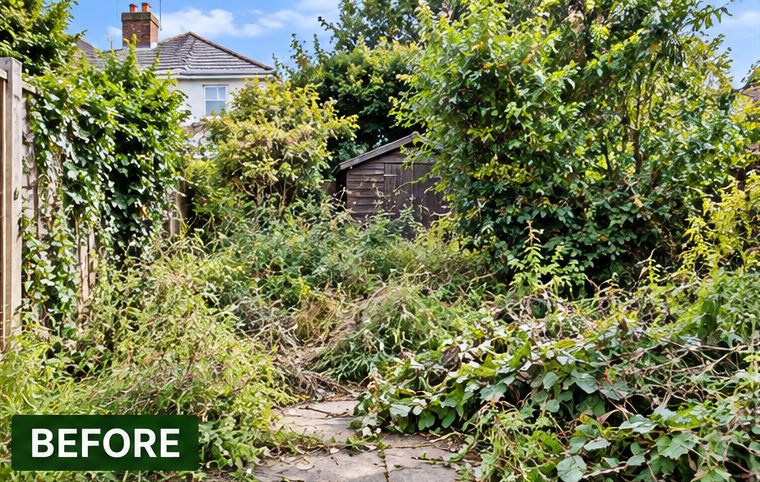
Land at the foot of the Black Mountains gets plenty of rain and grows fast. Left alone, open ground moves through the same stages almost everywhere: rough grass first, then docks, nettles and thistles, then brambles, and within a few years scrub and self-seeded saplings such as ash, hawthorn, birch and sycamore. On the drier, more acid banks, bracken and gorse take hold instead.
Each of these needs a slightly different approach. Brambles and nettles can be cut and cleared in a day or two on a modest area. Bracken comes back from underground stems year after year unless it is kept cut. Saplings more than a few years old need proper cutting and stump treatment or removal, or they simply regrow as a thicket.
Before we start: things to check
A little checking at the start saves trouble later. When Tony visits a Talgarth property to price a clearance, these are some of the questions we will ask and look into with you:
- What is hidden underneath? Old wire, fence posts, glass, tin sheets and hidden drains or wells are common on rural land.
- Where are the boundaries? Overgrowth can hide exactly where your land ends, and neighbours appreciate being told before work starts along a shared edge.
- What is worth keeping? Old fruit trees, a good hedge line or specimen trees can be spotted and protected before any cutting.
- Is there anything we cannot take? Asbestos sheeting, chemicals and some other waste need their own disposal route, so we flag them before the job rather than on the day.
- Are there any invasive plants? Japanese knotweed and Himalayan balsam are both found in Wales and need careful handling rather than simply being cut and carted off.
Timing around wildlife and the seasons
Overgrown land is full of life. Brambles and scrub are prime nesting cover for birds, and nests in use are protected by law, so the heavy clearing is best done from autumn through to late winter. If a job has to happen in spring or summer, the area needs checking carefully for nests first, and anything with an active nest is left until later.
Hedgehogs, slow worms and other small animals shelter in rough ground too. Working in from one side, cutting high first and then lower, gives them a chance to move away. Log piles and brash heaps are left alone until we are sure nothing is hibernating in them. The winter timing has a practical side as well: bracken and brambles have died back, and it is much easier to see what you are dealing with.
Access, machinery and soft ground
On a rural Talgarth plot, the biggest factor in how a clearance is planned is often access. We check the gateway width, the state of the track and where a vehicle can be parked for loading. Heavy ground near a stream or at the bottom of a field can turn soft through the wetter months, so we plan machinery for dry spells or use smaller kit that will not churn it up.
Large areas are often cleared in stages: the part nearest the house first, so you can use it, then the orchard or paddock beyond. That also spreads the work across a season rather than asking you to deal with everything at once, and it lets you see the shape of the land before deciding what to do with the far end.
Where all the green waste goes
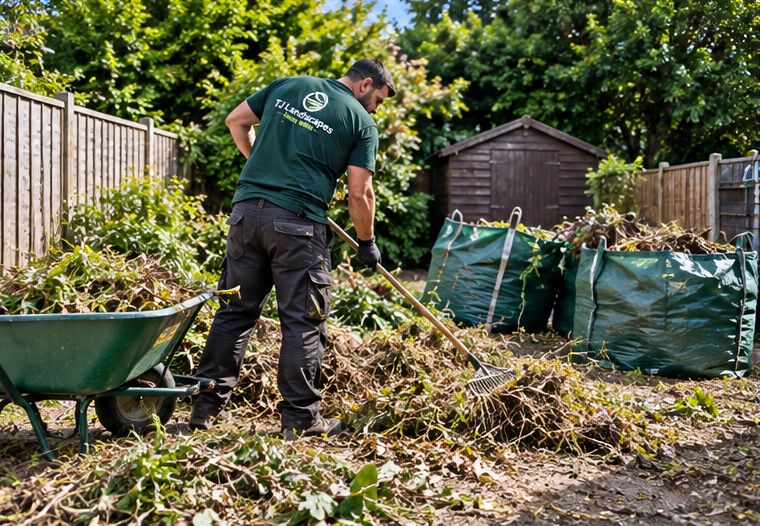
Clearing rural land produces a surprising volume of material. Some of it can stay on site if you want it to. Woody brash can be stacked at the edge as a wildlife pile, logs from saplings can be cut for the stove, and chippings can be spread on paths or around new planting. The rest, including brambles, nettles and roots, we load and take away.
Please ask before arranging a bonfire of the cuttings yourself, as smoke drifting across fields and lanes causes problems with neighbours, and wildlife often moves into a heap within days. Our guides on where garden waste goes and what can and cannot go in a garden clearance explain how it is handled once it leaves.
Keeping it clear afterwards
Cleared ground will try to go back to scrub straight away. The simplest way to stop it is to decide quickly what the land is for. A paddock can be mown or grazed. A garden area can be cultivated and turfed, which our guide to large lawn installation for a Talgarth property covers. A rougher corner can be left as long grass with a mown path through it, or sown as a meadow.
Bracken and bramble regrowth needs cutting a couple of times in the first year or two to weaken the roots. Newly cleared boundaries often reveal a hedge that needs laying or gapping up, or fencing that has long since fallen down; see managing big trees and hedgerows near Talgarth for the next steps.
Our garden clearance page sets out the clearance work we take on, and our Talgarth landscaping page shows how a cleared plot can be turned into a finished garden.
Talk to T J Landscapes about your garden
Free quotes and honest advice across South Wales.
Questions People Ask
Can you clear an acre or more of overgrown land?
Yes. Bigger areas are usually cleared in stages, with the machinery and team matched to the ground and the access. We look at the whole site on the free visit and plan it with you.
Will you take away old fencing and rubbish found in the undergrowth?
Usually. Tell us what is buried in there when we come to quote, so we can plan how old wire, posts and timber will be taken away with the green waste. Asbestos sheeting and chemicals are the exceptions and need separate, licensed disposal.
Can you remove bracken completely?
Cutting it clears the ground, but bracken regrows from underground stems. Regular cutting over a couple of seasons, or turning the ground into lawn or grazing, is what keeps it down.
What if I find Japanese knotweed?
Do not cut or dig it yourself, as small fragments can regrow and spread. It needs a proper treatment plan, and we will tell you if we spot it during the visit.
How do I get a quote for a clearance?
Send us a message with photos and a rough idea of the area. Tony will visit, walk the land with you and give you a free quote.