
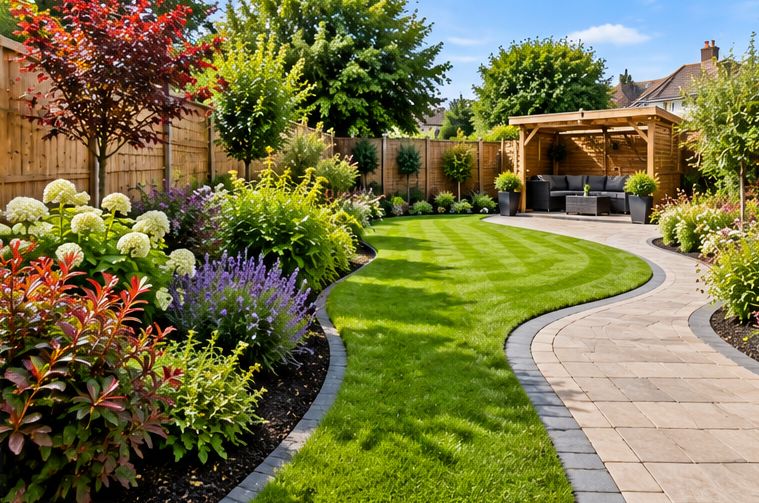
Plenty of people move into a house near the seafront in Port Talbot, fill the borders with plants from the garden centre and watch half of them turn brown by the end of the first winter. The plants were not poor ones. They were simply the wrong ones for a garden that catches the wind straight off Swansea Bay, with salt in it.
This guide explains how we approach planting in those conditions: which plants cope, how to arrange them, and how to get them established. It is part of the wider landscaping and garden design work we do, and our landscaping in Port Talbot page covers the rest of what a coastal garden needs.
How salt and wind damage plants
Salt reaches a garden in two ways. Spray is carried inland on strong onshore winds and dries on leaves as a fine crust, which draws moisture out of them and scorches the edges. Over time, some of that salt also washes into the soil. Plants with thin, soft or large leaves suffer most, which is why the damage usually shows first on the side of a shrub that faces the sea.
Wind does its own harm even without salt. It dries leaves faster than roots can replace the water, rocks young plants so their roots tear, and snaps tall flower stems. A plant that would be perfectly hardy a few miles inland can struggle in a gap between houses where the wind funnels through.
Work out how exposed your plot really is
Not every Port Talbot garden gets the full force of the weather. The streets closest to Aberavon Beach and the open seafront take the most, while gardens further back behind rows of houses, or on the inland side towards Margam, are far more forgiving. Even within one garden there are big differences between the open end and the corner tucked behind the house.
A few simple clues tell you a lot:
- Existing hedges and trees leaning away from the sea, or bare on one side.
- Brown, crisp leaf edges appearing after a stormy week.
- Soil that dries out quickly on the surface even after rain.
- Fence panels or trellis on one boundary that keep working loose.
- A spot by the back wall where washing hangs still on a breezy day. That is your natural shelter.
When we visit, we walk the garden with you and mark the exposed edges and the calm pockets before any plant list is written.
The outer layer: shrubs that take the weather
The first job of coastal planting is to build a living windbreak on the exposed side. These are the plants that do the heavy lifting, and most of them have tough, leathery, waxy or silvery leaves that shed salt well. Plants that often do well on the South Wales coast include:
- Escallonia, a classic seaside hedge with small glossy leaves and pink or white flowers in summer.
- Griselinia, with fresh apple-green leaves that shrug off salt; it suits milder spots best.
- Elaeagnus, tough, evergreen and quick to thicken into a screen.
- Tough hebes, compact and neat, useful where there is less room.
- Sea buckthorn and tamarisk, for the most exposed edges, where little else will stand.
A mixed hedge of two or three of these is often better than a single species, because if one struggles in a hard winter the others keep the shelter going. Filtering the wind like this also works better than a solid barrier. Where you need shelter straight away, a slatted fence can do the job while the hedge grows; our guide to fencing that handles sea wind in Port Talbot explains which designs cope, and our fencing in Port Talbot page covers the work itself.
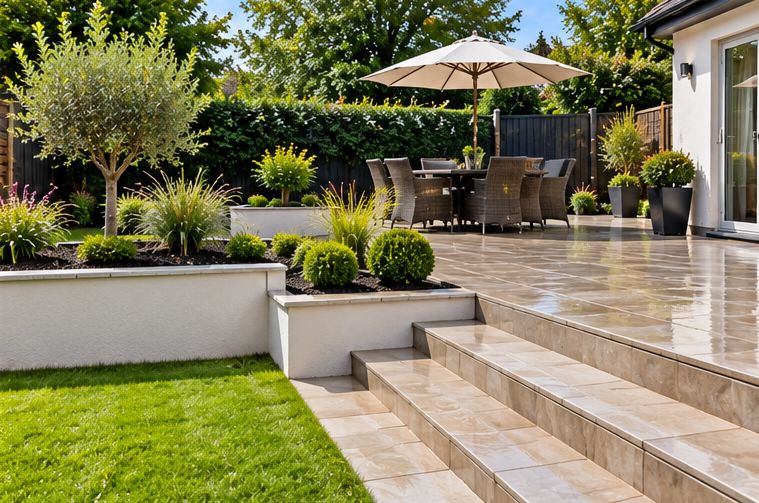
The inner layer: what grows once there is shelter
Once the outer layer is doing its job, the choice opens up a great deal. In the calmer space behind a shelter hedge, a Port Talbot garden can grow a lot of colourful plants that would be battered on the open edge.
Mediterranean and seaside plants are the easiest wins: lavender, rosemary, sea thrift, sea holly, santolina and many of the silver-leaved herbs. Ornamental grasses move with the wind instead of breaking, and they look good through the winter. Crocosmia, agapanthus in sunny corners, and many hardy geraniums also cope well. Hydrangeas often do surprisingly well near the coast as long as they are out of the full blast and kept watered.
Keep tall, top-heavy perennials and big-leaved plants for the most sheltered corners, and choose shorter, sturdier varieties where you can.
Getting the soil right, sandy or heavy
Near Aberavon the ground is often light and sandy. It drains well, which most coastal plants like, but it holds little water or food. Digging in plenty of organic matter before planting, and mulching afterwards, makes a big difference. Our article on sandy soil and new lawns near Aberavon explains the same problem from the lawn side.
Further inland, some gardens sit on heavier, stonier ground or on soil left compacted by building work on the post-war estates. There the task is opening the soil up so roots can get down and water can drain away, rather than holding moisture in. In both cases a mulch helps, but in a windy spot choose a coarse bark or gravel that stays put rather than a fine one that blows onto the lawn.
Planting, staking and watering
Small plants establish better than big ones in exposed gardens. They catch less wind, root faster and quickly overtake larger plants that sulk after being moved. Autumn and early spring are usually the best times to plant, when the soil is moist and the plants are not trying to cope with summer drying as well.
- Plant hedging young and in a staggered double row for a denser screen.
- Use short stakes, low down, so the root ball stays still while the stem can flex.
- Put up temporary windbreak netting on the most exposed side for the first year or two.
- Water new plants deeply and less often, rather than a little every day, especially on sand.
- Rinse leaves with the hose after a big salt-laden storm if the plants are young.
A hedge planted this way needs a light trim once or twice a year to keep it thick at the base; our guide to hedge trimming covers when, and our tree surgery and hedge care team can take it on if you would rather not.
Keeping it simple to look after
Tough coastal plants are, by nature, low-fuss plants. A border built from them needs far less watering, deadheading and replacing than a traditional bedding scheme, which suits many Port Talbot households. If easy upkeep is the main aim, read our guide to low-maintenance gardens for Port Talbot homes alongside this one, and look at coastal garden ideas for Port Talbot homes for how planting fits the wider design.
Talk to T J Landscapes about your garden
Free quotes and honest advice across South Wales.
Questions People Ask
What is the quickest hedge for shelter near the sea?
Elaeagnus and griselinia both thicken up fairly quickly, and escallonia is not far behind. None of them is instant, so on a very exposed Port Talbot plot we often suggest a slatted fence or netting to give shelter while the hedge grows.
Can I grow a leylandii hedge in Port Talbot?
It will grow, but it often browns badly on the seaward side, and leylandii does not regrow from old brown wood. On exposed plots a salt-tolerant broadleaf hedge is usually the better choice.
Why have my shrubs gone brown on one side?
Usually salt or wind scorch on the side facing the weather. Many tough shrubs recover and put out new growth in spring. Wait before cutting hard, then trim back to healthy growth.
When is the best time to plant a coastal border?
Autumn and early spring in most years, when the ground is moist and the weather is mild. Avoid planting just before a long dry spell or in frozen ground.
Do you supply and plant as well as design?
Yes. Tony and the team can prepare the ground, supply the plants and plant them as part of a wider project. Get in touch for free advice and a free quote.