
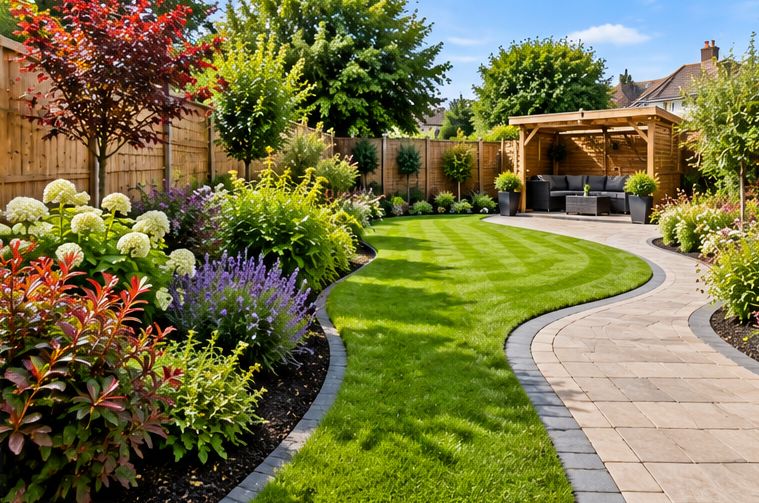
Ask most people in Port Talbot what they want from their garden and the answer is somewhere to sit, somewhere for the children or the dog, and not too much work. That is a very reasonable wish. The trick on this stretch of coast is that the usual advice for an easy garden does not always hold up to the wind and salt coming off Swansea Bay. Fine bark blows away, cheap fixings rust, lightweight furniture ends up in next door's garden and a thirsty lawn on sandy ground needs more watering, not less.
Below we look at how to plan a low-maintenance garden that suits Port Talbot, and which choices save the most time. Our general guide to planning a low-maintenance garden covers the principles, and our landscaping and garden design page shows how we put whole gardens together.
Decide what the garden is for
Easy gardens start with a short list. Write down the three or four things you actually use the garden for: drying washing, eating outside, a patch of grass for children, somewhere to keep the bins and bikes, a few pots of herbs. Anything not on the list is a candidate for simplifying.
Most Port Talbot terraces and post-war semis have modest gardens, which is an advantage here. A small space with a clear layout, a good surface and one or two planted areas can look smart all year with very little effort. Our guide to patio paving for Port Talbot semis and terraces shows how a typical plot can be laid out.
Surfaces that shrug off the weather
The surface you choose does more to cut upkeep than anything else. On the coast, it needs to cope with salt, blown sand and plenty of rain.
- Porcelain paving is dense, does not soak up salt or stains, and hoses clean. Well-pointed joints stop sand and weeds settling in.
- Dense natural stone or good concrete slabs suit a more traditional look and wear well if they are laid on a proper base with a fall for rainwater. See our patios and paving.
- Gravel or slate chippings over a membrane are cheap to lay and easy to keep, but choose a heavier grade that stays put in the wind.
- Artificial grass stays green without watering on sandy ground, though it still needs brushing and the odd rinse. Pets and shade need a little thought.
- Composite decking does not need staining and copes with damp, as long as the frame and fixings are chosen for the coast. Our guide to decking in a salty Port Talbot garden explains what to look for.
If you still want real grass
A real lawn is not high maintenance in itself; it is a lawn in the wrong place that makes work. Keep it to a simple shape that is easy to mow, with a hard edge of paving or a mowing strip so there is no edging to do. On the sandy ground near Aberavon, good topsoil underneath makes a huge difference to how often it needs watering. Our article on sandy soil and new lawns near Aberavon explains the preparation, and our turf laying covers the work.
Boundaries you will not have to keep fixing
In an exposed Port Talbot garden, a fence that keeps blowing about is one of the biggest sources of repeat work. A well-built slatted or hit-and-miss fence on sturdy posts filters the wind and stays put, and concrete posts do not rot at the base. Galvanised or stainless fixings save replacing rusted brackets and hinges every few years.
Hedges look softer but need cutting at least once a year. If you want one, choose a slow, tidy, salt-tolerant shrub rather than a fast conifer. Our guides to fencing that handles sea wind in Port Talbot and garden walls for Port Talbot homes weigh up the options.
Planting that looks after itself
A garden with no plants at all can feel bleak, and a handful of the right ones asks very little. Tough evergreen shrubs, ornamental grasses and Mediterranean plants like lavender and rosemary are happy with coastal weather, need little watering once settled, and only want a trim once a year.
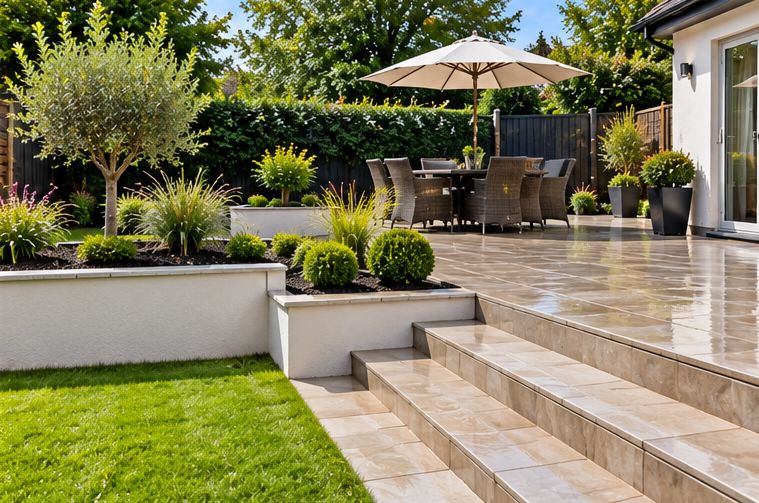
Raised beds make planting easier still: better soil, less bending and a clear edge to the paving. Mulch the beds with a coarse bark or gravel to hold moisture and keep weeds down. For plant choices, read planting for wind and salt in Port Talbot.
Storage, bins and furniture
Clutter creates work. A garden where the bins, bikes, hose and tools all have a proper home is quicker to tidy and looks better for it. A small store or bin enclosure built against a wall, on a paved base, keeps everything in one place and out of the wind.
Furniture matters too on this part of the coast. Lightweight chairs and parasols get picked up by a strong gust, so heavier pieces, or built-in seating along a raised bed or low wall, save chasing things round the garden. Anything metal will last longer if it is powder-coated or stainless and given a rinse now and then. Our brickwork team can build seating walls and bin stores as part of the same job.
The jobs that are left each year
No garden is maintenance-free, but a well-planned coastal one can come down to a short, predictable list:
- Sweep or blow paving and decking, and hose off salt after a stormy spell.
- Brush artificial grass and pick up leaves in autumn.
- Trim shrubs and hedges once a year, usually after flowering or in late summer.
- Top up gravel or mulch where it has thinned out.
- Check fence fixings and gate hinges each spring, and tighten anything loose.
- Clean paving once a year; see how to clean and look after a patio.
That is a few hours spread across the year, which leaves the rest of the time for actually enjoying the garden.
Talk to T J Landscapes about your garden
Free quotes and honest advice across South Wales.
Questions People Ask
Is artificial grass a good idea near the sea?
It suits many Port Talbot gardens, especially on sandy ground where a real lawn dries out. It needs a well-prepared, free-draining base and an occasional brush and rinse, and it can get warm in full sun.
Will gravel blow around in the wind?
Fine pea shingle can scatter on exposed plots. A heavier angular gravel or slate chipping, laid over a membrane and edged properly, stays in place much better.
What is the lowest-maintenance patio material?
Porcelain is hard to beat for upkeep, as it does not absorb stains or salt. Dense natural stone and good concrete slabs are also practical choices if laid well.
Can you turn an overgrown garden into a low-maintenance one?
Yes. We clear it first, then lay the new surfaces, fencing and planting as one project. See our guide to garden clearance in Port Talbot.
How do I get started?
Tell us what you use the garden for and send a few photos through the contact form. Tony will visit, talk through ideas and give you a free quote. You can also read more on our landscaping in Port Talbot page.