
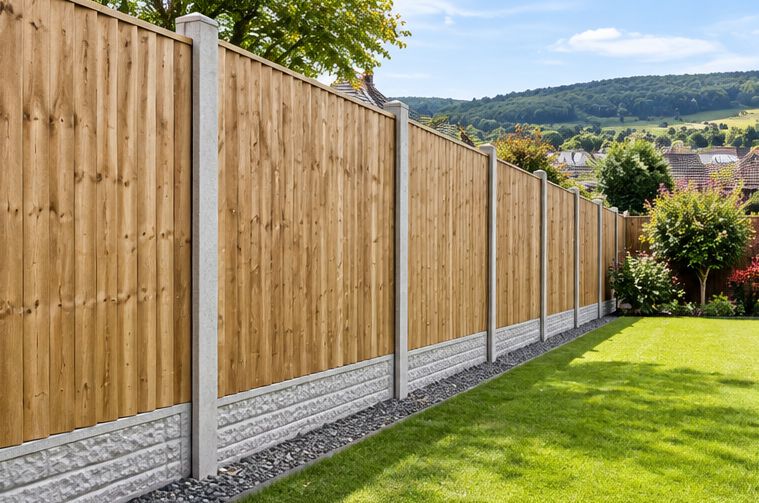
Ask anyone who lives near the seafront in Port Talbot about fences and you will probably hear about a winter storm that laid a run of panels flat. Wind off Swansea Bay is persistent rather than occasional, and a fence that faces it takes a pounding for months at a time. Add salt in the air and, near the beach, soft sandy ground, and it is easy to see why ordinary fences give up early here.
This guide is about the local side of fencing in Port Talbot: working out how exposed your boundary is, then matching the design, posts and fixings to it. For a side-by-side look at the main fence styles, read close board, panel or slatted fencing, and for what we fit, see our fencing services page.
How exposed is your boundary?
Not every fence in Port Talbot faces the same weather. We tend to sort boundaries into three rough groups when we visit, because the answer shapes everything else.
- Front line: gardens with an open view towards the bay or the beach, where wind arrives at full strength and salt is heaviest.
- Funnelled: gardens a little further back, but where the gap between two houses or at the end of a terrace channels the wind into a narrow jet.
- Sheltered: plots surrounded by other houses, or further inland towards Margam and the hills, where a standard fence usually copes well.
A single garden can have all three. The side boundary beside a gable end is often far more exposed than the back fence, so we sometimes suggest different designs on different runs.
Designs that spill the wind
On front-line and funnelled boundaries we generally steer people away from long runs of solid panels. A solid fence catches the full force of every gust and passes it straight down to the posts. Designs with small gaps between the boards reduce that load a great deal and still give reasonable privacy.
Hit-and-miss fencing, with boards fixed alternately on each side of the rails, looks the same from both gardens and lets air through the gaps. Horizontal slatted fencing is neater and more modern, and works well around a patio. Where full privacy matters more, close board on strong posts is the sturdiest solid option, as the boards are individually fixed rather than hung in a light panel frame.
Posts and footings
Most fences that fail in wind fail at the posts. On exposed Port Talbot plots we usually recommend concrete posts with concrete gravel boards, which do not rot and are not bothered by salt. Timber posts can look better with some designs, and where we use them they are heavy, pressure-treated posts set deep in concrete.
Sandy ground near Aberavon Beach needs extra thought. It is easy to dig but gives less grip than clay, so we go deeper and make the concrete footing wider rather than relying on a standard hole. Our comparison of concrete and timber posts covers the trade-offs in more detail.
Fixings in salt air
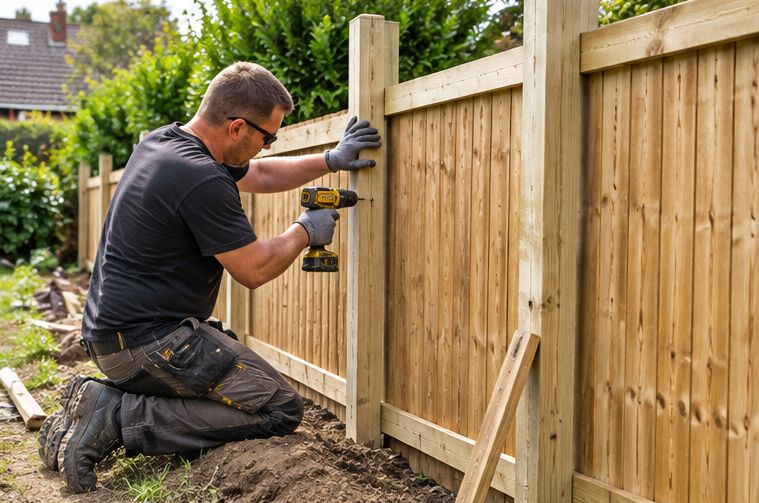
Bright zinc screws and nails can start to rust within a year or two when there is salt in the air, and once they go, boards and rails work loose. We use hot-dip galvanised or stainless steel fixings, hinges and brackets on coastal fences in Port Talbot. It adds little to the job and makes a real difference to how long the fence stays tight.
Once a year, especially after a stormy winter, it is worth walking the line of the fence. Look for rust stains running down from screws, boards that rattle when you push them, and any post that moves at ground level. Catching these early is far cheaper than replacing a whole run after the next gale.
Gates, corners and ends of runs
Gates, corners and the end of a run are where wind load concentrates. A gate is effectively a panel on hinges, so it needs a heavier post than the fence either side and strong hinges, with a drop bolt or hook to hold it in place on a wild day. A slatted gate catches less wind than a solid one.
On terraced streets, side and rear gates often open onto a lane between rows of houses, which can act as a wind tunnel. If a gate keeps dropping or swinging shut, the hanging post is usually moving. Our guide to choosing and fitting a garden gate explains what makes a gate last.
Mixing fences with walls and hedges
A fence on its own is not always the best answer on the most exposed boundaries. A low brick wall with a slatted screen on top combines a solid, heavy base with a permeable upper section, and it copes very well with the weather. Our article on garden walls for Port Talbot homes looks at this in more detail.
A hedge of salt-tolerant shrubs, planted on the windward side of a fence, takes the edge off the wind before it reaches the boards. See planting for wind and salt in Port Talbot for suitable plants, and our coastal garden ideas for how screens fit into a layout.
Heights, neighbours and permission
As a general guide, fences away from a road are often allowed up to about two metres without planning permission, with lower limits beside a road, but rules can differ and we are not planners. If you are unsure, check with Neath Port Talbot Council before building. It is also good practice to talk to your neighbour before replacing a shared fence, and to agree whose side the posts and rails will face.
A good-looking fence that suits the weather is well worth a little planning. Our fencing in Port Talbot page shows what we fit locally, and there are tips on upkeep in how to make a garden fence last longer.
Talk to T J Landscapes about your garden
Free quotes and honest advice across South Wales.
Questions People Ask
Why do fence panels keep blowing down in my Port Talbot garden?
Usually because light panels are acting as sails on an exposed boundary, or because the posts have rotted or were not set deep enough. Switching to a design that lets wind through, on sturdier posts, normally solves it.
Are concrete posts worth it near the sea?
On exposed boundaries, yes. They do not rot, salt does not affect them, and panels can be replaced without disturbing the posts. On sheltered boundaries, well-set timber posts are a fair choice too.
Can you replace just the damaged part of a fence?
Often, if the rest of the run is sound. We look at the posts and timber along the whole line first. Our guide to fence repair or replacement explains how we decide.
What affects the cost of a new fence in Port Talbot?
The length of the run, the design, post type, how hard the ground is to dig, access to the garden and whether an old fence needs removing and taking away. A free quote sets it out for your boundary.
Do you fit fences all over Port Talbot?
Yes, from the seafront to the streets further inland. Read more on our Port Talbot landscaping page or ask for a free quote.