
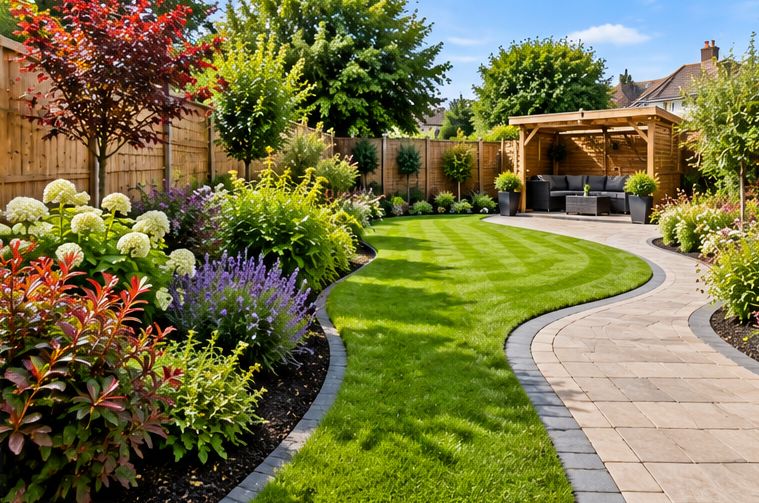
Drive through most of the post-war estates in Cwmbran and you see the same picture: strips of lawn running from one front door to the next, a path to each porch, and very little in the way of walls or fences. It was a deliberate part of how the new town was planned, and on a sunny day it still looks pleasant and generous.
Living with it is another matter. The grass needs cutting every week or so in the growing season, the bins sit in full view, cars end up half on the verge, and there is nothing to stop dogs or footballs wandering across. This guide sets out how we approach a front garden like this, from the paperwork to the planting. For a wider view of our work in the town, see landscaping in Cwmbran.
Start with the deeds, not the drawing
Before sketching anything, dig out the title deeds or the transfer documents from when the house was bought. On some Cwmbran estates, covenants were written in to keep front gardens open, and they can limit fences, walls, hedges above a certain height, or even what you park on the frontage. Some still apply and some are rarely enforced, but it is better to know than to guess.
It is also worth a quick look at where your boundary actually runs. On open-plan layouts the grass often continues past the true edge of the plot onto land owned by the council or a housing association, and the verge beside the pavement usually belongs to the highway. If in doubt, ask Torfaen council before you dig. We are landscapers, not solicitors, so we will flag anything that looks worth checking rather than give you a legal answer.
Write down what the front garden has to do
A front garden in Cwmbran is rarely just for looking at. Before choosing materials, list the jobs it has to do every day. That list, more than any style idea, decides the layout.
- Bins and recycling: several containers need a flat, hidden spot that is easy to wheel to the kerb.
- Parking: if a car needs to come off the road, that shapes everything else. Our guide to adding off-road parking to a Cwmbran front garden covers it in detail.
- The walk to the door: a path that is wide enough for a pushchair or a shopping trolley, lit at night and not slippery in the wet.
- Upkeep: how much time you honestly want to spend on it once it is done.
- Privacy: whether a front window looks straight onto the pavement.
Soft ways to mark the edge
Many people want a clearer edge to their frontage but do not want to wall themselves off from the street, or cannot because of a covenant. There are gentler ways to say where your garden starts.
A low hedge is the classic answer. Box-style evergreens, lonicera or a mixed native hedge can be kept to knee or waist height with a trim or two a year, and they soften the look of an estate road rather than hardening it. A planted border along the boundary does a similar job with more colour. Where something firmer is wanted and allowed, a low wall of one or two courses with a planted bed behind it looks settled in a year or so; we explain the options in building a low front wall in Cwmbran.
Even a crisp edging strip of brick or setts between lawn and pavement makes a front garden look cared for, and it stops the grass creeping onto the footway.
Less lawn, more structure
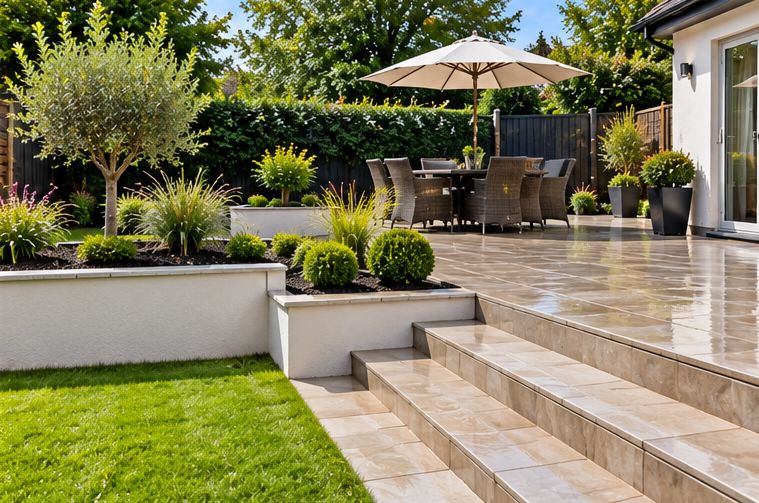
The single biggest change most Cwmbran households ask for is less grass. A small front lawn is surprisingly time-consuming for the space it takes up, and on many estates the soil was thin and compacted when the houses went up, so the grass struggles anyway.
Replacing part of it with a planted bed on a weed-suppressing membrane, finished with bark or gravel, cuts the mowing and gives the house more presence. Evergreen shrubs, grasses and a few flowering perennials look good for most of the year with a light tidy in spring and autumn. If you would like to keep some lawn, a neat rectangle with firm edges is far easier to mow than grass that wanders into odd corners. Our guide on planning a low-maintenance garden has more on choosing planting that looks after itself.
Hiding the bins properly
Nothing lets down a smart frontage like a row of wheelie bins by the porch. A small paved bay set to one side, screened by a timber bin store, a short run of slatted fencing or a clipped hedge, solves it. Keep the bay level and wide enough to turn a bin round, and link it to the pavement with a path so you are not dragging bins across wet grass on collection day.
Paths and steps to the front door
Many estate houses in Cwmbran still have their original concrete path, often cracked, sunken or tilted towards the house. Replacing it is a chance to widen it, straighten or curve it, and choose a surface that matches any new paving at the back. Porcelain, sandstone and block paving all work well; the main thing is a sound base and a slight fall so water runs off onto the planting rather than towards the door.
On the sloping streets higher up the valley sides, a front path may need a step or two. Good steps have an even rise, a generous tread and a handrail where anyone in the house is unsteady on their feet.
How we plan the work with you
Tony will come and look at the frontage, talk through how you use it and what the deeds allow, and suggest a layout. Our landscaping and garden design service covers the whole job, from lifting old turf and paths to building, paving and planting, and taking the waste away. Many people do the front and back of a Cwmbran house at the same time; others start with the front because it is smaller and makes the most difference to how the house feels when you come home. Ask for a free quote and we will arrange a visit.
Talk to T J Landscapes about your garden
Free quotes and honest advice across South Wales.
Questions People Ask
Can I plant a hedge on an open-plan Cwmbran frontage?
Often yes, but check the deeds first, as some covenants limit the height of hedges and walls at the front. A low hedge kept trimmed is usually the least controversial way to mark a boundary.
Is gravel a good idea for a front garden?
It can be, laid on a membrane with a firm edge so it does not spill onto the pavement. Choose a larger, angular gravel for areas people walk on, and keep it away from where bins are wheeled.
What decides the cost of redesigning a front garden?
The size of the area, how much old turf, concrete and soil has to be removed, the paving and walling you choose, the planting and whether any levels need changing. We give a free, written quote after seeing the garden.
Will the front garden look bare when it is first planted?
For a season it may look a little sparse, because shrubs need room to grow. We space plants for how they will look in a couple of years, and bark or gravel keeps the gaps tidy in the meantime.
Can you do the front and back garden together?
Yes, and it can save time because the waste from both is cleared in one go. Our guide to child-friendly garden layouts for Cwmbran homes covers the back.