
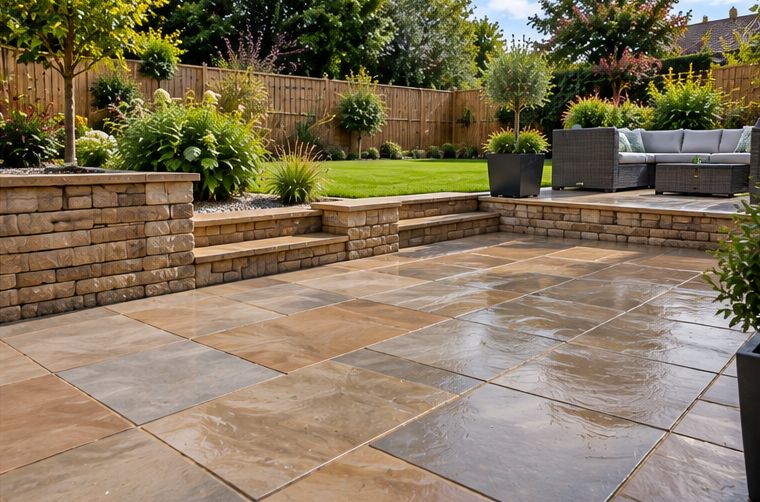
When the new town estates were built, a single garage block round the corner or a space in a shared bay was thought to be enough. Today a lot of Cwmbran homes have two or three cars, and the result is familiar: vehicles squeezed along narrow estate roads, wheels up on the verges, and neighbours quietly competing for the same few spaces at the end of the day.
A drive of your own takes that stress away. It is not a small job, though, and it depends on more than the size of the lawn. This guide goes through the questions to answer in order, starting with the ones that can stop the project altogether. You can read more about our work in the town on our landscaping in Cwmbran page.
Question one: can a car physically get in?
Measure the frontage from the house wall to the back of the footway, and from side to side. Then picture the car on it with the doors open. It needs to sit fully inside your boundary without hanging over the pavement, and you still need a way to reach the front door, the meter boxes and the bins with it parked.
On open-plan Cwmbran frontages, check where your land ends. The grass between your garden and the road may be a council verge rather than part of your plot, and you cannot pave or park on it without permission. The deeds, or a call to Torfaen council, will tell you. It is also worth reading the deeds for any covenant about parking or hard surfaces at the front.
Question two: will the council drop the kerb?
To drive across a pavement you normally need a dropped kerb, sometimes called a vehicle crossover. In Cwmbran that is a matter for Torfaen council as the highway authority, and the kerb and footway work is usually carried out by the council or a contractor it approves, not by the landscaper doing the drive.
Apply before any digging starts. The council will look at how close the crossing is to a junction, whether there are street lights, trees, drains or telecom boxes in the way, and whether there is enough room for a car to sit fully off the footway. If the answer is no, everything else is academic, and we would rather you found out before paying for anything.
Question three: where will the rain go?
Paving over a front garden changes where rain ends up. A solid surface that tips water straight onto the pavement or into the road drains can need planning permission, while one that lets water soak into the ground, or runs it into a border or soakaway inside the garden, usually does not. The rules and thresholds can change, so check the current position with the council before settling on a design.
Ground conditions matter here too. A good deal of Cwmbran sits on heavy ground that is slow to drain, so a permeable surface still needs a base that lets water get away, and in some gardens a soakaway or channel drain as well. Our general guide on stopping a garden waterlogging explains the drainage options.
Question four: is the frontage level with the road?
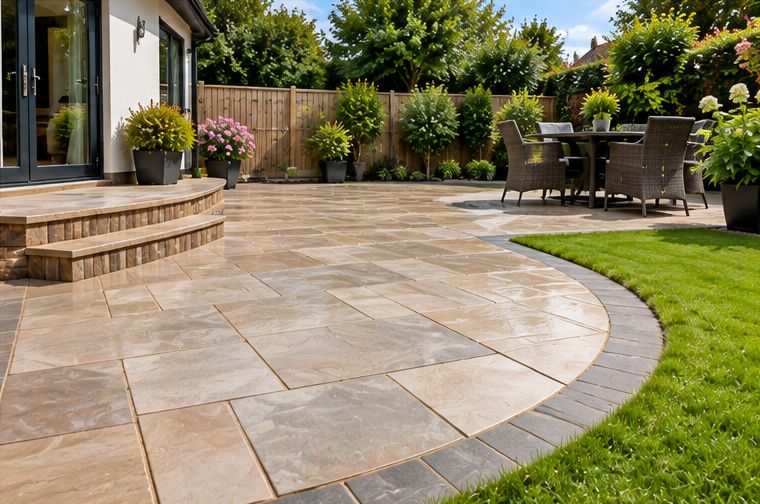
Plenty of estates in the town are built on the valley sides, and a front garden can sit well above or below the pavement. A drive needs a gentle gradient so the car can get on and off without scraping, and so it does not act as a chute for water running towards the house.
Where the garden is higher than the road, some soil has to be dug out and the sides held back with a low retaining wall. Where it is lower, the drive may need building up, with a drain at the bottom so the garage or front door does not collect water. Either way, the levels are one of the biggest influences on how much work is involved.
Choosing the surface
Once the practical questions are answered, the choice of finish is part looks and part upkeep. These are the surfaces we lay most often for front-garden parking:
- Block paving: hard-wearing, easy to patch if a service pipe needs digging up, and available in permeable versions. See our block paving driveways page for colours and patterns.
- Slabs: porcelain or sandstone can look smart, but they must be rated and laid for vehicles, on a stronger bed than a patio, or they will crack.
- Gravel in a grid: a plastic cellular grid filled with gravel stays put under tyres, drains freely and suits a more relaxed look.
- Two paved wheel tracks: a strip for each set of wheels with planting or gravel between them, which keeps more of the garden green.
Whichever you choose, a drive needs a far deeper sub-base than a garden path because of the weight on it. Before booking any installer, it is worth reading block paving driveways: what to ask before you book.
Keeping the front looking like a garden
A frontage that is wall-to-wall paving can look stark on an estate where the neighbours still have lawns. Leaving a planted strip along one side, a small bed under the window or a tree or shrub in the corner keeps the house looking settled, and it gives rainwater somewhere to go. A low wall or clipped hedge along the side boundary can also stop your drive feeling like an extension of the road.
If you are rethinking the rest of the frontage at the same time, redesigning an open-plan Cwmbran front garden has ideas for bins, paths and planting around the parking.
What happens when we build it
Once the kerb is approved, we lift the turf and old paths, dig out to the depth the surface needs, set any edging and drainage, lay and compact the sub-base in layers, then lay the finish and brush in the joints. All the spoil and old material is taken away. Our patio and paving page shows more of this work. If you would like Tony to measure up your Cwmbran frontage and talk it through, get in touch for a free quote.
Talk to T J Landscapes about your garden
Free quotes and honest advice across South Wales.
Questions People Ask
Do I need permission to park in my Cwmbran front garden?
You will usually need Torfaen council's consent for the dropped kerb, and a front drive that drains onto the road can need planning permission. Some deeds also have covenants about the frontage. Check all three before work starts.
Can I park on the grass verge outside my house?
Only if it is part of your property. Many verges on Cwmbran estates belong to the council, so paving or parking on them needs its permission.
How long does a front drive take to build?
It depends on the size, the levels and how much has to be dug out, but most small front drives take days rather than weeks once the kerb is approved. We will give you a clear idea when we quote.
What affects the cost of a front garden drive?
The area, the depth of dig, the levels, how much spoil has to go, the drainage needed and the surface you choose. The quote is free and itemised so you can see where the work is.
Can you fit a drive and keep some lawn?
Yes. Wheel tracks, a planted strip or a small lawn beside the parking all keep some green. On a wider or corner plot in Cwmbran there is often room for both.