
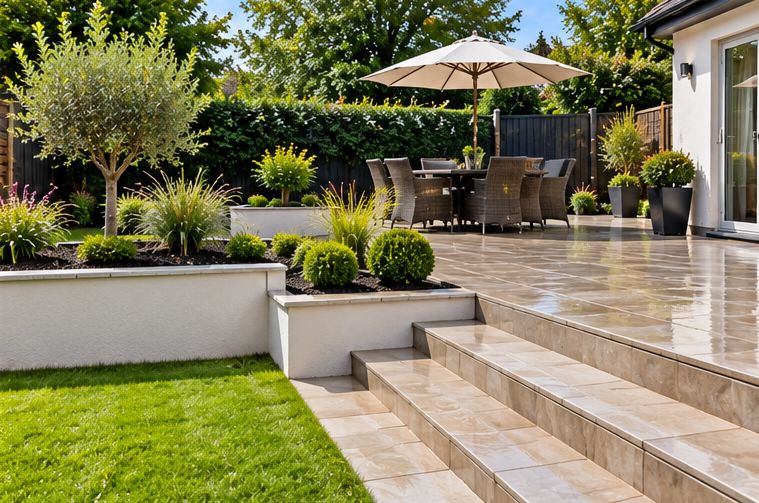
Cwmbran was planned as a town for families, and most of its back gardens are still used by children for at least part of their life. Many of them, though, have hardly changed since the house was built: a small patio by the door, a strip of lawn, a path along one side and a shed at the end. That layout was never designed with modern family life in mind.
This guide looks at how to arrange a Cwmbran back garden so it works for young children now and older ones later, without turning it into a playground the adults cannot enjoy. For the design service itself, see our landscaping and garden design page.
Start at the kitchen window
The single most useful question in a family garden is: what can you see from where you spend most of your time indoors? In most Cwmbran semis and terraces, that is the kitchen or the back room with the patio doors. The main play area should sit in clear view from there, not tucked behind the shed or round the side of an extension.
Stand at the window and look out. Anything that blocks the view of the lawn, such as a tall shrub, a rotary line or a greenhouse, may be better moved to the side. Low planting and open fencing between zones keep sightlines clear, while taller planting can go along the back boundary where it adds privacy without hiding anyone.
Zones that do different jobs
Even a modest estate garden can be split into areas with their own purpose. Thinking in zones stops everything happening in the same place and wearing it all out.
- A sitting area close to the house, on a patio or deck big enough for a table, where adults can sit while children play.
- An open lawn for running, ball games and paddling pools, as large and as level as the plot allows.
- A play corner for a climbing frame, swing or trampoline, on a soft surface.
- A growing patch with a raised bed or two, where children can sow and pick.
- A storage spot for bikes, scooters and toys, ideally near the side gate.
Our guides to patio extension ideas for Cwmbran semis and garden decking for a Cwmbran family home look at the sitting area in more depth.
Surfaces that forgive a fall
Hard patio edges and concrete are where most garden bumps and grazes happen. Under swings and climbing frames, a deep layer of play-grade bark or a rubber play surface is far kinder than grass, which wears to bare mud underneath in a season. A timber edge keeps the bark in place and makes the play area look deliberate.
For the lawn itself, a hard-wearing turf mix copes best with daily use. Where the existing grass is thin and bumpy, it is often worth starting again on properly prepared ground; see refreshing a worn-out lawn in Cwmbran and our turf laying page. Some families choose artificial grass for a small, heavily used area, though it gets hot in strong sun and needs a proper base and drainage.
Paving by the house should have a slip-resistant finish, and steps should have even risers and a clear edge. Rounded or chamfered edges on raised beds and walls are worth asking for where little ones will be running past.
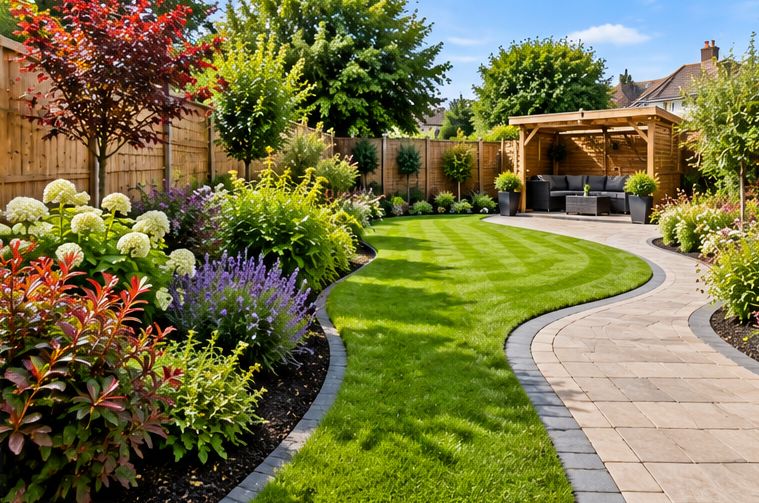
Water, plants and other hazards
Some features need more thought when young children are around:
- Ponds. Even shallow water is a drowning risk for toddlers. A bubbling stone or a spout into a covered reservoir gives the sound of water without open depth, and an existing pond can be filled in or securely covered until the children are older.
- Poisonous plants. Laburnum, foxgloves, yew and some others are best avoided or removed from a toddler's reach. If you are unsure about what is already growing, we can point out anything we recognise.
- Thorny shrubs. Roses and pyracantha are better along the back boundary than beside the lawn.
- Gates and latches. A side gate with a latch set high, or a bolt on the garden side, keeps small children in and the road out.
- Tools and chemicals. A shed or store that locks keeps them safely away.
Making room for bikes, bins and toys
Clutter is a common complaint in family gardens in Cwmbran, especially where a house has no garage to take the overflow. A simple timber store or a covered area beside the side gate keeps bikes dry and off the lawn. Built-in bench seating with a lift-up lid can hold outdoor toys and cushions.
The bin area is worth planning at the same time, so it does not take over the patio. A short screen or a low wall next to the path can hide bins while keeping them easy to wheel out. Our guide to replacing tired fences on a Cwmbran estate covers side gates and boundaries.
A layout that grows up with the family
The trampoline years do not last forever. A well-planned garden can change without being dug up again. The play corner on bark can become a seating area or a raised vegetable bed. Part of the lawn can be paved later to make a bigger patio for teenage gatherings. A sandpit can become a planted bed or a small water feature once everyone is older.
Planning for that from the start means putting drainage, paths and edges where they will still make sense in ten years. It also means choosing a patio and path layout that will extend neatly, rather than one that has to be broken out to add to it.
Getting started
Most family gardens in Cwmbran come together in a few stages: clearing out what is not wanted, sorting boundaries, laying the hard landscaping, and then the lawn and planting. If you have just moved in, garden clearance when moving into a Cwmbran house is a good place to start.
You can see how we approach gardens across the town on our landscaping in Cwmbran page. When you are ready, ask for a free quote and Tony will come round, look at the garden with you, and talk through a layout that suits your family.
Talk to T J Landscapes about your garden
Free quotes and honest advice across South Wales.
Questions People Ask
What is the safest surface under a climbing frame?
A deep layer of play-grade bark or a rubber play surface is much kinder to falls than grass or paving. Grass under play equipment also wears to mud quickly.
Is a pond safe in a garden with young children?
Open water is a risk for toddlers. A bubbling feature with no standing water, or a pond with a secure cover, is a safer choice until the children are older.
Can a family garden still look good for the adults?
Yes. Clear zones, a proper sitting area near the house and well-chosen planting keep it looking like a garden, not a playground, and the play areas can be changed later.
How much lawn do children need?
As much open, level grass as the plot sensibly allows, in view of the house. Even a modest lawn works well if paths and play equipment are kept to the edges.
What affects the cost of a family garden makeover?
The size of the garden, how much needs clearing, the materials for paving and decking, the ground and levels, drainage and access. We give a free, written quote.