
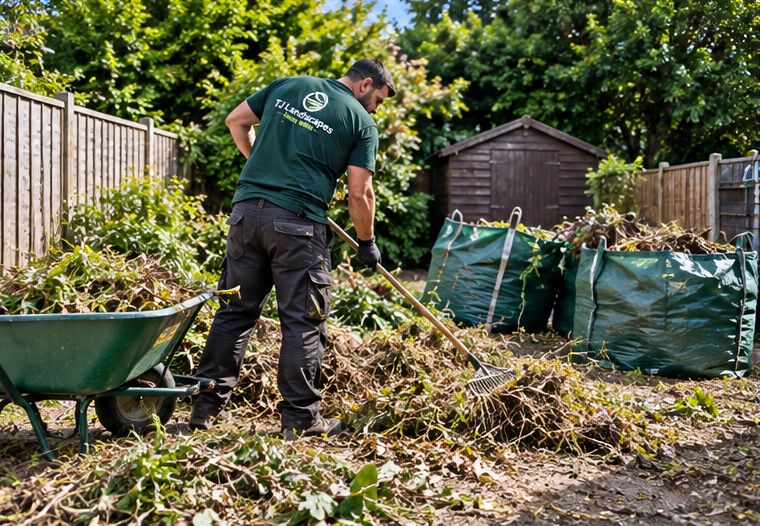
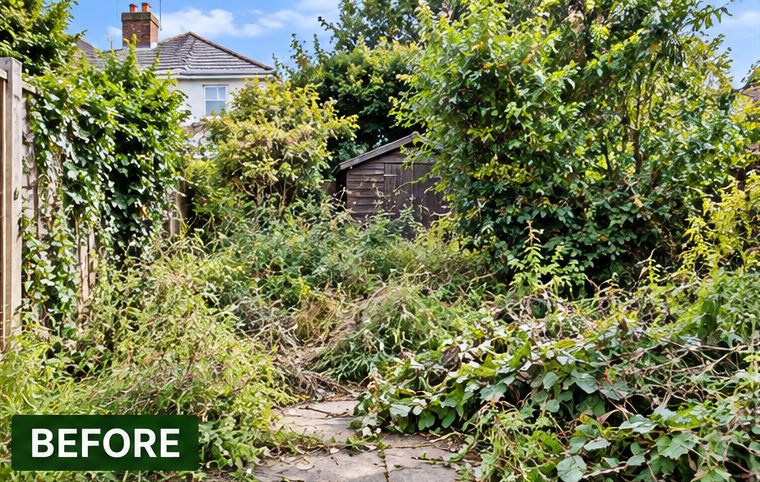
Almost every garden clearance has a shed at the bottom of it. Sometimes it is still sound and just needs emptying. More often the roof felt has gone, the floor has rotted and the door is held shut with a brick. Greenhouses, coal bunkers, old outside toilets and lean-to stores all turn up too, particularly behind older terraces.
This guide explains how we approach clearing and removing outbuildings as part of our garden clearance service, what needs special care, and what you might do with the space afterwards.
Step one: empty it and sort the contents
Before anything is taken down, the contents need to come out. This is the part people underestimate. A shed that has been used for decades can hold tools, paint, garden chemicals, bikes, old furniture, paperwork and boxes nobody has looked in for years.
If you can, go through it yourself first, or with us on the day, and split things into four piles: keep, give away or sell, recycle, and dispose of. Old hand tools, pots and bikes often find a new home through local groups or charity shops. If you are clearing a relative’s house, check boxes carefully before they go; paperwork and keepsakes do turn up in the oddest places.
Hazardous contents to look out for
Sheds are where households keep the things they do not want indoors, and some of them cannot go in with general or garden waste:
- Old weedkillers, pesticides and wood treatments, some of which are no longer approved for use.
- Paint, varnish, white spirit and other solvents.
- Petrol, two-stroke mix and engine oil from mowers and strimmers.
- Gas bottles from barbecues and patio heaters.
- Car batteries, old electrical tools and fridges.
Keep chemicals in their original containers where possible and take them to your council’s household waste recycling centre, which will tell you what it accepts. Our guide to what can and cannot go in a garden clearance covers the other routes.
Asbestos in older outbuildings
Asbestos was widely used in building materials until it was banned in the UK at the end of the 1990s. In gardens it most often turns up as corrugated cement roof sheets on garages and lean-tos, flat cement panels on prefabricated sheds and garages, and occasionally as old water tanks or flue pipes.
Cement sheeting in reasonable condition is not usually dangerous if left alone. The risk comes when it is broken, drilled, cut or crushed. We will not break up or remove any material that may contain asbestos. If an outbuilding looks as though it might, it needs to be sampled and, if confirmed, removed by a licensed or suitably trained contractor. Once that is done, we can clear the rest of the structure and the ground around it.
Electrics, water and the building itself
Some sheds and workshops have a power supply for lights, a freezer or tools. Before a building with electrics is taken down, have an electrician safely disconnect it and make the cable safe back at the house. Do the same with any outside tap or water pipe that runs into a greenhouse.
A typical timber shed then comes down in a sensible order: roof felt and any guttering first, then the roof boards, the side panels, and finally the floor and bearers. Glass from greenhouses and shed windows is taken out whole wherever possible and kept apart from everything else. Aluminium greenhouse frames and any metal fixings are separated for recycling.
Sound timber can sometimes be reused for compost bins, log stores or raised beds. Painted or treated timber is not suitable for chipping or burning.
The base underneath
Once the building has gone, you are left with whatever it stood on: a concrete slab, a few paving slabs, timber bearers on bricks, or just flattened soil. What happens next depends on your plans.
- Keeping a shed there? A sound, level concrete base can often be reused for a new one. A cracked or sunken base should be broken out or overlaid.
- Turning it into lawn or borders? The base needs breaking out and the hardcore removing, then the ground loosening and topping up with good topsoil. Compacted ground under an old shed drains badly otherwise.
- Making it into a seating area? The space is often a natural spot for a small patio or deck, and an old base can sometimes form part of the sub-base once it has been checked.
Wildlife in and under outbuildings
Old outbuildings make good homes. Birds nest in eaves and on roof beams, hedgehogs and toads shelter underneath, and bats sometimes roost in older brick and stone outbuildings. Nesting birds and bats are protected by law.
We look before we start, lift floors carefully and work round anything we find. If there are signs of bats, work should stop and advice be taken before going any further. Planning removal of an outbuilding for autumn or winter avoids the busiest nesting months.
Planning and permissions
Taking down an ordinary garden shed or greenhouse does not normally need any permission. It is different if the property is a listed building, or if the outbuilding itself is a historic structure, such as an old stone privy or a building within a conservation area, where your council may need to be consulted. Putting up a replacement is often allowed without planning permission within size and position limits, but check with your local council before you buy if you are unsure. We are landscapers, not planners, so we would always point you to the council for a definite answer.
What to do with the space
A corner that has been dark and cluttered for years can transform a small garden. Some people put up a smaller, better-placed shed; others turn the space into raised beds, a seating area or extra lawn with new turf. If the whole garden needs rethinking, our landscaping and garden design service can plan the new layout.
We clear sheds, greenhouses and outbuildings across South Wales, from Aberdare and Pontypridd to Chepstow. For the rest of the garden, see what happens during a garden clearance. Send us a few details and we will arrange a free quote.
Talk to T J Landscapes about your garden
Free quotes and honest advice across South Wales.
Questions People Ask
Can you take down and remove an old shed?
Yes, in most cases. Once it has been emptied and anything hazardous has been dealt with, we dismantle it, separate the glass, metal and timber, and take it away along with the garden waste.
What if my garage roof might be asbestos?
Leave it alone and do not break it. Have it sampled, and if it contains asbestos, have it removed by a licensed or suitably trained contractor. We can then clear the rest of the site.
Do I need permission to take down a shed?
Usually not. If the property is listed, or the outbuilding is an older structure in a conservation area, check with your local council first.
Can the old shed base be reused?
If it is level and sound, it can often be reused for a new shed or as part of the base for a patio. Cracked or sunken bases are usually better broken out.
Can you clear the contents as well as the building?
Yes, general contents can be cleared as part of the job. Chemicals, fuel, gas bottles and electrical items need separate disposal, so we will agree how those are handled when we quote.