
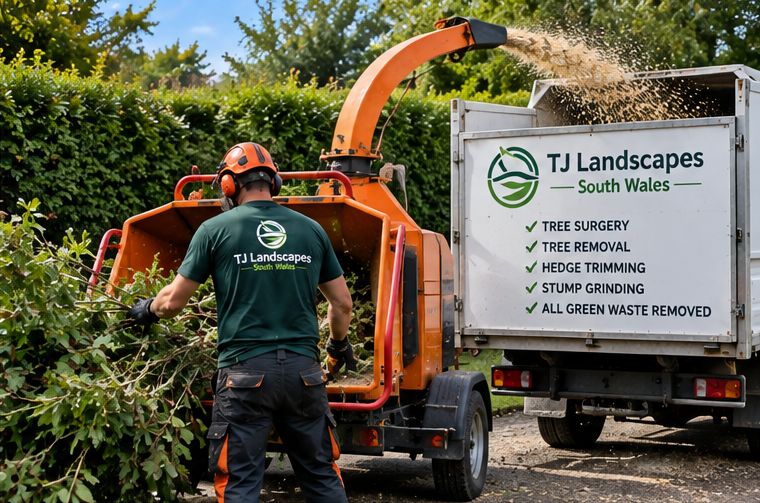
Gardens in Ebbw Vale often back onto open hillside or sit on the valley side above their neighbours. Trees in those spots have to put up with strong winds, heavy rain and cold winters, and it shows in their shape. Hedges, meanwhile, get planted for shelter and can quickly grow beyond what anyone can manage from a stepladder.
This guide looks at the tree and hedge problems we see most often in Ebbw Vale, what can be done about them, and the checks to make before cutting. For our other work in the town, see landscaping in Ebbw Vale.
What upland weather does to a tree
Wind from one direction tends to push a tree’s growth the other way, so on exposed plots you often see crowns that lean or carry most of their weight on one side. Add saturated soil in winter, which gives roots less grip, and a heavy, lopsided tree becomes more likely to lose limbs or, in the worst cases, to rock at the roots.
Careful pruning can reduce that risk. Thinning a dense crown lets wind pass through rather than catching it like a sail, and a gentle reduction can bring the weight back towards the centre. Our guide to crown lifting, thinning and reduction explains the difference between these cuts.
Signs worth a closer look
After a winter storm, it is worth a walk round any sizeable tree in an Ebbw Vale garden. Look out for:
- Snapped or hanging branches caught in the crown.
- Cracks in the trunk or where large limbs join it.
- Soil lifting or cracking on one side of the base.
- Fungus growing on the trunk or roots.
- A tree that leans further than it did last year.
None of these automatically means a tree must come down, but they are reasons to have it looked at. Our guide on felling or pruning explains how that decision is usually made.
Hedges that outgrow the garden
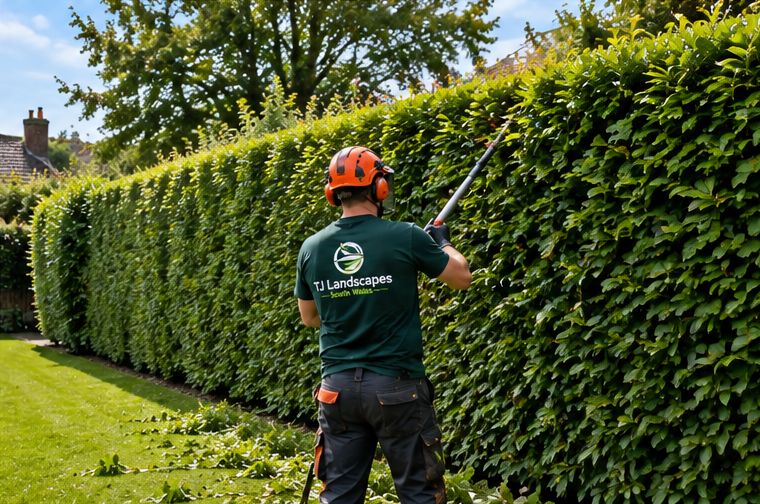
A lot of Ebbw Vale homeowners planted fast-growing conifers or laurel to break the wind, and on a newer estate that makes good sense. The trouble is that these hedges rarely stop at a sensible height. Left for a few seasons they block light, take moisture from the lawn and become too tall and wide to trim safely.
Most broadleaf hedges, such as laurel, privet and beech, can be cut back hard and will regrow. Leylandii and many other conifers are different: they do not usually regrow from bare brown wood, so they need to be kept in check with regular trims rather than rescued with one drastic cut. Our guide to hedge trimming covers how often to cut.
Choosing trees and hedges for the conditions
If you are planting new, choose species that are happy in cold, wet, windy places. Native hedging such as hawthorn, blackthorn and hazel copes well with upland weather, supports wildlife and filters wind rather than blocking it. For trees, rowan and birch are common choices on the hills for good reason: they are tough and do not grow into giants.
Plant well away from the house, drains and walls, and think about the full-grown size rather than the size in the pot. A little planning here saves a lot of work later.
Young trees on an exposed Ebbw Vale plot benefit from a short stake set low on the stem, which holds the roots steady while still letting the top flex and strengthen in the wind. Waterlogged planting holes are the other common cause of failure, so on heavy ground we plant slightly proud and improve drainage around the root area.
Laid hedges for open boundaries
Where a garden meets fields or open hillside, a laid hedge is worth considering. The stems are partly cut and bent over along the line of the hedge, where they regrow into a dense, stock-proof barrier that is thick at the base. It is a traditional method that suits the hill country above the valleys and gives a boundary that slows the wind without the sail effect of a solid fence.
Hedge laying is done in the dormant months, before birds start nesting. It works best on an older, overgrown hedge of native species with plenty of upright stems to work with.
Timing: birds, sap and the weather
Nesting birds are protected by law, and it is an offence to damage or destroy an active nest. Hedges and trees are prime nesting sites through spring and summer, so we check before cutting and hold off if birds are nesting. Our guide on when trees should be pruned covers the seasons in more detail.
At this altitude we also think about the weather. Working at height in high winds or on frozen, slippery ground is not safe, so tree work in Ebbw Vale sometimes has to wait for a calmer, drier day.
Permission before you cut
Some trees are protected by a tree preservation order, and trees in a conservation area can need notice to the council before work. If you are not sure, check with Blaenau Gwent council before any work starts. Our guide to permission to cut down a tree in Wales sets out the general position, though we are landscapers rather than planners.
Trees on a boundary raise their own questions. You can usually cut back branches that overhang your side, but it is courteous, and sensible, to talk to your neighbour first.
How we can help
We prune, crown lift, thin, reduce and fell trees, and we trim, reshape and lay hedges. All green waste is taken away, and if the garden needs more than tree work, it can be combined with a garden clearance. See our tree surgery and hedge care page for more, or ask Tony and the team for a free quote using the enquiry form.
Talk to T J Landscapes about your garden
Free quotes and honest advice across South Wales.
Questions People Ask
Can you reduce a tall hedge in one go?
With most broadleaf hedges, yes, though a very hard cut may leave it looking bare for a season. With conifers such as leylandii we usually reduce the height but take the sides back carefully, because cutting into bare wood can leave brown patches that do not recover.
Is it safe to leave a tree that leans?
Many trees lean naturally and are perfectly stable. What matters is whether the lean is new or getting worse, and whether the roots and soil show signs of movement. If you are worried about a tree in your Ebbw Vale garden, we can have a look.
What happens to the branches and logs?
We take all the green waste away. If you would like to keep some logs for a stove, just tell us beforehand.
What affects the cost of tree or hedge work?
The size of the tree or length of hedge, how easy it is to reach, what is underneath it, how much waste there is and whether it needs to be taken down in sections. We give a free quote after seeing it.