
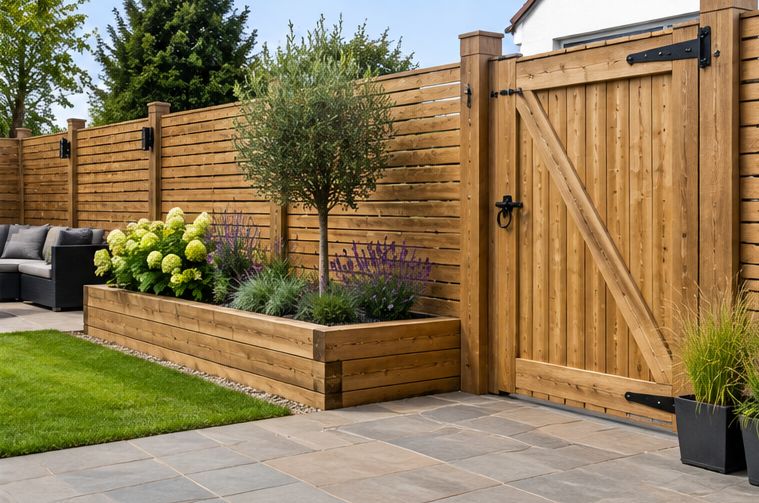
After a winter storm on high ground, the damage to fences tends to look the same: a run of panels flat on the lawn, or a line of posts leaning like a row of dominoes. Ebbw Vale sits high at the head of its valley, many gardens face open hills, and there is little between a boundary and the weather.
The good news is that fences on exposed plots can last well. It comes down to three things: what holds the fence up, how much wind the fence catches, and how well the timber is kept out of the wet. This guide takes each in turn, with the Ebbw Vale conditions in mind.
How exposed fences actually fail
It is rarely the boards that give up first. A failed fence on a windy plot usually comes down to one of these.
- Posts snapping at ground level, where timber sits in wet soil and rots from the inside.
- Posts rocking loose because they were set too shallow, or in a small lump of concrete that the wet ground lets move.
- Panels lifting out of slotted posts, or fixings pulling through soft timber in a gust.
- Frost heave in waterlogged ground slowly jacking posts upwards over several winters.
Every one of those has a fix, and most of them are decided before a single board goes on.
Getting the posts right
On a windy Ebbw Vale boundary, the posts carry the whole load. We set them deeper than a sheltered garden would need, bed them in concrete shaped to shed water away from the timber, and space them to suit the design and the exposure.
The choice between concrete and timber posts is a real one up here. Concrete posts with gravel boards do not rot, which is a big plus on wet ground, and panels slide into their grooves. Good pressure-treated timber posts are stronger for close board fencing, easier to fix gates to and look more natural, but they need to stay as dry as possible at the base. We compare the two properly in concrete posts or timber posts for a garden fence.
Whichever you choose, a gravel board along the bottom keeps the fence itself off the soil. On a plot where water runs down the slope, that one detail adds years to the life of the fence.
Choosing a design that lets some wind through
A solid fence facing a gale behaves like a sail. The more wind it blocks, the more force goes into the posts. On the most exposed Ebbw Vale boundaries we often suggest a design with small gaps, which lets some air through while still giving privacy.
- Close board, built on site with rails and overlapping boards, is much tougher than a lightweight panel and is our usual choice for a solid boundary in a windy spot.
- Hit-and-miss or board-on-board fencing has boards fixed alternately on each side, so you cannot see through it straight on but wind can pass between.
- Slatted fencing with narrow gaps looks modern and filters the wind well, though it offers a little less privacy.
- Standard lap panels are the most likely to come loose in a storm, so we are wary of them on open ground.
Our guide to close board, panel or slatted fencing goes into the look and cost drivers of each. For the wider question of which fences hold up in Welsh weather, see which garden fence stands up best to Welsh wind.
Lower fences, hedges and walls
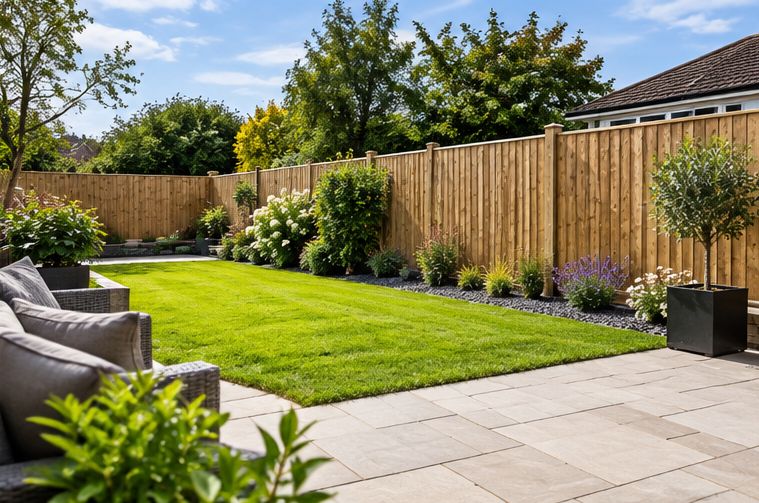
Sometimes the right answer is not a taller fence at all. On a boundary that looks out over the hills, a lower fence, a short wall with a fence on top, or a native hedge can give enough shelter and keep the view. A hedge in particular filters wind rather than blocking it, and it will only get stronger over the years.
Where a fence sits on top of a retaining wall, both need to be designed together, because the extra wind load on the fence pulls on the wall. Our guide to retaining walls for Ebbw Vale hillside gardens covers that side. For planting and shelter ideas more generally, see gardens that cope with Ebbw Vale’s upland weather.
Gates that stay shut
A gate on an exposed plot takes a battering. Every gust tries to swing it, and a gate that slams repeatedly soon loosens its hinges and post. We hang gates on a strong post, use heavy hinges and a latch that holds firm, and add a drop bolt or stop so the wind cannot throw it back against the fence.
Side gates between terraced houses are often a wind tunnel, so a solid, well braced gate is worth the effort there. Our guide to choosing and fitting a garden gate has more on styles and fittings.
Looking after a fence in Ebbw Vale weather
A little care goes a long way. Keep soil, leaves and plant growth away from the base of the fence so it can dry out. Check fixings after big storms and tighten anything that has worked loose before it gets worse. Treat or stain timber every few years, choosing a dry spell so it soaks in properly.
If a section has gone, it is worth asking whether the fault is the boards or the posts. A few broken boards can be replaced; rotten or rocking posts usually mean the run is due a rebuild. Our guide to fence repair or replacement explains how to tell.
Rules and neighbours
Garden fences are usually straightforward, but height limits apply, particularly next to a road or footpath, and some properties have covenants or other restrictions. We are landscapers, not planners, so if you are unsure, check with Blaenau Gwent council before work starts. It is also good manners to talk to your neighbour about a shared boundary before the old fence comes down.
You can see the range of boundaries we build on our fencing and gates page, and read more about our local work on our Ebbw Vale landscaping page. When you are ready, contact us for a free quote and free advice on the right fence for your plot.
Talk to T J Landscapes about your garden
Free quotes and honest advice across South Wales.
Questions People Ask
What is the strongest fence for a windy garden in Ebbw Vale?
A well built close board fence on deep-set posts is very sturdy, and a hit-and-miss or slatted design reduces the wind load further. Lightweight lap panels are the most likely to blow out on an exposed site.
Are concrete posts better than wooden ones on wet ground?
Concrete posts will not rot, which is a real advantage where the ground stays wet. Timber posts are stronger for some designs and easier to hang gates from, and they can last well if set properly and kept dry at the base. We will talk through both for your boundary.
My fence keeps blowing down. Do I need a new one?
Not always. If the posts are sound but panels keep lifting out, better fixings or a sturdier infill may be enough. If the posts are rotten, shallow or loose, a rebuild with deeper posts usually works out better in the long run.
Can a hedge replace a fence on an exposed boundary?
It can. Native hedging such as hawthorn, beech or hazel filters wind well and becomes stronger every year. It takes a few seasons to fill in, so some people put up a lower fence in the meantime.
Do you take the old fence away?
Yes. We remove the old fence, posts and concrete where needed and take the waste away as part of the job.