
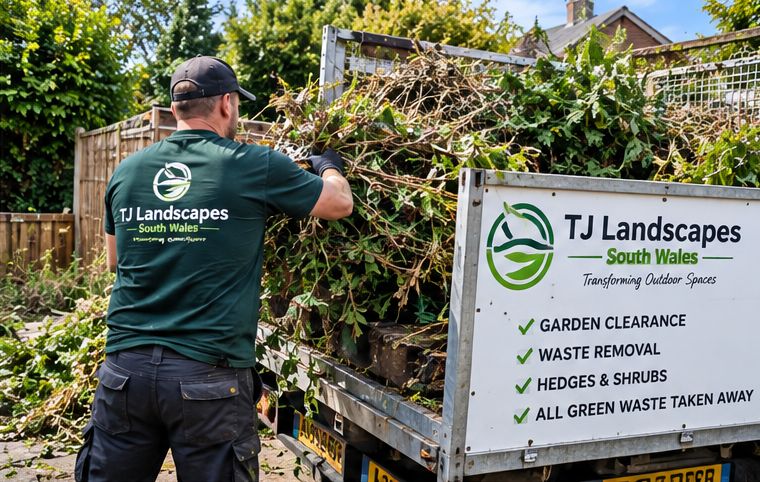
Moving house is busy enough without a garden full of someone else's leftovers. In Cwmbran, where many homes have changed hands several times since the new town was built, it is common to inherit a rotten shed, a broken greenhouse, a pile of slabs behind the garage, a trampoline frame and a hedge that has not been cut in years.
This guide is for people who have just moved in, or are about to, and want to know how to tackle the garden. It covers what to look at first, what to keep, what needs special care, and how a clearance leads into the next stage. For the service itself, see our garden clearance page.
Walk round before you decide anything
Before anyone starts pulling things out, take a slow walk round with a notebook or a phone camera. It is easy to clear something in a rush and then wish you had kept it.
- Which plants are worth keeping? A mature shrub or a well-shaped small tree can take years to replace.
- Are there slabs, bricks or edging stones in good condition that could be reused?
- Where do the drains, stopcock and outside tap sit, and are any covers hidden under soil or gravel?
- Which boundaries are yours, and what state are the fences in?
- Where does the sun fall through the day, and where does water sit after rain?
If you have moved in during winter, some plants may be dormant and look dead. When in doubt, cut them back rather than dig them out, and see what comes up in spring.
What a typical Cwmbran clearance involves
Every garden is different, but on the estates around Cwmbran the same things turn up time and again. Old timber sheds with felt roofs rotted through. Coal bunkers and concrete bases from an earlier era. Overgrown conifer screens planted as a quick hedge. Brambles and ivy along the back fence. Piles of rubble left over from an extension or a kitchen refit. And lawns that have turned into rough grass and moss.
A proper clearance deals with all of it in one visit or a short run of days. We cut back and remove the overgrowth, dismantle and remove old structures, break out small concrete bases where needed, and take the green waste and general garden waste away. Our guide to what happens during a garden clearance walks through the stages, and shed and outbuilding clearance covers old buildings in more detail.
Things that need extra care
A few things found in older gardens cannot simply go in a skip, and it is better to know before work starts:
- Cement sheet roofs and panels. Old garages, sheds and coal stores sometimes have corrugated sheets that may contain asbestos. They need checking and, if it is present, handling by a licensed firm.
- Chemicals and paint. Half-used tins of weedkiller, creosote and paint left in a shed go to the council's recycling centre, not in with the garden waste.
- Invasive plants. Japanese knotweed and some other invasive species need a treatment plan, not just digging and dumping.
- Nesting birds. A big hedge or shrub cut in spring or early summer should be checked for active nests first.
Our guide to what can and cannot go in a garden clearance explains each one, and we will point out anything like this when we come to quote.
Clear first, then plan
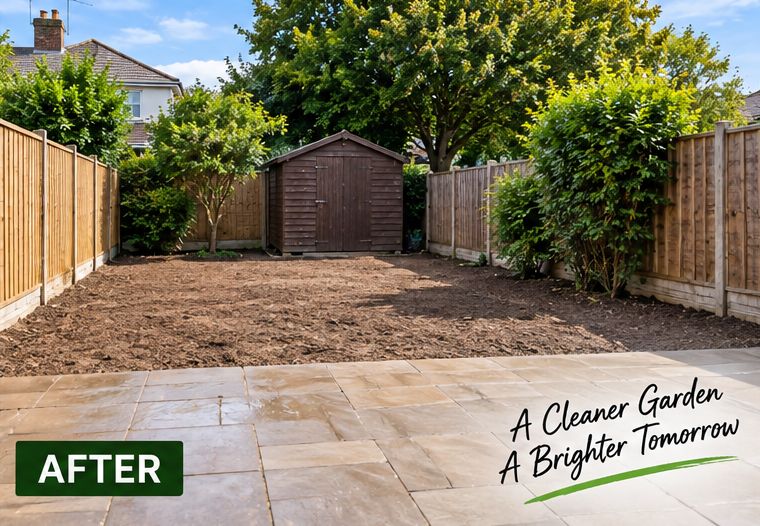
It can be tempting to plan the new garden straight away, but it is far easier to see what you have once the clutter has gone. Clearing shows the true size of the plot, the levels, the state of the fences and the soil, and where the light falls. Many people who move to Cwmbran are surprised how much bigger the back garden looks once the old shed and conifers are out.
If you already know you want a patio, a new lawn or new fencing, tell us at the start. We can leave the ground in the right state for the next job, for example stripping the old turf fully if the area is going to be paved, or keeping good topsoil to one side for reuse. That saves doing the same work twice.
Timing it around the move
Some buyers ask for the garden to be cleared before they move in, while the house is empty and there is room for a van on the drive. Others prefer to settle in first and live with the garden for a season to see how they use it. Both work. The main thing is not to let a cleared garden sit bare for too long, because weeds move in quickly on open soil in a Welsh spring.
If you cannot start the new garden straight away, a clear-out followed by a quick lawn mow, a hedge trim and a layer of bark on bare borders keeps things tidy while you plan.
What comes after the clearance
For most families in Cwmbran, the clearance is step one of a wider plan. The next jobs are often new fencing where the old panels were only held up by the ivy, a larger patio outside the back door, and a lawn the children can use. Our guides to replacing tired fences on a Cwmbran estate, patio extension ideas for Cwmbran semis and refreshing a worn-out lawn in Cwmbran pick up from there.
If big boundary trees came with the house, our guide on overgrown trees on a Cwmbran boundary helps with the next decision. You can see how we work across the town on our landscaping in Cwmbran page.
Getting a clearance quote
A few photos of the garden from each end, plus any sheds or piles of rubble, help us give you a rough idea before we visit. For a firm figure, Tony will come round, walk the garden with you and talk through what stays and what goes. The things that affect the cost are how much there is to clear, what it is made of, how easy it is to get to the road, and whether any structures need taking apart.
When you are ready, get in touch for a free quote and we will arrange a time that fits around your move.
Talk to T J Landscapes about your garden
Free quotes and honest advice across South Wales.
Questions People Ask
Can you clear the garden before we move in to our Cwmbran house?
Yes, as long as you have the keys or the seller agrees. Clearing an empty house is often easier, as there is room to park and nobody needs the garden in the meantime.
Do you take the waste away?
Yes. Green waste and general garden rubbish are taken away as part of the job, so you are not left with a pile or a skip on the drive.
Can you take down an old shed or greenhouse?
Yes. We dismantle and remove old sheds, greenhouses and small structures, and can break out small concrete bases. Sheets that might contain asbestos need checking first.
Should I keep any of the old plants?
Keep anything healthy and well placed, such as a good shrub or small tree, and cut back rather than remove anything you are unsure about. We are happy to give an opinion when we visit.
Can you do the new garden too?
Yes. Tony and the team can go straight on to fencing, paving, turf or a full redesign, and leave the cleared ground ready for it.