
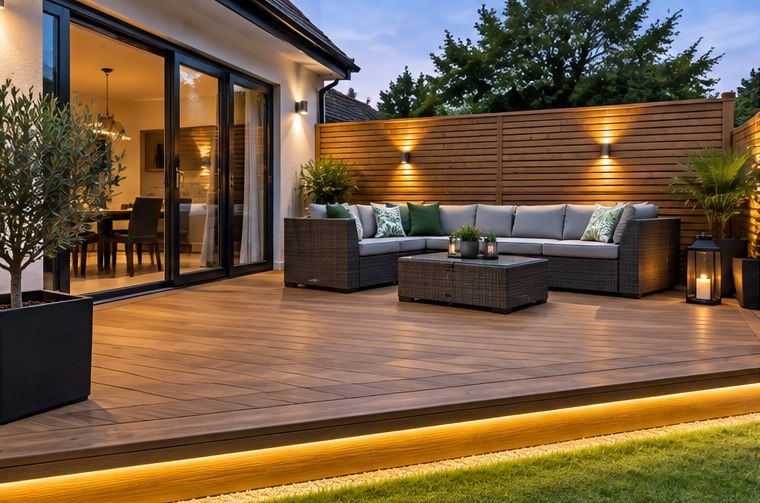
Decking has a mixed reputation. Plenty of people in Cwmbran have inherited a deck from a previous owner that is green, slippery and soft underfoot, and swore they would never have another. Built properly, with the right boards, good ventilation and a solid frame, a deck can be one of the most used parts of a family garden.
This guide looks at decking from the point of view of a busy household: where it should go, how it copes with children and pets, how to keep it safe in wet weather, and whether timber or composite makes more sense. You can find more about our work locally on the landscaping in Cwmbran page.
Why decking suits so many Cwmbran gardens
A lot of homes on the town's estates have a back door or patio doors that sit a step or more above the garden. On plots that slope away down the valley side, the drop can be a good deal more. Paving that gap means building up with walls and a lot of hardcore, whereas a deck simply stands on posts at the right height, giving a level floor straight out of the house.
Decking also goes down without heavy machinery, which helps on terraced or linked houses where every material has to be carried through. And because it sits above the ground, it can cover an old cracked patio or a patch of poor ground without it all being dug out first. Our guide can you build decking over an old patio or concrete? explains when that works.
Where the deck should go
The natural spot is right outside the kitchen or living room, so food and drinks can come straight out, and a parent indoors can keep an eye on the lawn beyond. That works well where the back of the house gets afternoon or evening sun.
If it does not, consider a second, smaller deck further down the garden in the sunny corner, reached by a path. On gardens that rise away from the house, a deck built into the top of the slope can make a good lookout over the valley, with steps back down. Either way, leave enough lawn for play. A deck that fills the whole garden becomes a wet-weather hazard rather than a family space.
Making it safe for children and pets
Family decks need a few details that a deck for two adults can do without. These are the ones we pay most attention to:
- Edges and drops: any deck more than a small step off the ground needs a balustrade or planters along the open sides, with gaps too narrow for small children to squeeze through.
- Steps: wide, shallow steps with an even rise are easier for little legs and older knees than a single tall step.
- Board finish: smooth-edged boards and screws set below the surface, so there is nothing to stub a toe or snag a paw on.
- Gaps underneath: skirting boards around the edge stop toys, balls and the cat disappearing underneath.
- Gates: a small gate at the top of the steps is worth considering while children are toddlers.
Our guide to raised decking has more on frames, steps and balustrades.
Grip in a wet valley
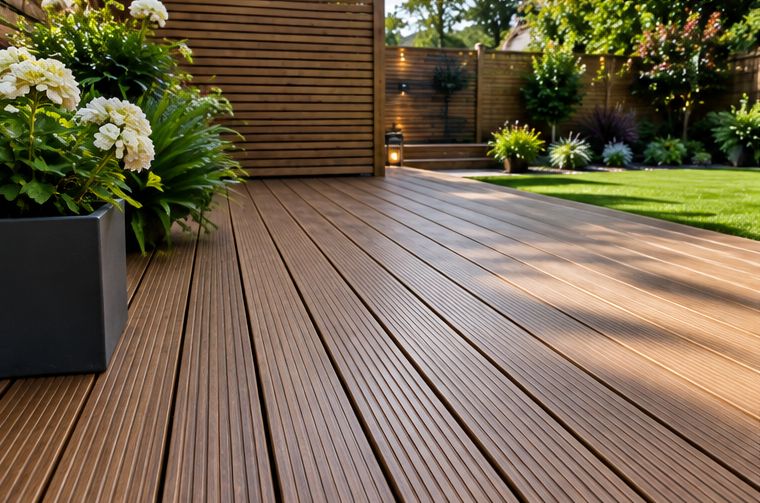
Cwmbran gets its share of rain, and gardens on the shaded side of a house, or overhung by trees, can stay damp for days. That is when algae builds up and boards turn slippery, which is the main reason people fall out of love with decking.
Several choices reduce the problem: good gaps between boards so water drains through, space and airflow under the frame so it dries out, grooved or anti-slip boards on shaded decks, and a regular brush and wash. How to stop decking going slippery goes through the options, including cleaning and treatments.
Timber or composite for a busy household
Treated softwood decking is the traditional choice. It looks and feels natural, is easy to cut and repair, and costs less to buy. It does need looking after, with a clean and a coat of treatment every year or two, and boards can splinter as they age.
Composite boards, made from wood fibre and plastic, need far less upkeep. They do not splinter, rarely need treating and hold their colour well, which suits families who would rather spend the weekend using the garden than maintaining it. They can get warm in strong sun, and they cost more to buy. We compare the two in more detail in composite or timber decking for a South Wales garden.
Adding storage and extras
A family deck soon collects cushions, toys and garden tools. Built-in bench seating with lift-up lids, or a storage box along one edge, keeps it tidy. A section of the frame can also be made into a sandpit with a lid, or a raised planter for herbs close to the kitchen.
Low-level lighting in the steps and edges makes the deck safer after dark and more usable in the evenings. See decking lighting, planters and finishing touches for ideas.
The rules on raised decks
A deck close to the ground does not usually need planning permission. A higher one can, broadly where it is raised more than about 30cm above the ground, and a platform overlooking the neighbours may raise objections even when it is allowed. If your Cwmbran garden slopes steeply and the deck will stand well above the lawn, check with Torfaen council before we start.
Building your deck with us
Tony will look at the height of the doors, the slope, the sun and how the family uses the garden, then suggest a size, shape and board. We set the frame on solid footings, lay a weed membrane, fit the boards, steps and balustrades, and clear the waste. Our garden decking page shows the kinds of deck we build, and a deck often works well alongside a new patio extension. Ask for a free quote.
Talk to T J Landscapes about your garden
Free quotes and honest advice across South Wales.
Questions People Ask
Is decking or a patio better for a family garden?
Both work. Decking is often easier where the back door is above the garden or the ground slopes, while paving suits level ground and heavy use. Many Cwmbran families have a little of each.
How long does decking last?
It depends on the boards, the frame and how well it is looked after. A well-built deck with good airflow lasts far longer than one laid directly on damp ground. See how long should garden decking last?
Can decking go on a sloping garden?
Yes, it is one of its strengths. The posts are cut to different heights so the deck is level even where the ground falls away, with steps down to the lawn.
What affects the cost of a new deck?
The size, the height off the ground, the boards and balustrades you choose, the steps, the ground conditions and access. We give a free, written quote after a visit.
Will a deck attract rats or other pests?
A deck with a weed membrane beneath, skirting around the edges and no food left out is unlikely to cause problems. Keeping the area underneath clear and dry helps.