
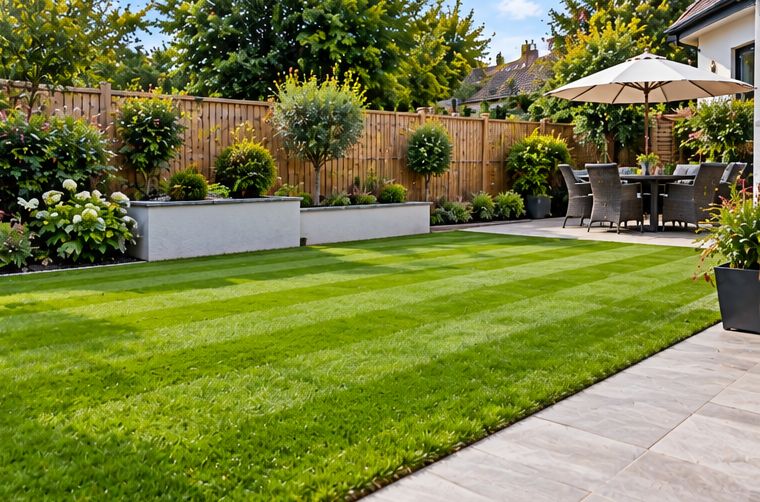
Plenty of back lawns in Cwmbran have had a hard life. They were laid when the house was built, sometimes on whatever soil the builders left behind, and then used for decades of football, paddling pools, washing lines and trampolines. By now many are thin in the middle, mossy along the fence, bumpy underfoot and bare where the goalposts stood.
This guide is about deciding what a worn lawn in Cwmbran actually needs, and then doing it in an order that lasts. For the turf service itself, see our turf laying page, and for how we approach gardens across the town, our landscaping in Cwmbran page.
A quick health check you can do yourself
Before anyone talks about seed or turf, spend ten minutes looking closely at the lawn. What you find tells you whether it is worth rescuing.
- Count the grass. Part the blades in a few spots. If more than about half of what you see is moss, weeds or bare soil, renovation becomes a long job.
- Push a garden fork in. If it goes in easily a few inches, the soil is workable. If it jars to a stop on stones or packed clay, the problem is underneath.
- Look after rain. Puddles that sit for a day or more point to compaction or poor drainage, not just tired grass.
- Note the shade. Grass that is thin only along one fence or under a tree is telling you about light, not soil.
- Walk it barefoot. Humps and hollows you can feel are hard to fix by feeding and overseeding alone.
What is often under a Cwmbran estate lawn
Much of Cwmbran was built quickly in the decades after the war, and lawns on estates of that kind were not always given much topsoil. It is common to find a thin layer of soil over compacted subsoil, clay or builders' rubble, sometimes with old path edges or concrete footings buried just below the surface.
On ground like that, grass roots stay shallow. The lawn looks fine in a mild, damp spring, then browns in the first dry spell and turns soft and mossy through a wet Torfaen winter. Feeding it helps for a season, but the underlying soil keeps pulling it back. That is often the point where people call us after a few years of trying.
When the grass is worth saving
If most of the lawn is still grass, the soil is reasonable and the levels are fairly even, a renovation can bring it round without digging anything up. The usual steps, done in early autumn or spring, are:
- Rake or scarify out the dead thatch and moss so air and water can reach the roots.
- Spike or hollow-tine the compacted areas, especially the paths children and dogs wear across the middle.
- Top dress with a sandy loam, brushed into the holes, to improve the surface soil a little at a time.
- Overseed thin areas with a hard-wearing mix and keep it damp while it germinates.
- Fill small hollows with top dressing over a couple of seasons rather than all at once.
A renovated lawn looks rough for a few weeks before it looks better. Our guide to why lawns go patchy, mossy or bare explains the causes in more depth, and looking after a lawn through the year covers the routine that keeps it going.
When starting again makes more sense
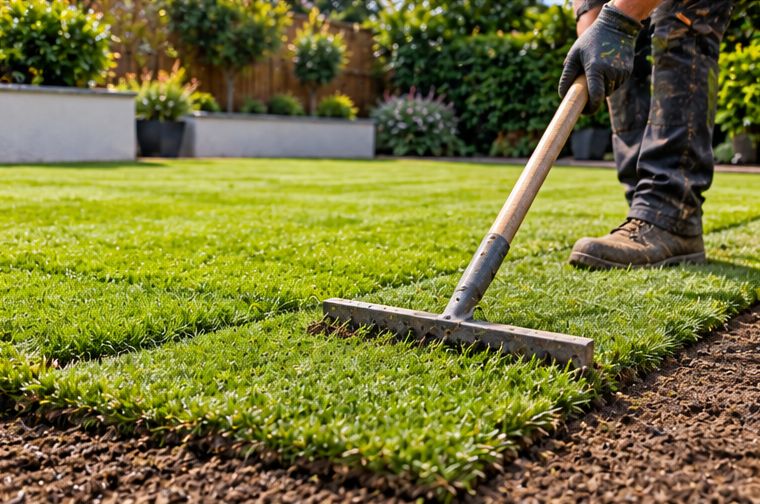
Where the lawn is more moss than grass, where the ground is lumpy, or where the soil beneath is poor, we usually suggest stripping it and laying new turf. It sounds drastic, but it is often the quicker way to a lawn the family can use, because the ground is dealt with properly while it is open.
We lift the old turf and take it away, dig out any rubble or buried concrete we find, and break up the compacted layer. Where the soil is thin, we bring in screened topsoil to give the roots a decent depth. The ground is then levelled, firmed and raked before the new turf goes down with tight, staggered joints. Our article on preparing the ground before laying turf goes through that stage step by step, and turf or seed explains why most families with children choose turf.
Deal with what wore it out
A new lawn will wear out again in the same places unless the causes change. In Cwmbran back gardens, a few come up again and again.
Tall panel fences along the boundaries shade a strip of lawn for much of the day, especially in narrow plots. Grass there will always struggle, so it may be better to widen the border along that fence, or to use a shade-tolerant seed mix in that strip. Where a tree has grown big since the estate was new, lifting its crown lets in more light; see dealing with overgrown trees on a Cwmbran boundary.
The route everyone walks from the back door to the shed or the gate will wear a line through any grass. A few stepping stones or a proper path along that line saves the lawn. Trampolines and paddling pools kill grass underneath if left in one place, so move them every week or two, or give them a permanent spot on bark or a play surface. Where water sits after rain, a drainage fix may be needed before any new turf; our guide to stopping a garden waterlogging covers the main options.
Fitting the work around family life
The awkward part of refreshing a lawn in Cwmbran is usually not the work itself but keeping people off it afterwards. New turf needs a few weeks to root before heavy use, and seeded patches need longer. Spring and early autumn are the easiest times, because the ground is warm and moist and there is less watering to do. Our guide on when to lay turf in South Wales explains the calendar.
If the children use the lawn every day, it can help to do the work in halves, or to time it for a holiday when the garden will be quiet. A temporary barrier of canes and string is usually enough to remind everyone which part is out of bounds.
The first weeks after the work
Water new turf every day or two in dry weather, early or late in the day, until you cannot lift a corner because the roots have gripped. Make the first cut high, with sharp blades, and only lower the mower gradually over the next few cuts. Our guide to caring for new turf in the first six weeks has the detail.
If the lawn is part of a bigger change, such as a larger patio or a play area, it is worth planning them together so the new grass is not trampled by later work. Child-friendly garden layouts for Cwmbran homes has ideas for where the lawn should sit. When you are ready, ask for a free quote and Tony will come and look at your Cwmbran lawn.
Talk to T J Landscapes about your garden
Free quotes and honest advice across South Wales.
Questions People Ask
Can my old Cwmbran lawn be saved, or does it need new turf?
If it is mostly grass, fairly level and the soil is reasonable, scarifying, aerating, top dressing and overseeding can bring it back. If it is mostly moss, lumpy or sitting on rubble and packed subsoil, new turf on prepared ground is usually the better choice.
Why does my lawn go mossy every winter?
Moss thrives in shade, damp and compacted soil, and many estate lawns have all three. Raking it out helps for a while, but improving light, drainage and soil is what stops it coming back.
Do you take the old lawn away?
Yes. We lift the old turf, remove any rubble we dig up and take the waste away as part of the job, so you are not left with a pile at the side of the house.
How long before the children can play on new turf?
Allow a few weeks for the roots to grip before football or running games, longer in dry weather. Light walking is fine sooner, as long as the turf is kept watered.
What affects the cost of re-turfing?
The size of the lawn, how easy it is to get materials and waste in and out, how much old turf and rubble has to go, whether topsoil is needed and whether drainage needs sorting. We give a free, written quote after seeing the garden.