
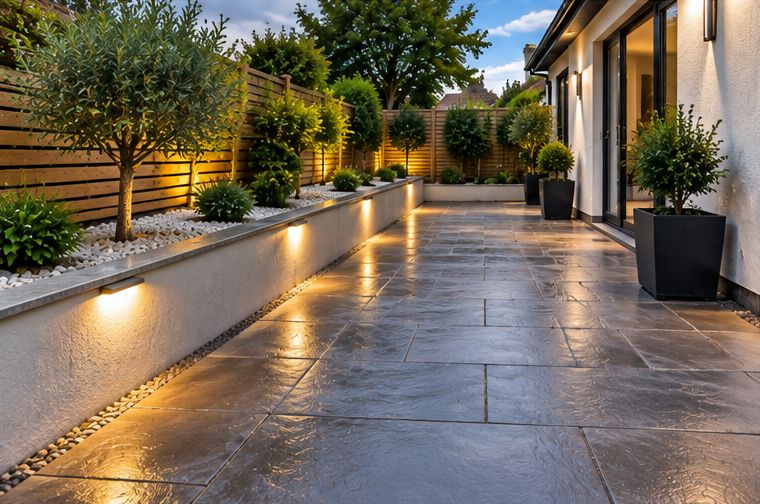
Garden steps get used in every kind of weather, often while carrying something, and in the dark on winter evenings. A flight that feels awkward is more than an annoyance; a step that is a different height from the others is a classic cause of trips.
The good news is that the principles are simple. This guide explains how we plan a flight of steps in brick or stone, what makes them comfortable and safe, and the details that stop them going green and slippery. Steps are part of our brickwork and garden walls work, and often part of a bigger landscaping project.
The rise and the going
Every step has two measurements. The rise is the height from one tread to the next. The going is the depth of the tread from front to back, measured where your foot lands. Getting the relationship between them right is what makes steps feel natural.
Outdoor steps generally feel best with a lower rise and a deeper going than the stairs inside a house. As a rough guide, many landscape steps have a rise of somewhere around 100 to 170mm and a going of 300mm or more. A common rule of thumb for checking the balance is that twice the rise plus the going should come to roughly the length of a comfortable stride, which works out somewhere in the region of 600 to 700mm for most adults.
These are guides, not fixed rules, and a garden flight can be gentler than this. What matters most is that every step in a flight is the same. People adjust to a rise after the first step or two, and a single step that is higher or lower than the rest is the one that catches them out.
Making the numbers fit the slope
Planning a flight starts with measuring the total height from the bottom level to the top, and the horizontal distance available. Divide the height by a comfortable rise to find the number of steps, then check that the goings fit into the length you have.
- If there is not enough length, the steps will be steep. Turning the flight, running it across the slope or adding a landing can help.
- If there is plenty of length, deeper treads, or pairs of steps with a short level section between, make a gentle, relaxed climb.
- The finished levels at the top and bottom must be fixed first, including any patio, path or lawn, or the first and last steps will end up a different height from the rest.
- On a long flight, a landing part way up gives a place to pause and turn, and breaks up the climb.
Materials for treads and risers
Brick and stone can be combined in many ways, and the choice usually follows the house and the rest of the garden.
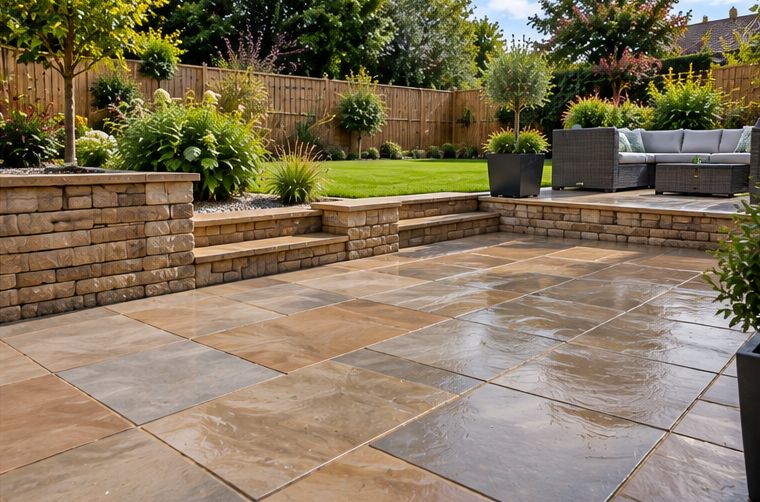
- Brick risers with paving treads are the most common arrangement. The treads can match the patio, which ties the garden together, and the brick can match the house or the garden walls.
- Solid stone steps, cut from a single block, look superb in period and rural gardens and are extremely durable. They are heavy, which can make them hard to get into a garden with difficult access.
- Brick-on-edge treads give a traditional look. They must be hard, frost-resistant bricks, ideally with a textured surface, as smooth bricks can be slippery when wet.
- Stone treads with rendered or stone-faced risers suit modern and natural gardens alike.
Whatever the finish, the core of each step is built on a proper footing, and the flight is tied into the retaining walls either side where the steps cut through a bank. Our guide on choosing bricks and coping covers frost ratings, which matter even more on a tread than on a wall.
Grip, water and green growth
Steps in a wet climate are only as safe as their surface. Riven or textured stone, sawn stone with a flamed or brushed finish and textured paving slabs all give better grip than polished or very smooth materials. Our guide on paving in Welsh rain compares the options.
Each tread should fall slightly towards its front edge so rain runs off rather than sitting in a puddle. A slight overhang, called a nosing, throws water clear of the riser below and makes the edge of each step easier to see. In shady spots, algae grows quickly on damp stone, so plan for an occasional clean, or choose a surface that is easy to keep clear.
Handrails, lighting and width
Building Regulations on stairs are mainly aimed at buildings, and ordinary garden steps are not usually covered, although the main approach to a new house can be; if in doubt, ask your council's building control team. Either way, the published guidance on safe steps is a useful benchmark. A handrail makes a real difference on any flight longer than a few steps, and it is worth planning the fixings in from the start rather than adding them later. Low-level lighting set into the risers or the walls either side makes steps far easier to use after dark.
Width matters too. A flight wide enough for two people, or for a person with a bag of shopping, feels generous and safe. Where steps are the only way from the lane to the back door, as in many terraced valley gardens, allow room for carrying bins and bags, and think about a gentler ramp alongside if anyone in the house has difficulty with steps.
Steps on steep valley plots
Steep plots in places like Abertillery and Ebbw Vale often have old concrete or stone steps of every height, built piecemeal over the years. Replacing them with a flight of even steps is one of the most noticeable improvements you can make to a garden like that.
On a big slope, steps are best planned together with the terraces and walls around them. Our guide on landscaping a sloping valleys garden covers the layout, and our article on retaining walls explains when the walls beside a flight need an engineer's input.
Talk to T J Landscapes about your garden
Free quotes and honest advice across South Wales.
Questions People Ask
What is a comfortable height for garden steps?
Outdoor steps usually feel best a little lower than indoor stairs, with deeper treads. More important than any single figure is that every step in the flight has the same rise.
Why do my garden steps feel awkward?
The usual reasons are uneven rises, treads that are too shallow for your foot, or steps that are too steep for the space. A flight can often be rebuilt with fewer, deeper steps or a landing to put it right.
Do garden steps need a handrail?
It is not always required for garden steps, but it is a good idea on longer or steeper flights, and for anyone who is less steady on their feet. It is easiest to plan in from the beginning.
How do you stop stone steps getting slippery?
Choose a textured surface, lay each tread with a slight fall so water runs off, and give shady steps an occasional clean to remove algae before it builds up.
Can you replace old concrete steps with brick or stone?
Usually, yes. We break out the old steps, check the ground and any walls either side, and rebuild the flight with even rises. Get in touch through the contact form for a free quote.