
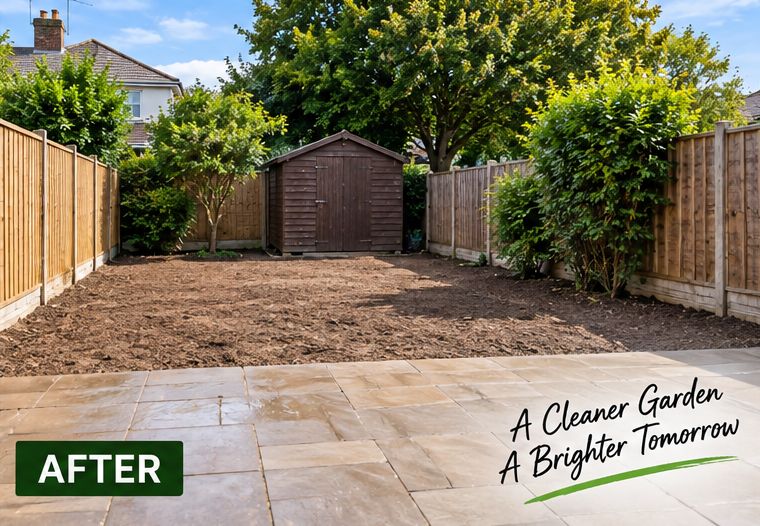
An overgrown garden on flat ground is hard work. An overgrown garden on a Chepstow hillside is harder, because every armful of brambles has to come up a slope, often up steps and sometimes through the house. That is why so many people chip away at it for months without seeming to get anywhere.
Clearing it in one go avoids that. With the right plan and enough hands, even a badly neglected plot can be taken back to bare, workable ground in a short visit. This guide explains how we approach it. Our garden clearance page covers the service in general.
Why doing it in one visit makes sense
Clearing a garden bit by bit means the first corner is growing back before the last one is done, and the waste piles up with nowhere to go. A single clearance gives you a clean starting point, lets you see the real shape of the garden and means the waste leaves in one trip rather than filling your bin for a season.
There is a practical side too. Tools, bags and barrows only have to be carried down the slope once, and the heavy lifting is shared between several people rather than falling on one tired homeowner at weekends. For many Chepstow households, especially after buying or inheriting a neglected house, that alone is worth it.
It also makes the next step easier to plan. Once the ground is clear, it is much simpler to decide whether you want a lawn, a patio or a few terraces, and to price them properly.
Planning access before the day
In Chepstow the biggest question is usually not the growth but the route out. Before we book the job, we look at:
- How waste leaves the garden: a side gate, a rear lane, a path round the house, or straight through the hall.
- Steps on the way: how many, how steep and whether they are safe once they are cleared of moss and leaves.
- Where a vehicle can stand: on steep streets with tight parking, this decides how far everything has to be carried.
- What needs protecting: carpets, door frames, a neighbour's wall or a greenhouse at the bottom.
Working from the top of the slope down
On a sloping plot we normally start near the house and work downhill. That keeps the cleared route open behind us, so bags and bundles travel back over clean ground rather than through the undergrowth. Brambles and tall weeds are cut down first, then the cut growth is raked out and bagged, and only then do we tackle roots and stumps.
Clearing top to bottom also helps us spot hazards before we reach them: broken glass, old wire, a hidden drop behind a wall. On very steep sections we work across the slope rather than straight up and down, which is steadier underfoot for everyone.
What is often hiding under the growth
Older Chepstow gardens quite often turn out to have more in them than anyone knew. Buried under years of growth there may be old stone steps, a paved path, the edge of a pond or a low wall marking a forgotten terrace. We clear carefully around anything like this so you can decide whether it is worth keeping.
Ivy on old stone walls needs particular care. On a wall with weak mortar, the ivy can be doing some of the holding together, and pulling it off in one go can bring loose stones with it. We usually cut the stems at the base and let the ivy die back before removing it, and flag any wall that looks unstable. Our guide to repairing old stone garden walls in Chepstow explains what to look for.
Wildlife, nesting birds and timing
Overgrown gardens are full of life, and nesting birds are protected by law. Thick hedges, brambles and ivy are favourite nesting spots, particularly from around March to August. Clearances at that time of year should start with a careful check, and any area with an active nest has to be left until the young have gone.
Late autumn and winter are often the easiest time for a big clearance: the growth has died back, you can see the ground and the birds have finished nesting. Hedgehogs and frogs may still shelter in log piles and compost heaps, so we look before we lift.
What goes, what stays and where it ends up
Before we start, we agree which plants, trees and features you want to keep and mark them clearly. Everything else goes: brambles, weeds, self-seeded saplings, old turf and the usual garden rubbish of broken pots and rotten timber. Larger trees on the boundary are a separate job, covered in our guide to tree surgery near boundaries in Chepstow.
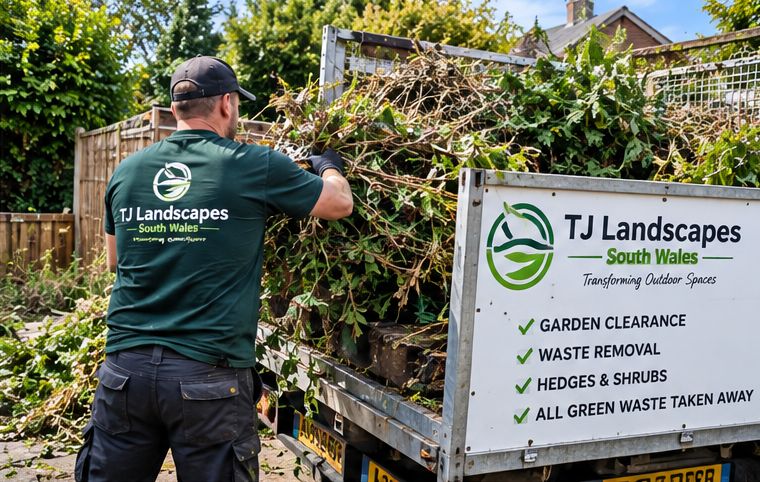
Green waste is taken away for composting wherever possible. Some things cannot go in with ordinary garden waste. Invasive plants such as Japanese knotweed have to be treated and disposed of under strict rules, and materials like asbestos sheeting from old sheds must be dealt with separately. Our guide to what can and cannot go in a garden clearance sets this out.
Keeping it clear afterwards
A cleared garden starts to regrow within weeks, especially where bramble roots are left in the soil. The quickest way to keep on top of it is to give the ground a use. Turf, a patio, planted beds or a membrane covered with bark all stop the weeds getting a hold again. On a steep plot, this is often the moment to think about levels and steps; see landscaping a steep Chepstow garden.
If you are not ready for new work yet, a couple of follow-up visits to strip any regrowth will keep the garden in hand until you are. Our guide to getting an overgrown garden back under control has more on this.
To see what we do across the town, visit our landscaping in Chepstow page. Tony and the team will happily look at your garden and give you a free quote; just get in touch.
Talk to T J Landscapes about your garden
Free quotes and honest advice across South Wales.
Questions People Ask
Can you clear a steep Chepstow garden with no rear access?
Usually, yes. If waste has to go through the house we protect floors and door frames and carry it through in bags. It takes a little longer, which is why we look at access when we quote.
How long does a garden clearance take?
It depends on the size of the garden, how overgrown it is, how steep it is and how far the waste has to be carried. Many gardens can be cleared in a day or two; we will give you a clear idea when we quote.
Will you remove tree stumps and roots?
We can dig out bramble roots and small stumps as part of the clearance. Larger stumps may need more work, and we will tell you what is involved when we see them.
Can you clear a garden during bird nesting season?
Yes, with care. We check hedges and thick growth for active nests first, and leave any nest in use undisturbed until the birds have gone.
Do you take all the waste away?
Yes. Green waste and general garden rubbish are removed as part of the job. Anything that needs special handling is flagged before we start.